Billions of dollars of highly sophisticated military equipment has been lost or significantly damaged since the U.S. and Israel began striking thousands of targets across Iran more than three weeks ago. The bulk of the damage on the ground has been caused by Iranian ballistic missiles and drones.
Graphics.
Battle damage and replacement of losses over the first three weeks of the war likely costs roughly $1.4 billion to $2.9 billion, according to Elaine McCusker, a top Pentagon budget official during the first Trump administration who has been tracking the cost of the conflict for the American Enterprise Institute. The higher estimate includes damage to a Qatari radar housed on a U.S. air base in the country.
Here are some of the weapons and platforms that the Pentagon would likely look to replace in the $200 billion Iran supplemental-spending request it has sent to the White House.
A Kuwaiti F/A-18 Hornet jet fighter mistakenly shot down three American F-15E Strike Eagles on March 1—all six crew members safely ejected. A new-model F-15 today costs about $100 million.
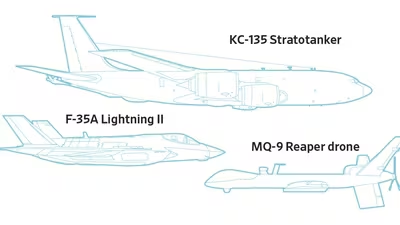
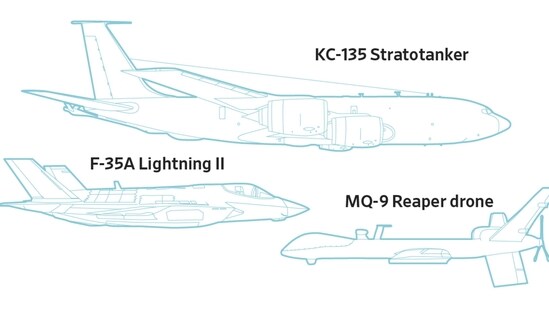
A U.S. F-35A Lightning II stealth fightermade an emergency landing on March 19, and its pilot was in stable condition. Iran claims to have shot at the aircraft. An F-35A costs about $82.5 million.
Six crew members of an Air Force KC-135Stratotanker aerial refueler were killed when their plane crashed after colliding with another KC-135 over Iraq on March 12. Five more KC-135s were damaged during an Iranian missile strike on Prince Sultan Air Base in Saudi Arabia. The damaged aircraft are being repaired.
Boeing hasn’t built KC-135s since the 1960s, so the Air Force will most likely replace the lost plane with a KC-46 Pegasus, a tanker that is based on a modified 767 airliner. A KC-46 costs about $165 million.
More than a dozen MQ-9 Reaper droneshave been lost since the war began. This includes at least eight shot down by Iranian missiles, three on the ground destroyed by Iranian missiles and one mistakenly shot down by a Persian Gulf nation. Additional Reapers have been damaged. The MQ-9s flown by the Air Force, which cost at least $16 million each, are no longer manufactured by General Atomics. The newer-model MQ-9B SkyGuardian drones are being manufactured for the U.S. and its allies, costing around $30 million each.
While not damaged in combat, a fire broke out on the aircraft carrier USS Gerald R. Ford on March 12. The fire began in the main laundry space and spread to other parts of the ship, including sailors’ sleeping quarters. The carrier is now in port at Souda Bay in Greece where it will undergo repairs.
Iran struck an AN/TPY-2 radar that is part of the Thaad missile defense battery in Jordan. The radar, which is used to track ballistic missiles, costs at least $300 million.
Iran has also attacked radar, communications and air defense systems in Qatar, the United Arab Emirates, Jordan, Bahrain, Kuwait and Saudi Arabia, including damage of the Qatari AN/FPS-132 early-warning radar at Al-Udeid Air Base. The radar, which can track several targets simultaneously, costs about $1 billion.
Note: Diagrams not to scale
Graphics sources: Missile Defense Advocacy Alliance, MissileThreat/Center for Strategic and International Studies (AN/TPY-2); Missile Defense Agency (AN/FPS-132); Air Force (KC-135, F-15E, F-35A, MQ-9 Reaper); U.S. Navy (USS Gerald R. Ford); U.S. Congress (Thaad)