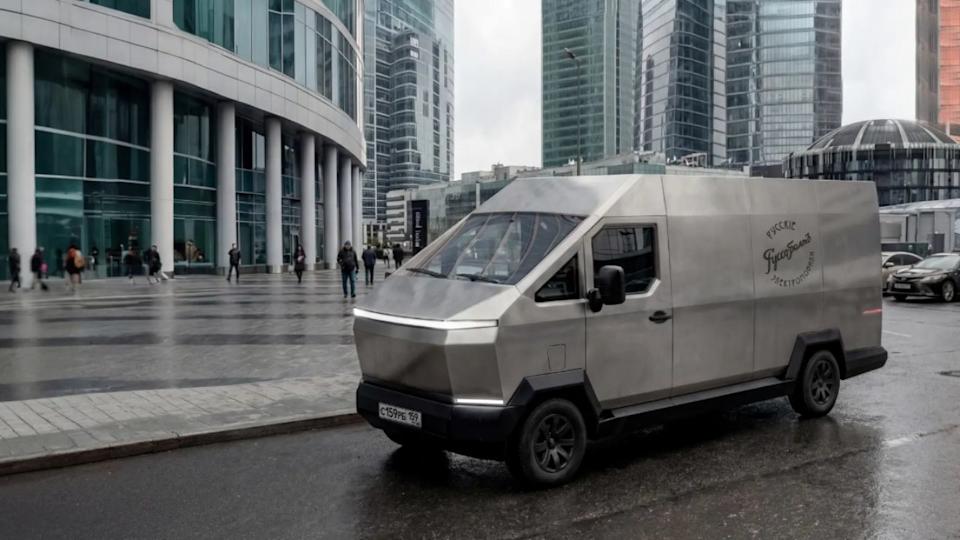
A Russian company is openly teasing what it describes as a domestic alternative to the Tesla Cybertruck, announcing plans for an all-electric delivery vehicle with stainless steel bodywork and sharply angular styling. The project comes from a company based in Perm that says it is reviving the historic Russo-Balt name.
The vehicle is currently presented as a concept, with market launch targeted for 2027. Russian outlets have referred to the project as the Russo-Balt Cybervan, positioned as a modern electric commercial van. The final production name has not been confirmed.
Cybertruck-Inspired Design With Stainless Steel Body

Photo Courtesy: Autorepublika.
At first glance, the design influence is unmistakable. Like the Cybertruck, the Russo Balt F200 abandons curves almost entirely in favor of flat surfaces, sharp edges, and a minimalist lighting signature. A full-width light bar dominates the front fascia, while thick plastic cladding outlines the body panels.
The biggest technical parallel with Tesla’s pickup is the use of stainless steel for the exterior body. Russo-Balt emphasizes the use of stainless-steel body panels and positions them as highly corrosion-resistant, but public reporting does not consistently cite a specific “100-year” corrosion warranty term. The company also emphasizes modular body panels that can be replaced without repainting, which it says will simplify repairs and reduce downtime for fleet operators.
Size, Powertrain, and Range
The positioning as a large van is fine, but the precise dimensions aren’t supported in the sources that document the rest of the spec sheet. Better to keep it categorical unless you have a spec doc.
Power comes from a single electric motor rated at 200 horsepower driving the front wheels. Energy is supplied by a 115 kilowatt-hour battery pack. Russo-Balt has quoted a range of about 400 km (roughly 249 miles) on a full charge, and Russian reports claim the battery can be recharged in about an hour under fast-charging conditions.
The payload rating is listed at roughly 2,200 pounds, aligning with typical light commercial delivery requirements.
Built for Extreme Conditions
One area where the company is clearly targeting local needs is climate durability. RussoBalt states the F200 is designed to operate in temperatures ranging from -49 degrees Fahrenheit to 113 degrees Fahrenheit. The exterior finish can be changed using wrap films rather than paint, another nod toward fleet flexibility.
Questions About Chinese Origins

Photo Courtesy: Autorepublika.
Despite the company’s claims of originality, international observers have noted a strong resemblance to Chinese electric delivery vans such as the Weiqiao V70 and its larger sibling, the V90. The similarities in body shape and proportions have raised questions about whether the F200 is a heavily reworked version of an existing Chinese platform.
According to Carscoops, Russo Balt has denied that the F200 is simply a rebadged Chinese vehicle, insisting that it is a distinct product developed for Russian conditions.
Pricing and Market Outlook

Photo Courtesy: Autorepublika.
Production is scheduled to begin in 2027, with a projected price of around 72,500 euros, roughly $78,000 at current exchange rates. Early prototype vehicles have reportedly already been spotted on Russian roads, suggesting that development has progressed beyond the purely conceptual stage.
Whether the Russo Balt F200 becomes a true homegrown electric commercial vehicle or remains a controversial design copy will likely depend on how transparent the company is about its engineering origins as production draws closer. For now, it stands as one of the most visually striking Cybertruck-inspired vehicles yet announced outside the United States
This article originally appeared on Autorepublika.com and has been republished with permission by Guessing Headlights. AI-assisted translation was used, followed by human editing and review.
Read More