COLOMBO, Sri Lanka—The initial notice that an American submarine had sunk an enemy ship for the first time since World War II came in the form of a brief 5 a.m. email from the U.S. Indo-Pacific command to Sri Lanka’s maritime-rescue agency.

A ship was in distress, roughly 20 nautical miles off the coast from the city of Galle.
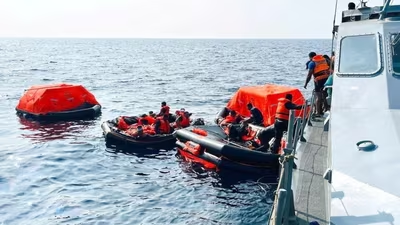
It would turn out to be the IRIS Dena, an Iranian missile frigate. By the time rescuers reached the site at 6 a.m. last Wednesday, it had already slipped beneath the waves, leaving dozens of bodies floating in an oil slick next to 32 survivors, many with mysteriously shattered leg bones.
Twelve hours later, U.S. Defense Secretary Pete Hegseth filled in the blanks. The Iranian warship had been struck by a Mark 48 torpedo launched from an American submarine, bringing an explosive end to what had been intended as a relatively low-key tour.
Two weeks earlier the crew—many of them cadets—had been gathered in their summer white uniforms along a beachfront promenade in the Indian port city of Visakhapatnam, soaking up the sun as part of a festive conclave of global navies that included Russia and the U.S.
They had taken in the Taj Mahal, visited museums and posed for selfies with onlookers.
The speed with which the Dena ended up in the firing line highlights how quickly the war in Iran escalated, spreading thousands of miles from the Iranian nuclear facilities the U.S. says were its primary targets. It also served as a reminder of American military power, and the Trump administration’s willingness to use it.
“I want to remind everybody that this is an incredible demonstration of America’s global reach,” said Gen. Dan Caine, chairman of the Joint Chiefs of Staff. “To hunt, find and kill an out-of-area deployer is something that only the United States can do at this type of scale.”
Iran’s foreign minister, Abbas Araghchi, said the U.S. had committed an atrocity—and that America would bitterly regret the precedent it had set.
As for the Sri Lankans, they got an early taste of the path they will have to navigate as the Trump administration rewrites the rules of global power politics.
The Dena sailed to India in mid-February despite the U.S.’s military buildup near its home shores. India has invited the frigate to take part in its biennial military exercises along with participants from dozens of navies. This year, Visakhapatnam was pairing the exercises with a public fleet review presided over by Indian President Droupadi Murmu.
The festivities included a city parade, where one Dena sailor, speaking to an independent journalist, Samson Sagar, marveled at the flavor of biryani, an Indian rice dish he had sampled. “So spicy!” the sailor said, covering his mouth.
The hosts had arranged for the Iranian crew to tour the local sites. A highlight was the INS Kursura, a Soviet-built, 300-foot submarine commissioned by the Indian Navy in 1969 that had been transformed into a museum ship. Roughly two dozen sailors from the Dena ducked through a makeshift door cut in the side of Kursura’s hull, passing through a forward compartment outfitted with six compressed-air launch tubes and storage racks holding spare bright green torpedoes.
The naval gathering was itself a relic of an earlier age, when rival militaries could coexist in the security of a global order that gave priority to stability above all else. Adm. Steve Koehler, commander of U.S. Pacific Fleet, attended and met with Indian leaders. The U.S. sent a P-8A Poseidon spy plane but elected not to send a destroyer as it had in the past. The Dena was part of Iran’s regular navy, not the more ideological Islamic Revolutionary Guard Corps navy.
The event concluded on the morning of Feb. 25. The following day, the Iranian Embassy in Sri Lanka, 800 miles to the south, asked permission for the Dena and two other naval vessels to dock for what it described as a goodwill visit starting March 9.
The ships were already close to Sri Lanka’s maritime border, raising concerns among some officials in Colombo, the Sri Lankan capital. The request for a goodwill visit from the ships struck the island nation as potentially risky, given every possibility of a conflict breaking out between the U.S. and Iran.
“We all know that a certain buildup was there in the Arabian Sea and the region,” said Sri Lanka Defense Secretary Sampath Thuyacontha, a retired air vice marshal. “It’s a very complex situation.”
The Sri Lankans stalled for time. The Iranian ships hung around—“loitering,” in the words of Sri Lanka’s deputy foreign minister—as the U.S. and Israel launched their first attacks on Feb. 28. Thuyacontha said Sri Lanka told the Iranians that Sri Lanka would follow a 1907 treaty that says neutral parties should allow naval ships that are at war to dock only if there is emergency aboard.
The three Iranian ships scrambled to find safe harbor elsewhere. The next day, India approved a request from Iran for the three ships to dock, said Indian Foreign Minister Subrahmanyam Jaishankar.
The Dena didn’t go. For reasons that remain unknown, it was still trying to make port in Sri Lanka as late as last Tuesday.
Early the next day, a U.S. nuclear attack-class submarine launched a 21-foot, 3,700-pound torpedo with a 650-pound warhead toward the Dena. The impact sent a roughly 100-foot plume of water into the air as it broke the ship’s hull. The U.S. military email to the Sri Lankans arrived shortly after.
International law requires belligerents in a war to assist sailors wounded or shipwrecked in battle. Submarines can claim an exemption if surfacing would put them at risk or if the number of people needing rescue is too large, but in that case they have to facilitate rescue by other means.
Sri Lankan Air Force helicopters flew over the waters to look for signs of life. The U.S. email hadn’t said the ship was attacked, but the scene the rescuers found pointed to one scenario.
“An attack, obviously,” said Thuyacontha, the defense secretary. “But we didn’t know whether it’s a torpedo or air attack.”
The Sri Lankan navy ferried the survivors to nearby Galle, famous for its 16th-century Dutch fort. Ambulances traveled back and forth down side roads with police escorts, taking the injured from the beach to the local hospital where doctors and nurses rushed outside with gurneys to receive the injured, one person who was present said.
As night started to fall, three cargo trucks brought more than 80 bodies wrapped in white plastic to the hospital. Staff in hazmat suits unloaded the bodies under the supervision of a medical officer. Locals brought ice to the hospital as the large numbers of dead overflowed from the morgue.
Religious leaders from the local Muslim community stepped forward to help. M.Z.A.S. Mohamed, 76, the head of the local branch of Sri Lanka’s main Muslim theologians body, had traveled in Iran years earlier and was familiar with Iranian tastes. He knew the injured sailors would want familiar food—not spicy Sri Lankan fare—and lots of meat.
At 11 p.m. that night he arrived at the hospital with 40 portions of rice, chicken, and a simple salad of cucumbers and onions.
A member of the Galle municipal council, Roshan Mawsoon, organized clothing for the Iranians after the hospital director called to say the donated sarongs and shirts the hospital had received were no good for the Iranians, who were bigger than many Sri Lankans.
“They need XL, XXL,” he said.
Leaders in Colombo wrestled with how to handle the survivors.
The dominant preference was to send them back to Iran, officials said, but some worried how that might complicate the island’s relationship with the Trump White House, weakening a fragile economy already buffeted by American tariffs. Sri Lanka’s defense secretary said the country is obligated to make sure the Iranians it now holds don’t join the war.
When one of the Iranian vessels accompanying the Dena, the Bushehr, appealed for permission to dock on the day the Dena was sunk, officials in Colombo discussed how to respond while maintaining Sri Lanka’s goal of staying neutral in the conflict.
After the Bushehr reported engine trouble, Sri Lanka allowed the vessel to enter Colombo, where authorities took in more than 200 sailors on Thursday.
Of the 32 sailors who survived the sinking of the Dena, 10 remain hospitalized while 22 others have been discharged and transferred to a military base near Galle. Sailors from the Bushehr are being housed at a separate base near Colombo. All of the rescued sailors will receive one-month visas on humanitarian grounds, Sri Lanka said Sunday.
What to do with the Iranians in its custody “is a decision for Sri Lanka to make pursuant to its domestic law and international legal obligations,” a State Department spokesperson said, adding that the U.S.’s ultimate goal is to mitigate the risks posed by Iran.
“I think it’s too early to predict what will happen,” said Sri Lanka’s deputy minister of information, Kaushalya Ariyarathne. “But I sincerely wish that this will end soon. I mean, my God, I’m praying for it.”
Write to Tripti Lahiri at tripti.lahiri@wsj.com, Josh Chin at Josh.Chin@wsj.com and Shan Li at shan.li@wsj.com