China isn’t known for its transparency.
Unlike Australia, where journalists would have near-daily access to speak with decision-makers and hold politicians to account, those in charge in China are closed-off from public scrutiny.
Decisions and policy are all made without the chance for media to question the leaders directly.
And any dissent from the public is regularly shut down and banned online.
In fact, there’s usually only one chance each year where politicians are given ‘in principle’ permission to speak with reporters, and that’s at the National People’s Congress (NPC) — the country’s largest political meeting of the year.
During the near week-long summit, 3,000 decision-makers, known as delegates, come to Beijing to vote on the priorities and ambitions for China in the coming year.
And this year, I attended.
But trying to get comment on the issues raised there was near impossible.
After multiple security checks, I was granted rare permission to go inside China’s most important political building, the Great Hall of the People.
Some foreign media were rejected.
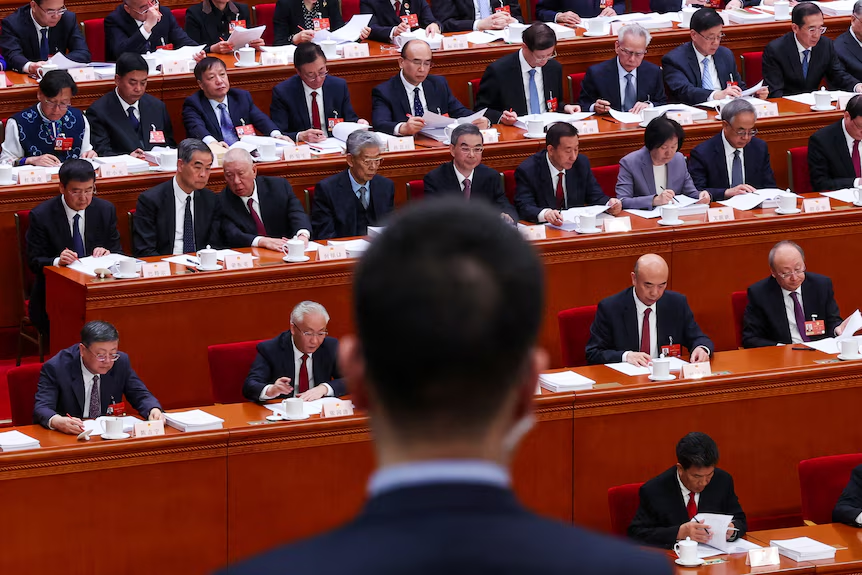
Inside, reporters were ushered onto an upper-floor balcony to watch a carefully choreographed opening session, where China’s Premier Li Qiang unveiled China was reducing its GDP target to the lowest rate in decades.
It was an unusual acknowledgement that China was facing some economic headwinds.
So naturally, I wanted to talk with the politicians to learn more about this significant fiscal shift.
At the end of the opening session, lower-level decision-makers spilled out of the meeting chamber to eagerly awaiting journalists — foreign and Chinese alike.
But trying to get them to speak and explain the change was a challenge.
Security tight at the Great Hall as some foreign media were rejected. (Reuters: Maxim Shemetov)
Delegate after delegate waved their hands in rejection, said no and offered polite apologies as I peppered them with questions about the GDP target.
Foreign journalists here are viewed with a combination of suspicion and curiosity, so I wasn’t surprised I was knocked back.
But it does give you some insight into the closed-ranks environment inside China and how hard it is to sometimes know what’s really going on.
After dozens of attempts, I finally got someone to talk — a low-level delegate from a province in southern China.
He told me the reduction of the GDP target was a responsible fiscal measure in the current unstable geopolitical environment.
“This means we objectively assess both domestic and international conditions,” he said.
“Our goal is not necessarily fixed at this level; we must pursue progress while maintaining stability.
Allyson Horn in front of the Great Hall of the People. (Supplied: Allyson Horn)
“This is a perfectly normal situation, as the current circumstances are indeed not optimistic.”
For years, China has relied on its export dominance to buoy its economy and cement its geopolitical power.
But global tensions and instability caused by the US, including wars and tariffs, threaten the reliance of that fiscal pipeline.
It seems China now acknowledges the power generated through its export supremacy, could have a finite end.
And it is now trying to rebalance the entirety of its economic approach, by focusing on its domestic market, which is severely flagging because of low-consumption, an ongoing property crisis, and a shrinking population.
People inside China are not spending money, and the reduced GDP target indicates the government’s desire to generate more domestic consumption, to risk-proof its future economic outlook.
The slimmed-down GDP target will also take pressure off the government to achieve unrealistic growth, in the current global environment.
Military delegates from the Chinese People’s Liberation Army at the Great Hall of the People in Beijing. (Reuters: Tingshu Wang)
Many analysts would consider it a responsible fiscal measure, but it is still rare for China to acknowledge when there could be problems on the horizon for the country.
Back at the NPC, the political show continued but it was behind closed doors — and the media ushered out of the area.
Our one window of the year to mingle with the decision-makers shaping China’s future, was closed.
But I will continue to ask the questions whenever I can.
Because China is the world’s second largest economy and a superpower that rivals the United States.
And the decisions made here have a direct impact on Australia and its people, and we need to try to understand them.
