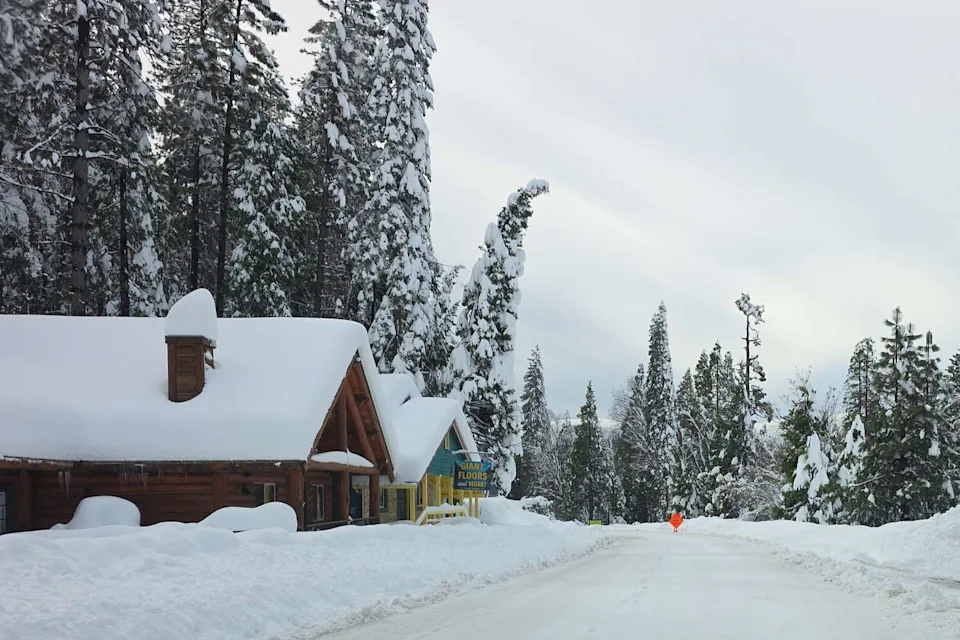
Thousands of people lost power in the Sierra foothills this week, with many snowbound by a storm that blanketed some areas in more than 10 feet of new snow.
But the conditions have done little to stem the flow of “snowplayers” – weekend visitors from the Bay Area or Central Valley who travel to the mountains to ski, sled and sightsee. The influx has strained the mountain towns around Bear Valley Mountain Resort, where local authorities say vehicles are blocking downed power lines and clogging already treacherous roads.
On Friday, the Calaveras County Sheriff’s Office pleaded with visitors to avoid the upper Highway 4 corridor until conditions improve. That stretch was still covered in snow, ice and debris from downed trees, the office warned.
Also, vehicles parked haphazardly along the road while drivers got out to sled or tube on the hills were blocking “critical access” for utility crews working to restore power to more than 8,000 Pacific Gas and Electric Co. customers in the area, according to the sheriff’s office. The limited parking space forced crews to load and unload their equipment from the road’s center medians this week.
“Despite repeated advisories, we continue to see a steady flow of recreational visitors traveling into the area,” the sheriff’s office said in a statement. “While we understand the desire to enjoy the snow, this is creating serious safety issues.”
Still, after Bear Valley reopened from a three-day closure Saturday, it “looked like summer” on the roads leading to the resort, according to Arnold resident Vern Baird. He hit the traffic on his way to pick up groceries for his neighbors, many of whom were still snowed in without heat or power by late Saturday afternoon.
“Tons and tons of people are getting in the way, driving up in their electric cars or their Teslas, even though there’s no way to charge them,” Baird said. “I don’t know how to say this nicely – city folks and mountain folks are completely different.”
On Tina Skillett’s way to work at a self-storage facility in Arnold, the narrow roads were lined with cars by midmorning Saturday. She said it made her nervous to see children playing in the snow just off the icy road: “Not only is it a distraction, but what if you slide into a kid?”
Skillett wished Bear Valley had stayed closed for even one more day, allowing more time for the ice to thaw and utility crews to restore power. But she understands why the resort opened when it did, noting that local tourism suffered after paltry snowfall early in the season.
“Our businesses are suffering,” Skillett said. “We’re getting to the end of the season, so it’s crunch time for them. And it’s good snow – this is when they make their money. But they shouldn’t be pushing it.”

The Calaveras County Sheriff’s Office warned weekend visitors of hazardous conditions on snow-covered roads after this week’s storms. (Calaveras County Sheriff’s Office)
The dump of snow this week came after a relatively dry January and February. That layer of fresh, uniquely powdery snow also created conditions conducive to avalanches, including the disaster that killed nine backcountry skiers in Tahoe on Tuesday. Other resorts in the area have also seen a recent string of skiing deaths.
About 2,500 people visited Bear Valley on Saturday, about 500 short of a typical day, according to General Manager Brad Cumberland. The resort decided to reopen after the snowfall slowed and crews were able to clear some of the snow and ensure that lifts would function, he said, adding that a ski patrol team trained in avalanche mitigation was working “around the clock.”
“My understanding is Arnold’s in pretty rough shape after this after the storm,” Cumberland said. “We’re really having to walk a fine line, because most of our employee base comes from that area, and we understand that all these people have their own personal yards to clean up and their own problems to deal with.”
In Arnold, the scramble to clear the roads amid the onslaught of visitors has meant long hours for the small town’s few plowing and tree removal businesses. Jessica Snider’s husband worked a “40-hour stretch” Friday and Saturday, clearing feet of snow from country roads that she said the county had neglected to plow in the early days of the storm. The county’s public works department did not immediately respond to a request for comment Saturday.

Calaveras County is digging out from a fierce winter storm that dumped several feet of snow in some areas. (Calaveras County Sheriff’s Office)
By Saturday, retired nurse Kathleen Morris Bince had been snowbound in her Arnold home for five days, alone and without power. She kept her cold food outside on her porch this week, despite her concern about bears. At least six trees have fallen around her home, with one sending power lines “bouncing everywhere” and another landing in her driveway, forcing her to “crawl over and through it” every time she takes her dogs for a walk.
“I only have minutes a day that I can get on the internet. I’m holding up ok, have wood for fire and food in my belly,” Morris Bince wrote in a message to the Chronicle. “It’s been an adventure to say the least, easy to talk about, hard to experience it.”
Stephanie Peffer, who runs a snow and tree removal service with her husband, said she “couldn’t even count” the number of people who had called to report that trees had fallen on – or into – their houses, in some cases trapping them inside. The snow and debris sometimes overwhelmed her husband’s equipment, Peffer said.
“He’s showed up to houses where people are like, ‘I have no food in here, I have no heat, it’s 40 degrees inside my house,’ and he can’t get them out,” she said. “That kind of pressure is heavy for your average snow and tree guy.”

A home in the Calaveras County community of Arnold is buried under snow – and a tree – after this week’s storms. (Courtesy of Stephanie Peffer)
Peffer understands visitors’ excitement about the snow, as well as its importance to the local economy. But the stop-and-go traffic in Arnold on Saturday felt incongruous with the “state of emergency” she’s lived in all week.
“It’s just frustrating that people don’t know how to read the room,” she said. “Like, it’s not the time to play. We’re trying to get people warm and safe and get our little town cleaned up, and then they can come play once that’s done.”
This article originally published at Pummeled by snowstorms, California mountain towns urge tourists to ‘read the room’.
