With nine people feared dead northwest of Lake Tahoe in California’s deadliest avalanche in decades, authorities and experts are seeking to understand what led a group of backcountry skiers, including four professional guides, to venture into the snow and away from shelter amid blizzard conditions.
Among the questions: What went into the 15-member group’s decision Tuesday morning to leave the ski huts where they had been staying? And how far apart were they as they traveled, given that maintaining space is recommended when there is avalanche risk, so that an entire group is not buried?
Officials said the four local mountain guides and 11 clients – many of them said to be mothers of kids on Sugar Bowl Resort’s ski team – headed into the backcountry last Sunday to stay at the Frog Lake huts, a well-known but remote set of cabins close to Castle Peak, north of Interstate 80. Already, one member of the group who had planned to join the journey had backed out.
Experts said the weather in the Tahoe area was creating the conditions for a destructive avalanche. A storm following a prolonged dry period created a thick slab of untethered snow whose weight alone could have caused it to break away. But on the first day of the trip, skies in the area were blue. The storm that would beset the skiers wouldn’t arrive in the Donner Summit area until later that night.
On Sunday morning, the National Weather Service broadcast a message from the Sierra Avalanche Center for the greater Tahoe area, cautioning of a “powerful storm with rapidly accumulating snowfall and strong winds” that had the potential to cause “large avalanches capable of burying or injuring people.”
The landscape transformed quickly. The storm blanketed the mountains in several feet of snow, shutting down Highway 80, burying buildings and stranding cars. On Monday, the second day of the trip, the guide company, Blackbird Mountain Guides, posted its own warning to Instagram that the heavy snowfall following a dry start to the year could lead to avalanche hazard.
By Tuesday morning, some ski resorts had decided to shut down and traffic had stopped on Highway 50. The Sierra Avalanche Center upgraded its watch to a formal avalanche warning, discouraging travel in avalanche-prone terrain.
Amid the white-out conditions, freezing temperatures and gusting winds, the 15 skiers at the Frog Lake huts tried to make their way across the mountain, back to the trailhead. The group had always planned to end their trip on Tuesday, said Nevada County Sheriff Shannon Moon and Blackbird Mountain Guides. The website for the huts shows that reservations are made in two-night blocks from Sunday through Tuesday and that dates sell out a year in advance.
Authorities have not accused Blackbird Mountain Guides of any wrongdoing. At a Wednesday news conference, Moon said the company had been working with officials throughout the search process. But she also said that the severity of the storm had been forecast ahead of time.
“Those are the decisions that the guide company clearly had made,” Moon said. “We’re still in conversation with them on the decision factors.”
Representatives of Blackbird Mountain Guides did not respond to a request for comment, but said in a statement Tuesday night that the company’s leadership was “fully engaged in assisting the Search and Rescue efforts on the ground as we navigate this incredibly difficult situation alongside those involved.”

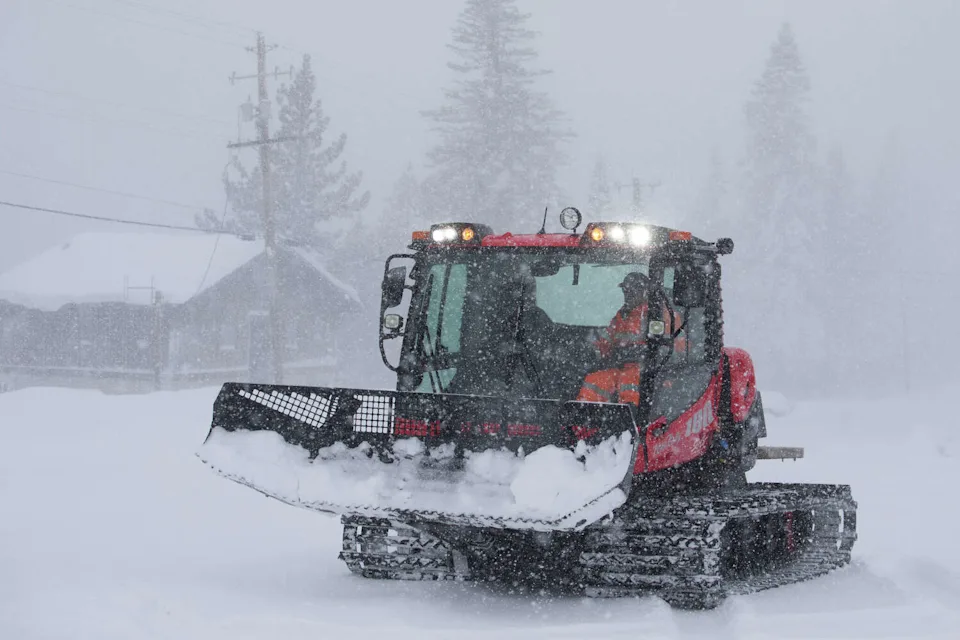
A snowcat is seen driving down the road on Donner Summit on Wednesday. (William Hale Irwin/For the S.F. Chronicle)
Moon’s office learned of the avalanche around 11:30 a.m. Tuesday through a satellite 911 call. The slide happened roughly a half-mile from the huts. Through satellite messaging, search and rescue officials were able to stay in touch with the six survivors, who were located and escorted off the mountain around 5:30 p.m. Tuesday. Eight other skiers were found dead in the snow; a ninth skier remained missing as of late Wednesday but was presumed dead.
Authorities have not identified any of the victims or shared what the survivors said went into the decision to leave.
David Lerach, a professor of meteorology at the University of Northern Colorado and an experienced ski patroller, said he could not speculate about the Castle Peak avalanche given the lack of public knowledge about the circumstances facing the group. But he said backcountry skiers should always be prepared with provisions to survive several days in case treacherous conditions make it too dangerous to ski out. In a storm, he noted, fresh powder can be a water source.
“It’s really best to sit out the storm as a whole, if possible, unless you are very confident in the nature of the terrain and that you can find a safe way to travel back to the trailhead or parking lot,” Lerach said. If trapped skiers do choose to try to leave, he said, it’s important to avoid steep slopes.
Avalanches generally happen on slopes greater than 30 degrees, said Wendy Antibus, education manager at the Sierra Avalanche Center, so skiers traversing risky terrain should avoid being either on or below such slopes. Lerach added that sticking to areas of dense trees that might break the path of a slide can also reduce a skier’s risk of being swept away.
Groups should generally ski one-by-one rather than all together so that, in the event of an avalanche, not everyone will be hit at once, both experts said. It’s not clear how close together the members of the Tahoe group traveled.
“It was reported by the individuals that survived that they were attempting to go out as a group, that someone saw the avalanche, yelled avalanche, and that it overtook them rather quickly,” Nevada County sheriff’s Capt. Rusty Greene said.
It’s also unknown exactly where the group was positioned when the avalanche struck. Much of the area is sloped, with some patches of clustered trees and some wide-open areas. Officials said they believe the avalanche covered an area roughly as long as a football field.
Lerach said it’s possible, given the extreme conditions, that there was no safe path off the mountain that day. He highlighted the importance of skiers’ planning ahead and paying attention to weather forecasts to avoid getting stuck in a position where they may be forced to traverse dangerous terrain.
“It doesn’t matter what elevation you’re at, it doesn’t matter whether you’re above tree line, below tree line, north aspect, east aspect. It doesn’t matter where you are. All of that snow is coming down everywhere, and all of that stress is sitting on top of that weak layer below,” he said. “That avalanche problem exists everywhere. You can’t really find safety.”
This article originally published at Key question in deadly Tahoe avalanche: Why did skiers leave shelter in blizzard conditions?.