A wolf made history last Saturday when she wandered into the mountains of Los Angeles County, where her kind hadn’t been documented in more than a century.
She had come seeking a mate. Mid-to-late winter marks breeding season for wolves. The broad-muzzled canids are only fertile once a year — right around Valentine’s Day.
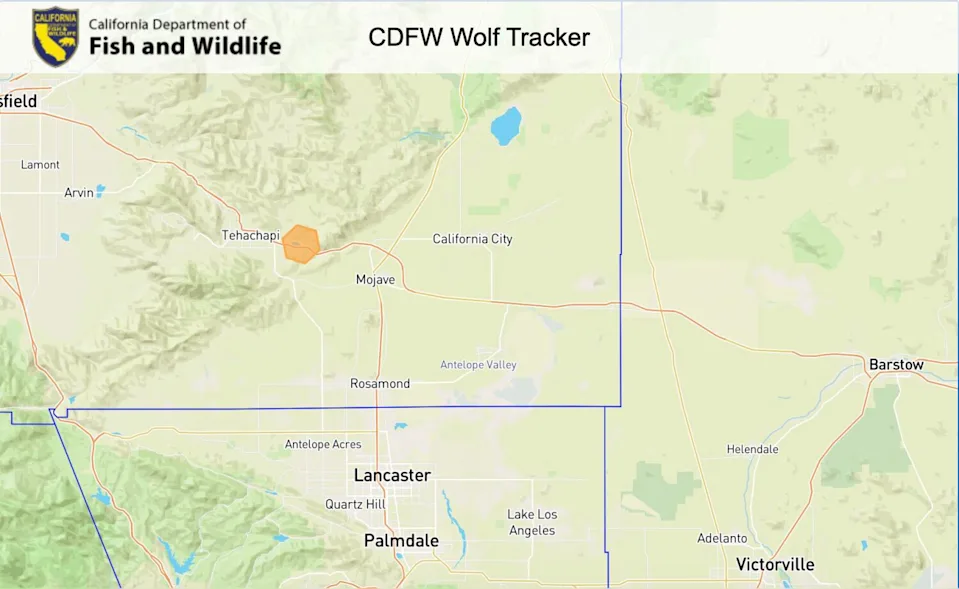
But the 3-year-old wolf — known as BEY03F — is spending the romantic holiday in Kern County. She kept her time in L.A. brief, having traveled north over the county line by Monday morning, per a state-run tracker of GPS-collared wolves.
Now, time is of the essence for her to find a hubby.
“Unlike dogs who can mate a couple times a year, come into heat a couple times a year, wolves aren’t that way,” said Amaroq Weiss, senior wolf advocate with the Center for Biological Diversity. “So it’s really important for them to find a mate before this window of time. She’s really kind of on the border here. It’s possible she could find a mate still within the next, like two weeks or so, and still be fertile. But time is slipping away and the clock is ticking.”

Last known location of BEY03F. (California Department of Fish and Wildlife)
BEY03F, affectionately called “bae” by some, hails from far northeastern California, in Plumas County, where she was born into the Beyem Seyo pack in 2023.
Last year, that pack made headlines for an unprecedented number of livestock attacks — leading state wildlife officials to euthanize several members.
But BEY03F left her family before that happened, according to John Marchwick of California Wolf Watch, an educational group.
She spent time with the Yowlumni pack, the state’s southernmost group of wolves in Tulare County, where she was collared in May, said Axel Hunnicutt, gray wolf coordinator for the California Department of Fish and Wildlife.
She came a long way looking for love. To get from her birthplace to the mountains north of Santa Clarita, she traveled more than 370 miles and walked the length of the Sierra Nevada.
As of Saturday morning, she was just south of State Route 58, the dividing line between the Tehachapi and Sierra Nevada mountains, according to Hunnicutt.
Hunnicutt surmised she was heading north because she didn’t come across signs of other wolves during her southern jaunt. Infrastructure like the Grapevine might’ve also warded her off.
“If [it] wasn’t there, I’d bet that she would have kept going west into Ventura County,” Hunnicutt said in a text message.
Exactly where she goes from here is a bit of a toss-up. Hunnicutt said she could potentially head back south, but based on her movements, he believes she’ll continue north on Sunday.
“Impossible to say, but keeps me waking up early to look each day!” he said.
Unlike mountain lions, wolves need a lot of open space, according to Beth Pratt, California regional executive director for the National Wildlife Federation.
That’s not L.A.’s forte.
“You’re never going to see a wolf pack running in Griffith Park,” she said.
However, she didn’t rule out that a wolf could one day venture over the massive Wallis Annenberg Wildlife Crossing being built over the 101 Freeway.
Some see BEY093’s arrival in L.A. as a big conservation win for the endangered species.
“This signifies a historic moment in the return of wolves for California,” Marchwick, of California Wolf Watch, told The Times when she first showed up.
California’s wolves were wiped out by hunters and trappers about a century ago, with the last documented wild wolf shot in 1924.
It wasn’t until 2011 that the apex predators returned, when a wolf ventured into the state from Oregon. He didn’t stay, but his arrival presaged their comeback.
Today, it’s believed that roughly 60 wolves, at minimum, roam the Golden State.
Read more: A wolf has come to Los Angeles County for the first time in more than a century
Not everyone is enthused by their comeback, and challenges remain. It’s spurred tension in rural counties where the animals prey on livestock.
Their biggest threat is roads, especially freeways. Vehicle collisions are the leading cause of death for the state’s wolves.
In 2021, a wolf known as OR-93 made a stir when he ventured into San Luis Obispo County and possibly farther south into Ventura County.
His journey ended when he was struck and killed along Interstate 5 in Kern County.
This story originally appeared in Los Angeles Times.