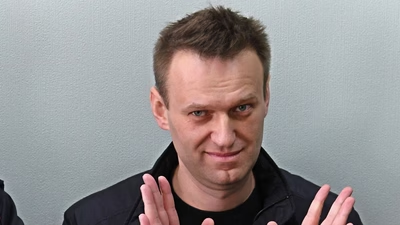
Five Europeans counties on Saturday accused Russia of ‘poisoning’ opposition leader Alexei Navalny in prison using a ‘rare toxin’, almost two years after his death.

The foreign ministries of the UK, France, Germany, Sweden and the Netherlands said the Russian opposition leader was poisoned with a rare and lethal toxin found in the skin of poison dart frogs.
“The UK, Sweden, France, Germany and The Netherlands are confident that Alexei Navalny was poisoned with a lethal toxin,” the countries said in a joint statement, following “analyses of samples” from his body,” news agency AFP reported citing a joint statement from the countries at the Munich Security Conference.
The countries said that they reported the country to the world’s chemical weapons watchdog, the Organisation for the Prohibition of Chemical Weapons, over the finding adding that they were concerned that Russia did not destroy all of its chemical weapons.
They also accused Moscow of breaching the Chemical Weapons Convention.
Navalny, a strong nitpicker of Russian President Vladimir Putin passed away in February 2024 while he was serving a 19-year-long prison sentence. He had rallied hundreds of thousands across Russia in anti-Kremlin protests as he exposed the alleged ill-gotten gains of Putin’s inner circle, the AFP report said.
‘Poisoning’
The poison, an ‘epibatidine toxin’ which is found in the skin of dart frogs native to South America was found in samples and “highly likely resulted in the death” of the Kremlin opposer, the European states said.
In September 2025, Yuli Navalnya said that laboratory analysis of smuggled biological samples found that he was killed by poisoning and that this case was now ‘science-proven’.
Speaking at the Security Conference, Yuli said, “Two years ago I came on stage here and said that it was Vladimir Putin who killed my husband.” “I was of course certain that it was a murder… but back then it was just words. But today these words have become science-proven facts,” she added.
UK Foreign Secretary’s response
The UK Foreign office stated that only the Russian state had the means, motive and opportunity to deploy the ‘lethal toxin’ to target Navalny during this imprisonment in a Russian penal colony situated in Siberia.
“Today, beside his widow, the UK is shining a light on the Kremlin‘s barbaric plot to silence his voice,” UK Foreign Secretary Yvette Cooper, who met Yuli while attending the Munich conference, said in a statement.
Previous attemps to poison Navalny
While campaigning in Siberia, the Kremlin critic was earlier poisoned in 2020 with the Soviet-era nerve agent Novichok. He was then flown to Germany on an emergency flight and took months to recover from the incident.