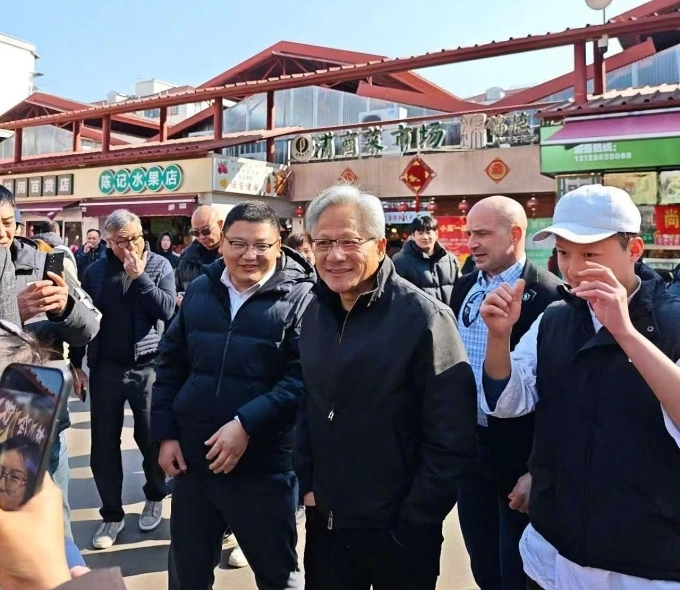
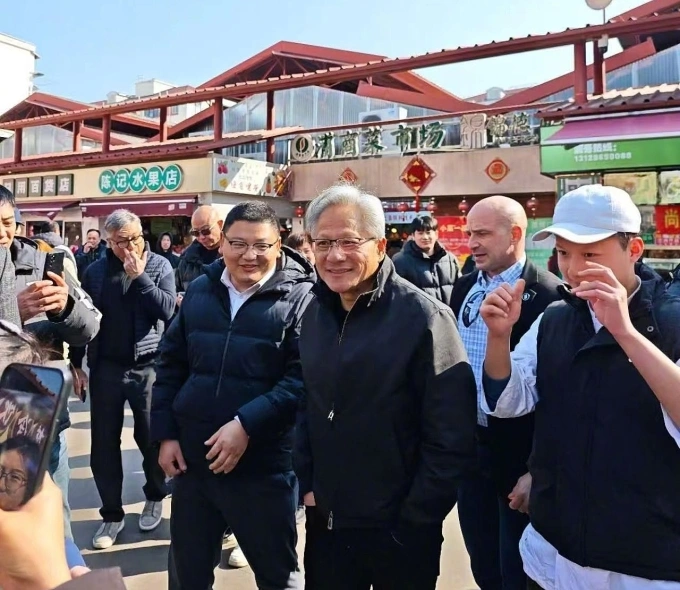
Jensen Huang, CEO of the U.S. chip giant Nvidia, recently visited a wet market in Shanghai, where he sampled fruit, chatted with vendors, and handed out lucky money in red envelopes. After his visit, crowds gathered at the stall to take photos and buy the same items, drawing widespread attention.
The following day, Huang traveled to Beijing, dining at a local restaurant and interacting casually with residents, according to Chinese media reports.
Tesla CEO Elon Musk’s 44-hour visit to China in 2023 generated similar enthusiasm. His meals and travel itinerary dominated mainland social media, amassing more than 170 million views. According to China Entrepreneur magazine, customers even flocked to restaurants to try the same dishes Musk ordered.
 |
|
Nvidia’s CEO Jensen Huang during his China trip in January 2026. Photo from X |
Public fascination with tech founders extends beyond foreign executives. A previously obscure village in southern China has become a tourist hotspot, attracting more than 10,000 visitors a day simply because it is the hometown of Liang Wenfeng, founder of Chinese AI firm DeepSeek.
In China, these figures have moved beyond their roles as corporate leaders and are often treated as cultural icons.
“Admiration for tech leaders can be seen as a form of affective politics, but it is not the same as political worship. It often comes from a natural attraction to their personality,” Liu Taishi, a researcher at the Center for Sociodigital Futures at the University of Bristol in the U.K., told the South China Morning Post.
“In the U.S., the personal image of tech leaders is often crafted by public relations, becoming a key part of the company’s assets. As some tech companies face scrutiny from politicians, the public’s admiration for their leaders is often clouded by scepticism, particularly around issues of monopoly,” said Liu.
In China, however, public admiration for billionaires is largely devoid of political undertones.
A study published in Forum on Science and Technology in China found that the personal narratives of prominent tech figures often align with traditional Chinese values, particularly those emphasizing collective identity, hard work, professionalism, and social contribution.
One frequently cited example is Zhou Qunfei, often dubbed the “touchscreen queen.” Zhou dropped out of school at 15 after growing up in deep rural poverty and later built a global touchscreen manufacturing empire supplying companies such as Apple, Samsung, and Tesla.
 |
|
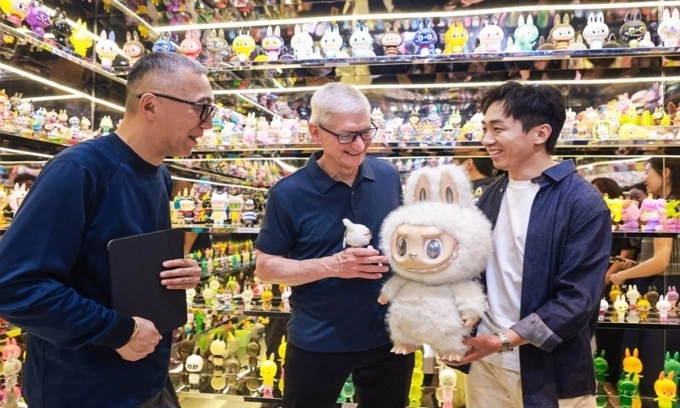
Tim Cook (center) receives a Labubu doll from Pop Mart CEO Wang Ning (R) and The Monsters creator Kasing Lung. Photo from X |
Foreign executives have also strengthened their appeal by engaging directly with Chinese culture. Huang has worn a traditional Tang suit and delivered speeches in Mandarin, while Microsoft co-founder Bill Gates has shared photos of himself enjoying Chinese milk tea on social media.
An investor in Shanghai said the superstar treatment is also strategic, helping amplify corporate influence and fuel market growth.
That effect was visible during Apple CEO Tim Cook’s visit to China late last year. Cook made a surprise appearance on a Douyin livestream to promote the iPhone 17 series and the iPhone Air, quickly pushing the session to the top of social media trending lists. The Air sold out minutes after bookings opened at brick-and-mortar Apple stores in Beijing and Shanghai the following day.
During his livestreaming debut online, Lei Jun, who is regarded as the “grass roots hero” from an ordinary programmer to the founder of tech giant Xiaomi, reached more than 50 million viewers and generated 210 million yuan (US$30 million) for Xiaomi in smartphone and television sales.
Online reactions reflected both enthusiasm and caution. One user wrote that “appearing more like a human rather than a god” helps consumers connect more easily, while another warned: “Personal charm is a double-edged sword. If these tech billionaires lose their reputations, their brands will fall with them.”