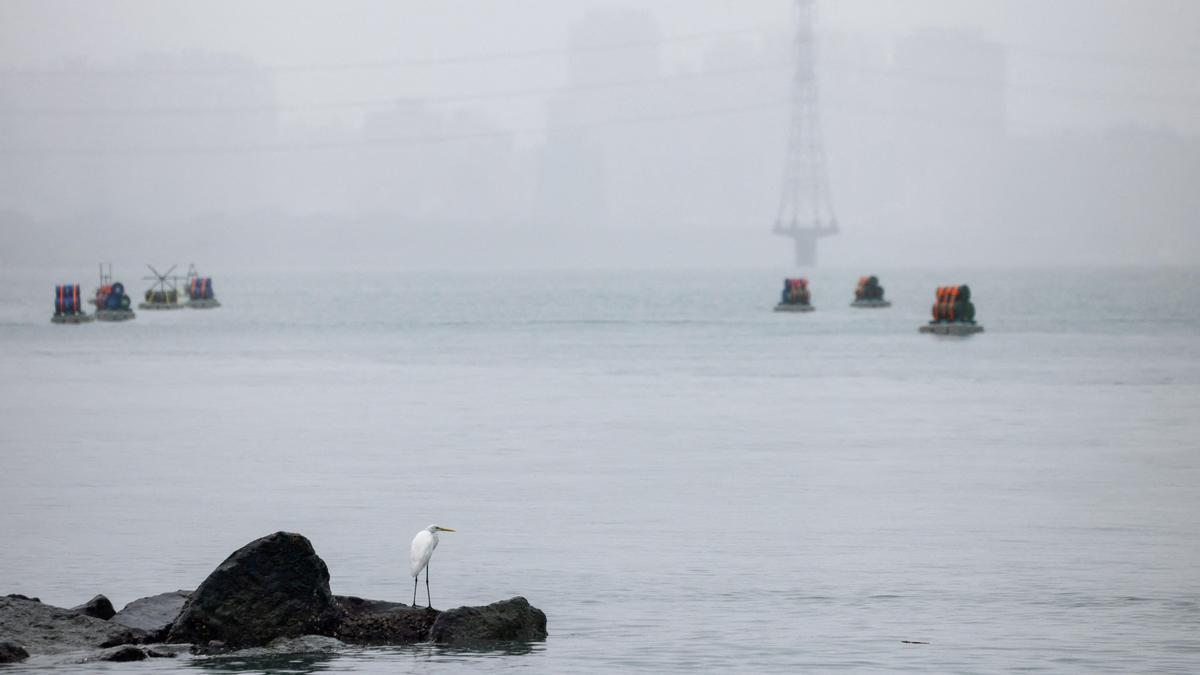
A bird stands on a rock on Tamsui River, with explosive barrels placed by the Taiwan military visible in the background, which are part of a series of emergency combat readiness drills, in response to China conducting “Justice Mission 2025” military drills around Taiwan, in Taipei, Taiwan, on December 31, 2025.
| Photo Credit: REUTERS
The story so far: China’s People’s Liberation Army (PLA) conducted a military exercise around Taiwan from December 29-30, 2025. This is the second such drill of the year, with the aim being to safeguard China’s sovereignty and national unity, and to serve as a warning to Taiwanese separatist forces and foreign interference, China’s Ministry of National Defence (MND) said.
What are the latest military drills?
The military drill codenamed ‘Justice Mission-2025’ focussed on the sea and combat readiness of the troops, comprehensive superiority, blockade of key ports and territory, and three-dimensional external line deterrence using land, sea, and air forces. A press release by China’s Ministry of National Defence reported that on day one the most tactical air drills with 130 sorties were conducted, of which 90 crossed the Taiwan Strait centreline. The second day focused on long-range rocket firing, with 10 rockets landing in Taiwan’s contiguous zone, which is the closest it has ever been. China claims Taiwan as its breakaway province, and its Ministry of Foreign Affairs called the mission a deterrence against “separatist forces.”
What about other drills near Taiwan?
The first such military exercise was conducted in 2022 after U.S. Speaker of the House Nancy Pelosi visited Taiwan. China deployed carrier groups, nuclear submarines and fired 11 missiles into the water near Taiwan. The next time was in April 2023, when the then-Taiwanese President Tsai Ing-wen visited the U.S. and met then U.S. Speaker Kevin McCarthy. In August, 2023, another smaller-scale drill was held against then-Taiwanese Vice President William Lai Ching-te’s diplomatic trip to the Americas. Furthermore, large-scale military exercises happened in the East China Sea after William Lai Ching-te of the Democratic Progressive Party (DPP) won the Presidential election. In April 2025, the ‘Strait Thunder–2025A’ drill focused on advancing, deterrence, closure, destruction and paralysis as stated by PLA Eastern Theatre Command.
Justice Mission-2025 comes in light of the Trump administration’s arms sale deal worth $11 billion with Taiwan. The package, yet to be approved by the U.S. Congress, includes self-propelled howitzers, advanced rocket launchers and other missiles.
What has been Taiwan’s response?
Taiwan’s Mainland Affairs Council called these drills “provocative and coercive military actions.” To further advance its military capabilities, Taiwan proposed a multi-layered air defence system called the ‘T-Dome.’ This advancement is steady but slow, as Taiwan lacks a unified action plan to develop its military infrastructure. This is due to the incongruence between the two major parties of Taiwan, with both currently holding political offices. While the DPP has the majority in the Executive Yuan, the highest administrative body, the Legislative Yuan is led by the opposition Kuomintang (KMT) and the Taiwan People’s Party (TPP) together. The DPP strongly pushes for Taiwan independence and the protection of its sovereignty from China. But any defence legislation is thwarted by the opposition, KMT and TPP.
How did external actors respond?
While the U.S. underplayed the drills, other countries expressed concerns. The EU Commission believed that these drills increase cross-strait tensions and endanger international peace and stability. China’s MND clearly noted that the presence and increasing involvement of foreign interference as one of the reasons for the exercise. The U.S. arms sale deal with Taiwan is an important development in light of which these drills happened. Similarly, the recent statement made by Japan’s newly elected Prime Minister Sanae Takaichi have escalated tensions in the East Asian region. Ms. Takaichi declared that a Chinese military attack on Taiwan constitutes a survival-threatening situation for Japan. China found Ms. Takaichi’s comments egregious and demanded a retraction.
Femy Francis is Project Associate, China Reader, at NIAS.
Published – January 22, 2026 08:30 am IST