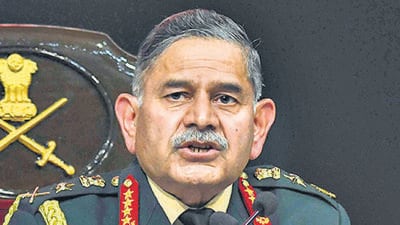
Army chief General Upendra Dwivedi on Tuesday rejected Beijing’s claims over Shaksgam valley, underlining that India considers the so-called China-Pakistan Boundary Agreement of 1963 — under which Islamabad ceded 5,180 sq km of Indian territory in Pakistan-occupied Kashmir to China — to be illegal.

His comments came a day after China reaffirmed that Shaksgam valley belongs to it and that it was fully justified for Beijing to build infrastructure on its own territory.
“We do not approve of any activity in Shaksgam valley,” the army chief said at his customary press conference ahead of the 78th Army Day on January 15, reiterating India’s stance on the matter. To be sure, India does not recognise the China-Pakistan Economic Corridor (CPEC) that cuts across Indian territory under forcible and illegal occupation of Pakistan.
“We do not accept the statement issued in China on CPEC and consider it to be an illegal action being carried out by the two nations,” Dwivedi said.
Also Read: China’s claim on Shaksgam valley unacceptable, PoK ours: Ladakh lt governor
On Monday, Beijing reaffirmed its territorial claims over Shaksgam valley in the backdrop of India’s objections, adding that the Chinese infrastructure projects in the area were “beyond reproach.”
“It’s fully justified for China to conduct infrastructure construction on its own territory. China and Pakistan in the 1960s signed a boundary agreement and delimited the boundary between the two countries, which is the right of China and Pakistan as sovereign countries,” Chinese foreign ministry spokesperson Mao Ning said at a media briefing in Beijing.
The comments came days after India opposed China’s infrastructure development projects in the Shaksgam valley and said it has the right to take measures to safeguard its interests as the region is Indian territory. “Shaksgam valley is Indian territory. We have never recognised the so-called China-Pakistan Boundary Agreement signed in 1963,” external affairs ministry spokesperson Randhir Jaiswal said at a weekly media briefing on January 9.
Also Read: ‘Such audacity’: Cong hits out at BJP over China meet as Beijing lays claims to Shaksgam Valley
Jaiswal was responding to a question about Chinese infrastructure development in the Shaksgam Tract, which includes the Shaksgam valley and covers 5,180 sq km north of the Karakoram watershed, illegally occupied by China since 1963. The region was earlier occupied by Pakistan since 1947 before Islamabad illegally ceded it to Beijing. Shaksgam valley is claimed by India as part of the erstwhile state of Jammu and Kashmir.
On the situation along the northern front with China, the army chief said it remains stable but needs constant vigil. Apex-level interactions, renewed contact and confidence-building measures are contributing to gradual normalisation of the situation, he said.
“This has also enabled grazing, hydrotherapy camps and other activities along the northern borders. With our continued strategic orientation on this front, our deployment along the LAC (Line of Actual Control) remains balanced and robust. Concurrently, capability development and infrastructure enhancement are progressing through a whole-of-government approach.”
The Indian Army resumed its patrolling activity in Demchok and Depsang in eastern Ladakh in 2024 after a gap of more than four years. This restored the ground situation in the two forward areas to what it was pre-April 2020 before the India-China military standoff began. With that breakthrough, the Indian Army and Chinese People’s Liberation Army moved past a two-year impasse in negotiations — the fourth and last round of disengagement from Patrolling Point-15 in the Gogra-Hot Springs area took place in September 2022 after which the talks were deadlocked.
Since October 2024, both sides have worked closely to maintain peace and tranquility in the border regions.
“Both sides are making efforts to increase trust levels. There is a sense of urgency on both sides to keep the borders as calm as possible…As far as force reduction or deployment is concerned, it is a matter of time, space and resources. What we look at is that forces should be placed in such a manner that they should be able to reach a particular deployment within the stipulated time,” Dwivedi said.
Two groups have been formed to handle the situation — an expert group and a working group, he said. “The expert group is looking at the boundary delimitation and the working group is looking at boundary management. Once these groups give us some additional guidelines, developments will take place on ground,” he said.
In June 2025, India pushed for a permanent solution of border demarcation with China and underlined the need to solve complex issues through a structured roadmap of engagement and de-escalation, during talks between defence minister Rajnath Singh and his Chinese counterpart Admiral Dong Jun.
Terror camps active in Pakistan
Terrorist-initiated incidents are down to almost nil after Operation Sindoor — the four-day military confrontation between India and Pakistan in early May following the April 22 Pahalgam terror attack, the army chief said.
However, eight terror camps are still active in Pakistan with 100-150 people present there, he said, adding two of the camps are across the international border and remaining six across the Line of Control (LoC). He warned of action if Pakistan directs terror against India, adding that the army was monitoring the situation closely.
“The past year saw a sharp rise in the number and intensity of armed conflicts worldwide. These global shifts underline a simple reality: nations that stay prepared, prevail. In this backdrop, Operation Sindoor, India’s calibrated and resolute response to cross-border terrorism, demonstrated our readiness, precision and strategic clarity.”
Operation Sindoor marked New Delhi’s direct military response to the April 22 Pahalgam terror attack in which 26 people were killed. India launched the operation in the early hours of May 7 and struck terror and military installations in Pakistan and Pakistan-occupied Kashmir (PoK) before the May 10 ceasefire.
Operation Sindoor was conceptualised and executed with precision, Dwivedi said. “Through 22 minutes of initiation on May 7 and an orchestration that lasted 88 hours up to May 10, the operation reset strategic assumptions by striking deep, dismantling terror infrastructure and puncturing long-standing nuclear rhetoric. It is an ongoing operation, and any future misadventures will be resolutely responded to,” the army chief added.