For marrying innocence and joy with tragedy, few historic events come close to the events of Christmas Day in 1914.
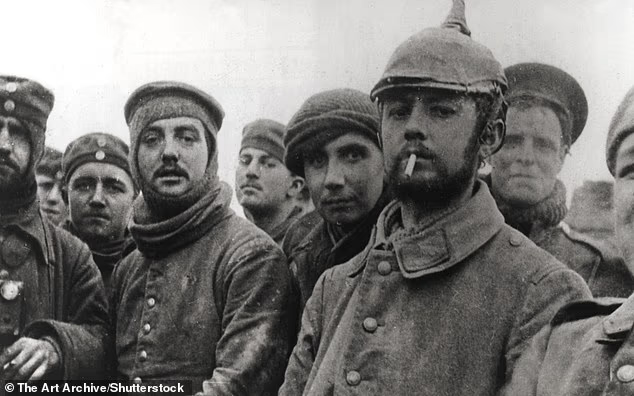
Five months after the start of the Great War, British and German troops were prompted to put down their weapons for little over a day and formed a tentative stalemate that allowed for soldiers on both sides to collect their dead and wounded men from No Man’s Land between the trenches.
Soldiers are believed to have spoken to one another, sung carols, exchanged food and cigarettes – but the most enduring detail is that in the midst of war, the two sides chose to play a football match to mark the occasion.
So powerful is the image of soldiers laying down arms to take up a football that the match of the 1914 Christmas Truce has become the inspiration for plays, films, novels, songs – and even a Sainsbury’s Christmas advert.
But when asking questions about how the contest came about – and who won the tie – sifting through reality and myth is a little bit more complex.
For one eye witness, it was the British who produced a ball and tempted the Germans into a contest.
British and German soldiers put down their weapons and came together for a unique Christmas truce in 1914

The brief festivities and pause in the violence in some areas came against the backdrop of the horrors of trench warfare
‘Suddenly, a Tommy came with a football, kicking already and making fun, and then began a football match,’ Lieutenant Johannes Niemann of the 133rd Saxon Infantry Regiment wrote.
‘We marked the goals with our caps. Teams were quickly established for a match on the frozen mud, and the Fritzes beat the Tommies 3-2.’
But more likely was that there was no formal game at all, with everyone who could keen to join in.
‘We were sharing fags and goodies with the Germans, and then from somewhere, this football appeared,’ Ernie Williams, who served with the Cheshire Regiment’s 6th Battalion recounted. ‘It was a proper football.
‘But we didn’t form a team, it wasn’t a team game in any sense of the word. You know, it was a kickabout, everyone was having a go.
‘It came from their side, it wasn’t from our side where the ball came. I should think there would be at least a couple of hundred (taking part). I had a go at it. I was pretty good back then, at 19.’
Up and down the lines, where a ball couldn’t be found, substitutes were used. George Ashurst, a British NCO who served with 2nd Battalion Lancashire Fusiliers, remembered something much more makeshift, ‘an empty sandbag, we tied it up with itself in string and kicked it about on top’.
An even less malleable ‘ball’ was described in a letter published in the New Year’s Eve edition of the Manchester Guardian that year.

In some sections of the Western Front soldiers were lucky enough to play with a ball whereas others had to make do with ersatz replacements
‘One officer met a Bavarian, smoked a cigarette, and had a talk with him about half-way between the lines,’ the letter described. ‘Then a few men fraternised in the same way, and really today peace has existed.
‘Men have been talking together, and they had a football match with a bully beef tin, and one man went over and cut a German’s hair.’
While the Christmas truce was limited to certain sections of the Western Front, with an estimated 100,000 men taking part, not all those involved in the temporary truce felt comfortable taking part in the sport.
General Sir Walter Congreve, VC, shunned the Christmas Truce because he didn’t trust the Germans to resist shooting an officer of his high rank, he revealed in a letter he wrote to his wife.
Congreve, who led the Rifle Brigade, wrote the letter after visiting troops in a section of trench known as Dead Man’s Alley in northern France on December 25, 1914.
He describes what he saw there as ‘an extraordinary state of affairs’ and tells of troops and officers from both sides ‘walking about together all day giving each other cigars and singing songs’.
Congreve, then 52, who won his Victoria Cross during the Second Boer War in 1899 and was known as ‘Squibs’, adds: ‘I was invited to go and see the Germans myself but refrained as I thought they might not be able to resist a General.’
The general does however confirm the story of football being played in No Man’s Land, starkly setting the festivities against the backdrop of ongoing war further down the line.
‘Next door the two battalions opposite each other were shooting away all day and so I hear it was further north, 1st R.B. playing football with the Germans opposite them – next Regiments shooting each other,’ Congreve wrote.
But as difficult as it is to separate fact from fiction, there is no doubting that the Christmas pause in hostilities between the two warring sides has become a poignant example of humanity in the face of war – and remains an enduring symbol of those values.
At Messines in Belgium, a memorial of the truce was unveiled in the form of a sculpture by Andrew Edwards of British and German soldiers about to shake hands, with a football between them at their feet. In England, another handshake memorial was unveiled at the National Memorial Arboretum, showing clasped hands surrounded by the wire outline of a football.
Eleven years ago, the Christmas truce was commemorated for its 100-year anniversary by the Football Remembers project, with Premier League and amateur opponents alike posing as one team before their kick-offs around the country on the first weekend of December.

Teams up and down the country posed together as one in commemoration of the anniversary
More than 30,000 schools were sent an education pack which included resources to help children learn about the truce and football’s role in recruitment and morale during the First World War.
Prince William, who was then the Duke of Cambridge called the project ‘a powerful way to engage and educate young people about such an important moment in our history’.
‘We all grew up with the story of soldiers from both sides putting down their arms on Christmas Day, and it remains wholly relevant today as a message of hope over adversity, even in the bleakest of times,’ he added.
That year, a commemorative match was also played between British and German serviceman. There at least, the result was conclusive – with the hosts in Aldershot edging out the Bundeswehr by a single goal.