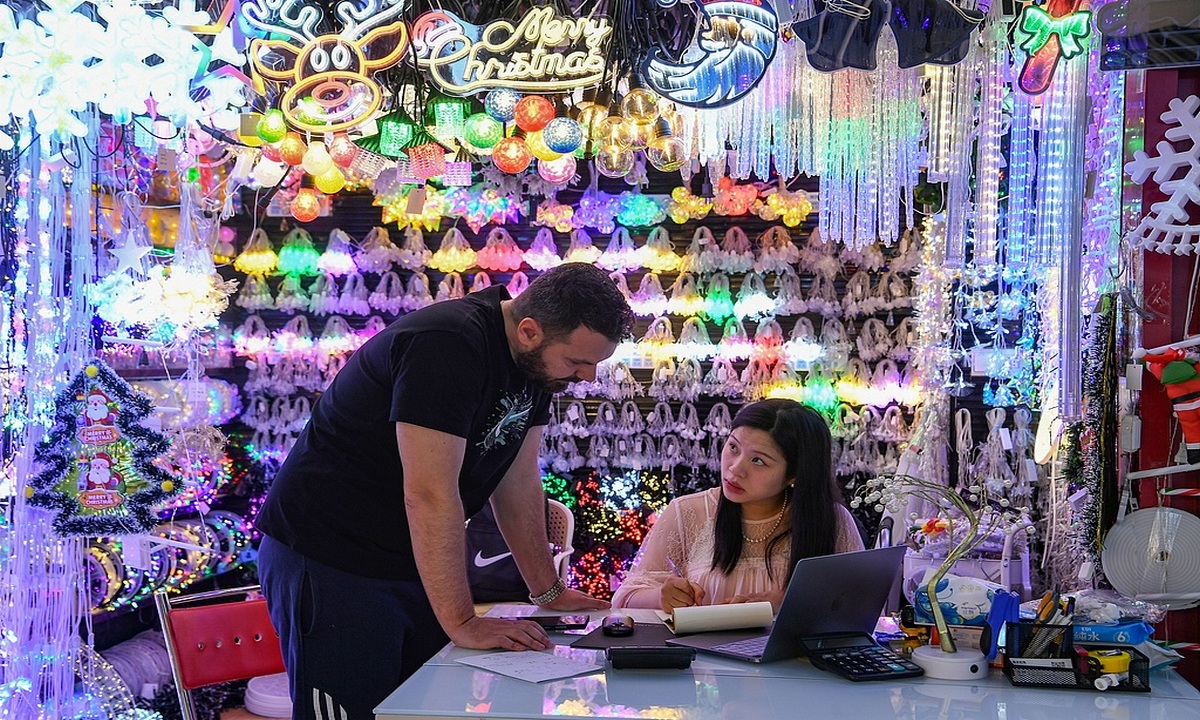
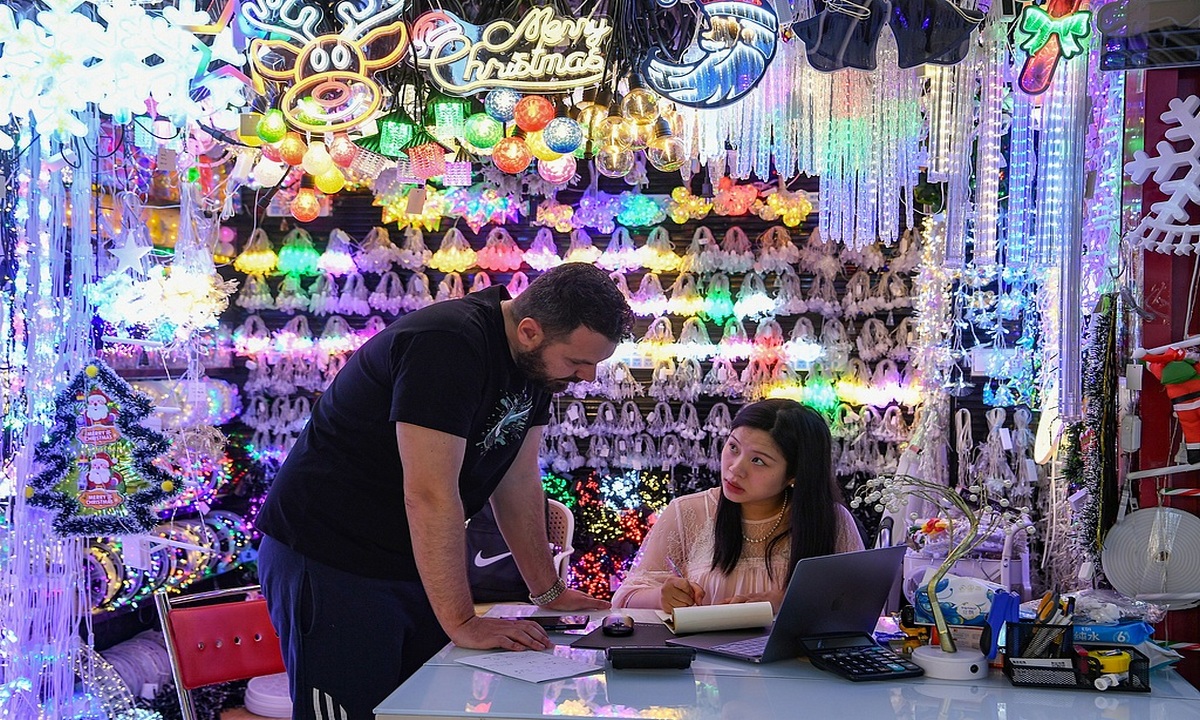
A foreign buyer selects Christmas decorations at the Yiwu International Trade Market in Yiwu, East China’s Zhejiang Province. File photo: VCG
As Christmas is around the corner, data released on Monday showcased the sustained resilience and vitality of East China’s Yiwu, the world’s largest wholesale market for small commodities and an epitome of China’s foreign trade sector.
In the first 11 months of 2025, the city recorded total imports and exports of 770.39 billion yuan ($108.5 billion), up 25.5 percent year-on-year, with exports growing 24.9 percent, official data showed on Monday. Despite a complex and volatile global trade environment, local exporters have been able to secure orders and maintain production, providing solid support for peak-season shipments, according to the Yiwu Municipal Bureau of Commerce.
Yiwu has been guided by a new round of comprehensive international trade reforms aimed at building a global benchmark for trade, while stepping up efforts to stabilize foreign trade and foreign investment and boost consumption, achieving steady and sound growth in its commercial sector.
Christmas mood in advance
While Christmas is just around the corner, many exporters in Yiwu, East China’s Zhejiang Province, said they had entered “the Christmas mode” about four months ago, as foreign clients rushed to place additional orders and expedite shipments for fear of missing the peak sales season in December.
Analysts said the popularity of Chinese Christmas products in overseas markets underscores the competitiveness of Made-in-China products amid the global peak consumption season, while China’s advantages like a full industrial chain, growing export diversification and continuous innovation underpin the sustained steady growth momentum of China’s goods trade and contribute to the security and stability of global industrial and supply chains.
“Every year, our peak shipping season falls in August and September, and this year’s [shipping season] had been especially bustling. Back then, customers were scrambling to add orders and request earlier deliveries for fear of missing the peak sales season,” Sun Lijuan, owner of Hongsheng Toys in Yiwu International Trade City and exporter of Christmas product, told the Global Times on Friday.
Despite global trade uncertainties, Sun said her company’s export volume still increased this year, with clients mainly coming from Latin America, Africa, Central Asia, and Europe.
In addition to surging sales, Sun highlighted a striking trend this year: Smart products integrated with artificial intelligence (AI) conversational functions are exceptionally popular. “Despite their higher prices, these high-end offerings have garnered more orders,” Sun said.
Gong Sihan, CEO of Bosen Christmas Factory in Yiwu, told the Global Times on Friday her company’s export volume by November has exceeded last year’s record. “As overseas orders keep flooding in, our production capacity cannot fully meet the demand,” Gong said.
Based on the changes in the global market, we proactively adjusted our export strategy and shifted to explore the markets with faster growth instead of the US, Gong said.
“Some small factories in Southeast Asia cannot match us in terms of industrial chain scale, product quality, and craftsmanship. Meanwhile, manufacturing in Europe and the US is even costlier with far fewer product categories,” Gong said. “For such Christmas products, Chinese manufacturing still holds an overwhelming advantage,” she said.
While a product as small as a ball ornament, the popularity of Made-in-China Christmas products in overseas markets demonstrates China’s irreplaceable role in global supply chains, Huo Jianguo, a vice chairman of the China Society for World Trade Organization Studies in Beijing, told the Global Times on Friday.
According to data released by the General Administration of Customs on November 7, the value of China’s exports grew by 6.2 percent year-on-year in the first 10 months to reach 22.12 trillion yuan, demonstrating resilience and vitality despite a complex external environment.
Playing a critical role
With the world’s most comprehensive industrial categories and a well-rounded industrial system, China has sustained its status as the “world’s manufacturing hub” and contributed to the security and stability of global industrial and supply chains, Hu Qimu, a deputy secretary-general of Forum 50 for Digital-Real Economies Integration, told the Global Times.
“As a major manufacturing country, China provides the world with high-quality, affordably priced consumer goods, intermediate goods, and capital goods. This not only significantly enhances consumer welfare across the world but also offers robust support for the smooth operation of global supply chains and the healthy development of manufacturing industries,” Hu said. He highlighted that China’s industrial transformation and upgrading are offering more high value-added and differentiated goods that precisely meet consumers’ needs.
On October 14, the Yiwu Global Digital Trade Center, hailed as Yiwu’s sixth-generation market, officially opened, marking a significant leap from traditional trade to a fully integrated digital trade ecosystem.
China has maintained its position as the world’s largest manufacturer for 15 straight years, Li Lecheng, minister of industry and information technology, told a press conference in September.
China’s manufacturing value-added output is expected to have increased by more than 8 trillion yuan during the 14th Five-Year Plan period (2021-25), contributing over 30 percent of global growth, according to Li.
In the process of strengthening the domestic manufacturing sector, China has provided solid support to the smooth operation of global industrial and supply chains in multiple aspects. For instance, the third China International Supply Chain Expo (CISCE) held in July in Beijing saw the signing of over 6,000 cooperation agreements and partnership intents among upstream, midstream and downstream sectors, as well as small, medium and large enterprises.
In addition, China had joined multiple countries in launching the initiative on enhancing the resilience and stability of industrial and supply chains, aiming to safeguard global supply chains and foster more inclusive, stable partnerships.
Since the running of the first China-Europe freight train in 2011, the service had completed more than 110,000 trips as of July, emerging as a vibrant engine propelling the global economic development. From January to November this year, China-Europe and -Central Asia freight train services operated a total of 31,200 trips, marking a year-on-year increase of 9 percent, Xinhua News Agency reported.
On September 22, the Ningbo-Zhoushan Port in East China’s Zhejiang Province launched its first China-Europe Arctica container express route, marking the first time the port has extended a route to the Arctic Ocean, and providing a more convenient, low-carbon choice of international logistics.
“Certain Western countries’ ‘decoupling’ and ‘disruptions’ push will only harm the smooth operation of the global supply chains. Only open cooperation and strengthened collaboration for inclusive growth is the way forward,” Huo said.