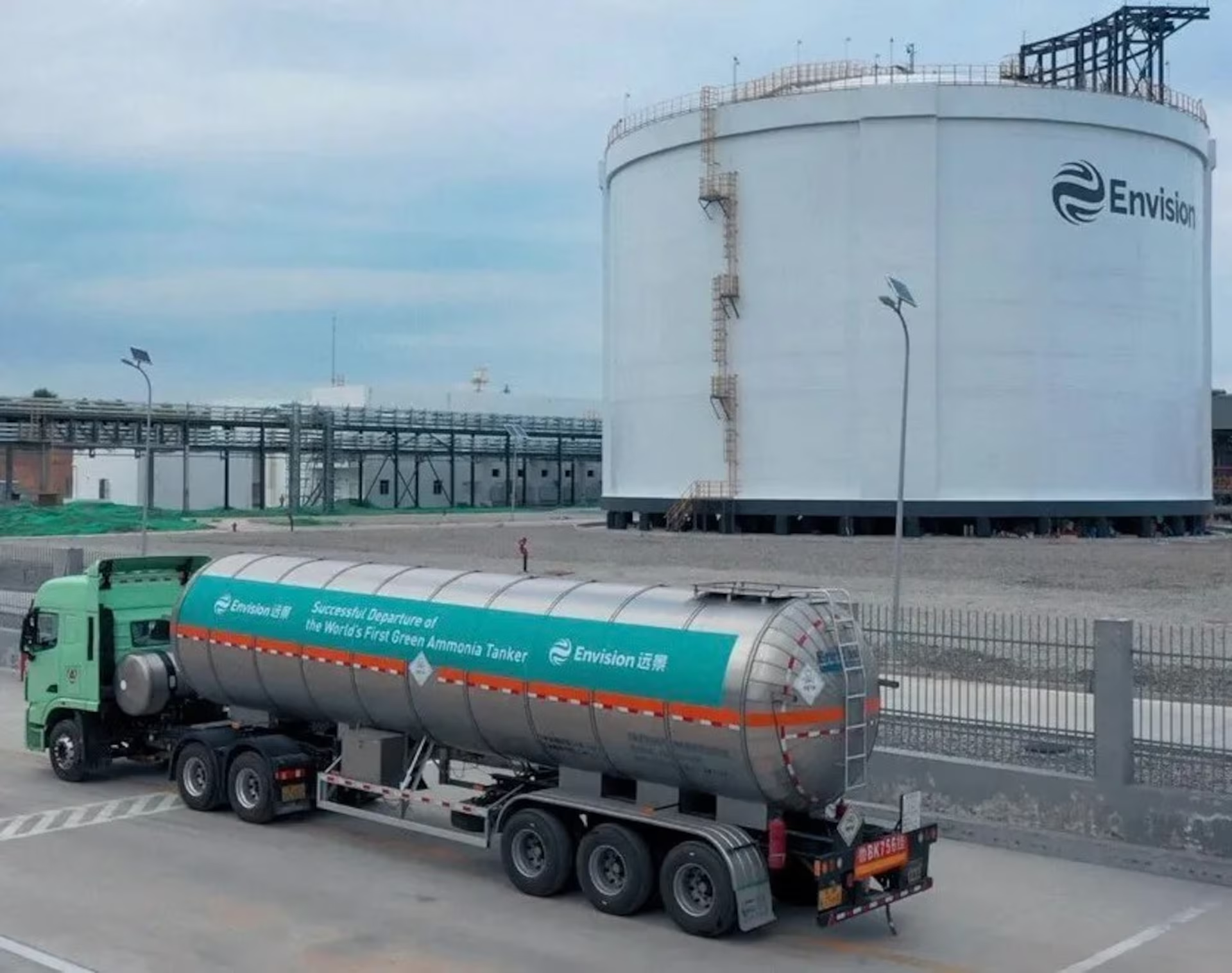
December 16 – In the city of Chifeng in northern China, an ultra-modern factory owned by green-energy company Envision is making hydrogen and ammonia using renewable electricity, helped by artificial intelligence (AI).
The plant is powered by a standalone grid that sends electricity straight from its own wind and solar farms. The production of the chemicals relies on a consistent supply of electricity – and a lot of it – but renewable power is often unpredictable and unstable. To solve the dilemma, Shanghai-based Envision has developed an AI-driven operating system to enable the factory to run smoothly and efficiently.
Zhang Jian, Envision’s chief engineer for hydrogen energy, described the system as “a conductor” that automatically matches the plant’s electricity use with weather conditions.
For example, when the AI system detects that the wind is picking up, it will automatically dial up the factory’s production to the maximum, enabling it to use as much green electricity as possible, Zhang told China Energy News, a state-run newspaper. “When the wind is waning, it will quickly wind down the load (the electricity use) to the lowest level.”
“AI can play a hugely important role in China’s climate action and energy transition,” says Zheng Saina, an associate professor specialising in low-carbon transition at Southeast University in Nanjing, China.
There are many different ways in which it can help, she says, from calculating and projecting companies’ and industries’ carbon emissions to forecasting the supply and demand of electricity.

However, AI data centres are also expected to cause an “explosive growth” in China’s electricity demand, Zheng warns. “This is a problem that urgently needs addressing.”
As China beats the world in installing wind turbines and solar panels, it needs a more flexible grid that allows more renewable power to be absorbed. That’s where the country sees the value of AI, according to Cory Combs, associate director of Beijing-based research firm Trivium China.
In September, Beijing launched an “AI+ energy” strategy aimed at spurring a “deep integration” between AI and its energy system.
By 2027, the plan calls for China to promote the “deep” use of more than five large AI models dedicated to different aspects of the energy system; plan more than 10 “replicable, promotable and competitive” pilot projects; and explore more than 100 typical application scenarios.
In another three years, China is to reach a “world-leading level” in combining specialised AI technologies with the energy sector.
China’s aim is to develop “very specific, tailored AI solutions that just support energy work, just support the grid, just support some specific industries like wind or nuclear”, says Combs.
In contrast to the United States, where much of the investment has been directed towards building advanced large-language models, Chinese AI developers have focused on integrating AI into commercially scalable applications, says Hu Guangzhou, professor of economics at the China Europe International Business School in Shanghai.

One of the most crucial roles AI can play is in predicting electricity demand, says Fang Lurui, an assistant professor of power-system planning at Xi’an Jiaotong-Liverpool University in Suzhou, China.
A power grid must ensure that its electricity supply meets the demand at any given second to maintain a stable operation and prevent blackouts.
“If AI models are well trained to give accurate forecasts on how much renewable electricity will be generated throughout the day and how much electricity will be needed at corresponding times, then the grid operator can decide how to balance the demand and supply in advance more efficiently and safely,” Fang says.
For example, the grid operator will be able to have a better idea of how much electricity it needs to store in batteries to help fill gaps. “This not only allows the grid to absorb more wind and solar power, preventing less of them from being wasted, but also reduces its need to call up backup coal power,” says Fang.
Some Chinese cities have got a head start. Shanghai, China’s financial hub, has launched a citywide virtual power plant (VPP), backed by “AI+ Duangming”, a digital platform developed by the state grid to help mega cities manage their grids.
The platform aggregates the power-generation and load-reduction capacities of 47 diverse operators, including data centres, building heating and cooling systems, and electric vehicle charging networks, allowing them to function as a single, flexible power source.

Its demand response technology allowed the system to successfully flattened a demand spike at a trial run one day in August, shaving off a combined 162.7 megawatt (MW) of power resources – equal to the capacity of a small coal-fired plant.
In Combs’s view, specifically designed AI programmes will be highly valuable in optimising the energy system in China and elsewhere because power generation is now more fragmented and intermittent.
“You need something very robust that is able to be predictive and account for new information very quickly,” he says.
Although still at the early stages, AI can potentially help the regulator verify whether the emissions data submitted by companies are accurate, says Chen Zhibin, senior manager for carbon markets and pricing at adelphi, a Berlin-based think-tank.
It can also help the government design a more effective system for giving out free emission allowances, and enable participating firms to calculate its production costs more precisely, Chen explains.
Major challenges are on the horizon, however. China’s AI data centres are projected to devour more than 1,000 terawatt-hours of electricity yearly by 2030, roughly the annual electricity consumption of the whole of Japan today, according to a study. It predicts that the lifecycle carbon emissions of China’s AI industry will double between 2030 and 2038, and peak at 695 million tonnes, more than the total carbon emissions of Germany in 2024.

The finding was not surprising because China’s power grid is still heavily reliant on coal, says Xiong Qiyang, a PhD candidate in Renmin University of China, who participated in the study.
Given that the industry is projected to peak its emissions eight years after China’s official target of 2030, he says “The AI boom could seriously complicate the country’s national climate goals”.
Data centre operators on the populous east coast are also trying to maximise the use of local renewable resources. A pioneering data centre will soon open under the sea near Shanghai, using cool ocean water to help it cut energy and water usage.
The underwater pod is set to draw more than 95% of the electricity it needs from a nearby offshore wind farm, according to Hailanyun (also known as HiCloud), the project’s developer. The company says it plans to build more wind-powered underwater data centres in China if this project turns out to be a success.
Although AI’s own energy use is a “real concern”, Xiong thinks it “does much more good than harm” in helping China’s key sectors reduce their emissions. “That makes AI an essential tool in China’s green transition,” he says.
Opinions expressed are those of the author. They do not reflect the views of Reuters News, which, under the Trust Principles, is committed to integrity, independence, and freedom from bias. Ethical Corporation Magazine, a part of Reuters Professional, is owned by Thomson Reuters and operates independently of Reuters News.