The Russian economy has been dealing with growing headwinds this year: unruly inflation, a ballooning budget deficit – due in part to massive military spending – and shrinking revenues from oil and natural gas.
Economic growth has also slowed sharply. But the gathering economic storm is unlikely to bring President Vladimir Putin to the negotiation table anytime soon to end the war in Ukraine. Analysts say the Kremlin could weather it for many more years at the current pace of fighting and with existing Western sanctions in place.
“If you look at the economy itself, it’s not going to be that ultimate straw that breaks the camel’s back,” said Maria Snegovaya, a senior fellow for Russia and Eurasia at the Center for Strategic and International Studies (CSIS), a think tank. “It’s not catastrophic. It’s manageable.”
Looking at the next three to five years, Russia could carry on fighting, she said, noting that it’s hard to make a reliable assessment beyond that.
And a contingent of exiled, anti-Putin Russian economists believes the war of attrition could continue even longer because the Kremlin’s ability to wage the war is “unimpeded by any economic constraints.”
Western sanctions have not inflicted enough pain on Russia’s energy-focused economy to change Moscow’s plans for the war, Richard Connolly at the Royal United Services Institute (RUSI) told CNN.
“As long as Russia’s pumping oil and they’re selling it at a fairly reasonable price, they have enough money to just muddle along,” said the senior fellow in international security at the UK-based think tank.
“I’m not saying it’s a really rosy picture for them, but they’ve got enough for the economy not to be a factor in Putin’s calculus when he’s thinking about the war,” Connolly added.

History shows that Russia is more likely to agree to an unfavorable peace settlement if it is experiencing an economic slump, as was the case at the end of World War I and the Soviet war in Afghanistan, Snegovaya said. But the current economic situation is “nowhere near there yet, and it will take much more serious pressure on (the) Russian economy and longer, much longer for it to get there,” she told CNN.
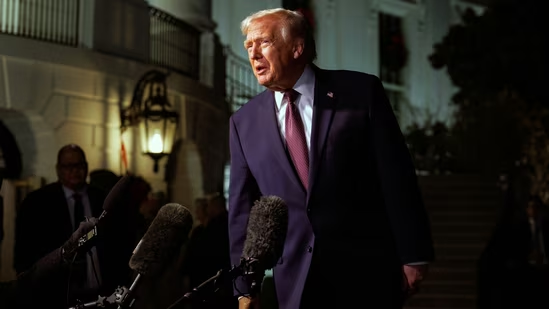
That is bad news for Ukraine, and for the Trump administration, which has held numerous rounds of talks to try to negotiate an end to the war.
Tax hikes and rising prices
What has changed for Russia is that the initial economic boost caused by surging military spending appears to be over and now the Kremlin has to “keep pushing the burden of the war on the Russian society,” Snegovaya said.
That burden on society has taken the form of a large increase in corporate and income tax rates, as well as a hike in the value-added tax, or VAT, to help fund record levels of military spending. Russian consumers are also grappling with sharp price rises, especially for imported goods.
But unlike in the West, high inflation “does not create a lot of social discontent” in Russia, Snegovaya argued, noting the effects of government propaganda and repression.
Like other experts, Connolly also said that inflation in post-Soviet Russia has always been high, so consumers are used to it. The International Monetary Fund has forecast that year-over-year inflation in Russia will average 7.6% this year, down from 9.5% in 2024.
Russia is now spending nearly 40% of its budget “on aggression,” NATO Secretary General Mark Rutte said earlier this month, one among a number of varying estimates of Russia’s military spending. That expenditure jumped 38% last year compared with 2023, according to an April report by the Stockholm International Peace Research Institute
The higher spending has created a new class of wartime economic “winners,” including defense contractors, such as weapons manufacturers, and blue-collar workers. As a result, economic inequality in Russia has fallen, meaning Putin faces even less pressure from some sectors of society, experts argued.


As Russia has tried to substitute some imports from the West, it has expanded manufacturing of textiles, footwear and basic electronics, noted Ekaterina Kurbangaleeva, a visiting scholar at George Washington University, specializing in political and social research, including Russian taxpayer data. Some types of workers saw their wages triple and in some cases quintuple between 2021, the year before Russia launched its war, and 2024, her research has found.
“It was like a shot of adrenaline,” Kurbangaleeva said of the wartime boost to the economy, though she noted the slowdown in economic growth since then.
Some of Russia’s more deprived, rural areas have also experienced an economic uplift since the start of the war, in part because of huge pay checks going to Russian soldiers and their families – a strategy the Kremlin has used to recruit volunteer soldiers and avoid wider conscription as it seeks to replace those lost on the frontlines in Ukraine.
“Russian soldiers today are paid more than any Russian soldier in the history of Russian soldiers,” RUSI’s Connolly said. “They have been earning more money than they ever would have hoped to have earned if they’d have stayed in those relatively depressed parts of the country and got another job in the civilian economy.”
The Russian government has also disbursed large compensation payments to the families of soldiers killed or injured in the war, Kurbangaleeva noted.
In part by throwing money at the military workforce and their families, the Kremlin has managed to temper discontent despite Russian casualties in Ukraine nearing 1 million people, with 250,000 of those dead, according to a CSIS estimate published in June.

The government has largely avoided the kinds of protests seen during the wars in Chechnya and Afghanistan, when the families of conscripted soldiers from Russia’s and the Soviet Union’s poorer regions demanded an end to the conflicts.
“I don’t think the regions would exercise any influence over sustaining the war, but the fact that you’re not seeing sort of outbursts of public protest – it relieves the pressure on Putin when he makes his decisions about what he’s going to do next,” Connolly said.
What the Kremlin may be cognizant of, experts say, is concerns about a large group of war veterans re-entering society – without jobs and many with expensive medical needs – if a peace agreement is reached.
“It’s in Putin’s best interest to keep this war going, just from a domestic standpoint,” said Kimberly Donovan, the director of the Economic Statecraft Initiative at the Atlantic Council.
While the economic headwinds are manageable in the short term, the long term could be a different story. Russia has dipped heavily into its sovereign wealth fund, which a recent Atlantic Council report said creates “new trade-offs for the Kremlin,” as the cushion that once insulated the general public from the war’s costs shrinks.
According to the Kyiv School of Economics Institute, the value of assets that are liquid, or easily converted into cash, in Russia’s National Welfare Fund has declined by 57% since the start of the war.
As the fund is drained, “it is difficult to imagine a scenario in which the Russian government can sustain its current defense expenditures without social spending cuts that are pervasive and visible to the general population,” the Atlantic Council report said.
In addition, the recent sanctions that the United States and United Kingdom placed on two major Russian oil producers – Lukoil and Rosneft – have driven up the costs of business for Russia, Donovan at the Atlantic Council told CNN.
“They (Russian oil producers) are rerouting oil exports through smaller Russian companies… That is all costing a lot of money,” she said.
If that is combined with stronger sanctions enforcement and increased pressure on India and China to stop buying Russian oil, the Kremlin could eventually change its calculus, she argued.
“The more pressure we can put on Russia using these types of sanctions, the more it’s going to cost them to try to evade them.”
![[China Tech] Local Pediatric Hospital's Research Ward Attracts Overseas Patients](https://news.charm-retirement.com/wp-content/uploads/2025/12/985a6d2b-4f83-44d8-943a-f00ce098c5ab_0-scaled.jpeg)