Sala Bikini was one of the trendiest clubs in Barcelona in the 1990s and 2000s.
The venue peaked in 2006 when a masked Ronaldinho was found playing the bongos on stage during a gig by Brazilian band Samba Tri. Footage emerged the next day and attracted media scrutiny over the Ballon d’Or winner’s nocturnal habits.
Hansi Flick might see a sort of blessing in that Ronaldinho night out, because the Samba Tri percussionist, known as Maninho, became a very close friend of the Brazil star, and he also had a son named Raphael Dias Belloli. Barcelona’s current No 11 is better known as Raphinha.
It was not the first time that Sala Bikini witnessed Barca players having a good time. In 2006, the squad led by manager Frank Rijkaard celebrated their Champions League success with a private party there. Before that, Johan Cruyff’s Dream Team of the 1990s were regular customers.
Bikini is still open, but the good old days have left it behind. On Tuesday, however, a different kind of Barca crowd was back.
Local businessman Marc Ciria hired the place out to launch his candidacy for the club’s presidential elections. A few hours before Flick’s players beat third-tier side Guadalajara in the Copa del Rey, over 700 people were treated to fancy cocktails, a few canapes and some live music, although no bongos were spotted.
Barca’s presidential elections are coming up next year, but the race has already started. Joan Laporta’s potential opponents are already making moves.
Last month, the 2021 runner-up to Laporta, Victor Font, launched his candidacy at an event attended by over 1,000 people. These figures might not seem too significant in the context of such a massive brand, but in the particular world of FC Barcelona, every bit of support counts.
Here, The Athletic explains the latest — including why Lionel Messi’s secret visit to the Camp Nou in November had a political context.
When is Barca’s presidential election and how does it work?
Barca’s elections will take place before the end of the season. According to the club’s statutes, they need to be held on a day between March and June, but there is still no confirmation on when the exact day will be.
“By the end of January, we will start thinking about when is the best day for the club,” Laporta said at a media event set up by local newspaper La Vanguardia in November. “A presidential election is always stressful, so we have to select the day carefully.”
Also last month, speaking to Catalunya Radio, Laporta said he was considering the days before a potential Champions League semi-final — the first legs are scheduled for April 29 and April 30.
At least 33 working days’ notice must be given before the date. It is also encouraged that the election takes place on a day the men’s first team are playing at home.
All Barca members above 18 can vote, so long as they have been members for at least a year. Not everyone, however, can run to become club president.

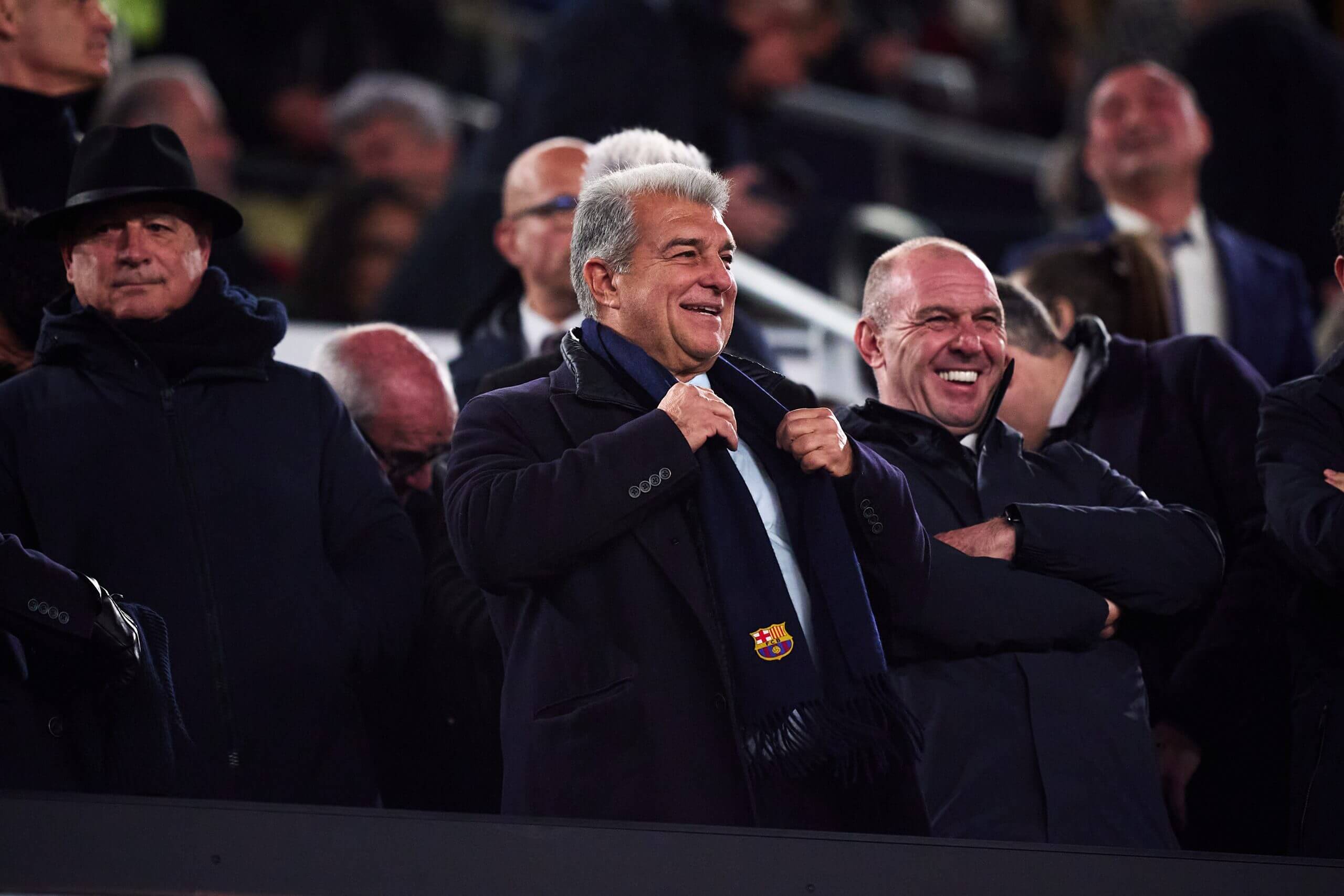
Laporta in the stands at the Camp Nou in December (Pablo Rodriguez/Quality Sport Images/Getty Images)
Candidates must have been club members for a minimum of 10 years, and they also need to reach a certain number of supporting signatures: at least half the total votes cast in the most recent annual general assembly. For the purposes of this election, they will need around 2,300.
Each Barca member can only sign to support one candidate. Any former player or manager, meanwhile, also needs to have spent a minimum period of two years out of Barca before being eligible to run.
There is a big chance that not all members who launch campaigns to stand as candidates will be able to do so. At the most recent elections in 2021, only Laporta, Font and Toni Freixa stood. Five others had declared their intentions to run.
When the date of the election is announced, hopeful candidates have seven working days to present the supporting signatures they need. After that, campaigning officially starts.
According to the latest numbers released by Barca in October, there were 112,313 club members with a right to vote. This figure will be revised and updated when the elections are officially announced.
For the 2021 vote, Barca set up multiple stations around Catalonia in order to facilitate participation. They are considering a similar plan for 2026.
Who will be the candidates?
We have four pre-candidates for now. Laporta will be up for re-election, and is the favourite to win.
The 63-year-old returned for a second tenure as president when he won the elections of March 2021. He took over with the club in a pretty sorry state, one which essentially forced Josep Maria Bartomeu into resigning in the previous October.
It would be hard to argue against the idea that, on the pitch, Barcelona have not dramatically improved since then. They won their first La Liga in four years in 2022-23, and last season claimed a domestic treble while also reaching the Champions League semi-finals — again their best run in the competition since 2019.
Off the pitch, the desperate situation of Barcelona’s finances has still not been fully fixed. It is hard to blame that on Laporta entirely, but critics have pointed out the short-termism of the economic policies that have allowed for renewed investment in the playing squad in recent seasons — including those infamous levers. Others have found fault with the delays and ballooning costs of the Camp Nou redevelopment.
Laporta’s populist style goes down well with the Barca members who enjoy his combative and colourful charisma, but there are still major problems. The club’s debt is the largest in world football at around €1.45billion and they have had difficulty meeting La Liga’s spending rules.
Font, 53, is perhaps the best-placed opposition candidate as things stand. He was the runner-up in 2021, winning 16,679 votes to Laporta’s 30,184. When he formally announced his intention to run for the presidency again, Xavi, who was sacked by Laporta’s board at the end of 2023-24, attended his launch event in a show of support.

Font (left) at a tennis event in April (Pedro Salado/Getty Images)
Xavi Vilajoana, 52, was a pre-candidate back in 2021, and has already announced his intention to run again. He is a former La Masia graduate who played for the club’s third team back in the 1990s, also featuring for local lower-league sides.
He is probably best known for being a former club executive under the presidency of Josep Maria Bartomeu, but he first entered Barca’s setup back in 2003, during Laporta’s first tenure as president, to get involved with the futsal team. From 2019 to 2021, he was the executive in charge of Barca’s youth academy.
This week, another pre-candidate entered the mix. Marc Ciria, a 46-year-old local economist and businessman, will be in the running for the first time. He was an advisor to Laporta’s 2015 candidacy — one they lost to Bartomeu. He has built something of a media profile in recent years, with his commentary on Barca’s finances.
History tells us that all of Laporta’s rivals have got their work cut out. No serving Barca president has ever been beaten at re-election in the club’s entire history. A split in the opposition plays into Laporta’s hands, too.
But next year will most likely be the last elections with Laporta as a candidate.
Any Barca president is only allowed two consecutive terms — they can’t do three in a row. Laporta would need to let another president come in for their five-year term before returning for another go in 2031. He would only be 69 but, two weeks ago at La Vanguardia’s media event, said he was “not planning” on doing that as he “might be too old”.
Why is Messi still important?
Laporta does look like he is in a strong position to be re-elected, but another problem for him is his relationship with Messi.
In his presidential campaign four years ago, Laporta made use of his past relationship with Messi to label himself as the president that would guarantee the Argentina international would stay at Barca.
Less than a year after he was elected, Messi left in tears after he was told the club could not afford his contract extension. His relationship with Laporta has been broken since.

Messi announced his Barcelona departure in August 2021 (Eric Alonso/Getty Images)
The fact Messi could not be given a proper farewell (there were restrictions regarding the Covid-19 pandemic back then) is still a sore point for the Barca fanbase. While Laporta is still in charge, it seems difficult to see any sort of reunion happening. That is something that will certainly be exploited by opposing candidates.
At least one of Laporta’s rivals has already been in touch with the Messi camp. Sources close to the 38-year-old insist he has no intention of becoming involved in any campaign. But last month, his clandestine trip to the Camp Nou sent a message with a clear political meaning.
The fact that Messi chose to visit the stadium out of the blue, without contacting Barca in any way, was on one side read as a show of love for the club. It was also a hit on Laporta. In a sense, it has thrown a lifeline to all the other pre-candidates. If they want to attack Laporta, here they have a narrative they can use, one that will easily get fans on board.
Even if the Messi factor could potentially destabilise Laporta’s position of strength, there has been no sign of him wanting to engage in a deeper political battle.
Despite that, however, his name will be heavily used in every debate over the coming months — with the fun just getting started.