Santa Claus may or may not have a rally in store for this high-flying AI stock.
Nvidia (NVDA +0.37%) appears to be about to do it again. The chipmaker has delivered big gains in all but two years since 2014. Its shares are up more than 35% year-to-date, with only three and a half weeks remaining in 2025.
Should you buy Nvidia stock hand over fist before the end of the year? Here’s what history suggests.
Today’s Change
(0.37%) $0.67
Current Price
$183.08
Key Data Points
Market Cap
$4433B
Day’s Range
$182.52 – $185.69
52wk Range
$86.62 – $212.19
Volume
1.6M
Avg Vol
190M
Gross Margin
70.05%
Dividend Yield
0.03%
Happy holidays?
Stocks, in general, tend to perform well near the end of the year. December ranks as the third-best month for the S&P 500 (^GSPC 0.08%) since 1950. Only April and November have higher historical average returns.
There’s also a phenomenon called the Santa Claus rally. These stock market surges occur during the last five trading days of December and the first two trading days in January. Santa Claus rallies have occurred in roughly four out of every five years.
Why does the holiday season bring cheer to investors so often? One potential explanation is that tax-loss harvesting typically wraps up by mid-December. The theory is that once this selling pressure eases, stocks are more likely to rise.
Another suggestion is that institutional investors often take vacations in late December. This allows retail investors to have a greater impact on stock moves. Additionally, some retail investors have more money to buy stocks thanks to year-end bonuses.
Image source: Nvidia.
Nvidia’s December track record
Has Nvidia typically participated in the late-year festivities? I examined the chipmaker’s December performance since its IPO in 1999 to find out.
As the chart below shows, there has been no clear pattern in how Nvidia’s stock performed during December in past years. The average historical gain for the month has been 3.2%, while the median gain is a little lower at 2.6%.
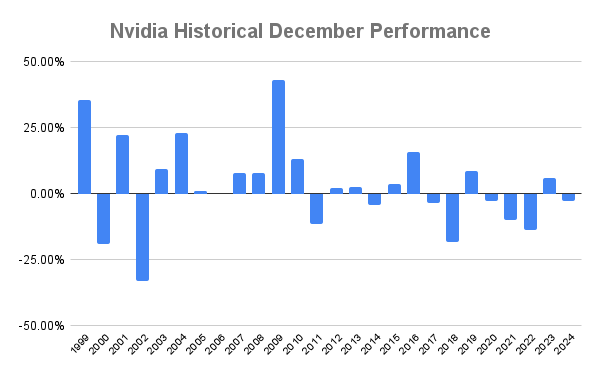
Data source: YCharts. Chart created by author.
You might have noticed that most of the years when Nvidia delivered its biggest gains during December all occurred before 2010. Some of the stock’s greatest losses also happened during this period.
However, if we limit the lookback period to the last 10 years, the likelihood of a year-end surge for Nvidia is even less encouraging. The GPU stock fell half the time, including two years with double-digit percentage losses in December. Nvidia’s average return during the last 10 years was a loss of 1.7%. Its median loss during the period was 2.7%. As it turns out, December ranks as Nvidia’s worst month over the last decade.
Is there a simple explanation for why Nvidia’s December performance has been sub-par? Maybe. It’s possible that investors took profits off the table. After all, Nvidia has typically been a big winner in recent years.
This could also explain a broader pattern. Bank of America (BAC +0.18%) found that the tech sector has historically delivered some of the lowest returns of any sector during the month of December, despite generating the greatest gains during most full-year periods.
Think bigger
History suggests that Nvidia won’t be a big winner before the end of 2025. Does that mean you shouldn’t buy the stock hand over fist? Not necessarily.
It’s not a good idea to focus solely on a single month when buying any stock. Think bigger than that. Focus on the stock’s long-term prospects.
In Nvidia’s case, those long-term prospects look quite promising. The skyrocketing demand for artificial intelligence (AI) applications continues to drive growth in the data center market. This serves as a huge tailwind for Nvidia, with the company’s GPUs remaining the top alternative for developers building, training, and deploying AI models.
We’re still in the early innings of AI adoption. Agentic AI is only beginning to hit its stride. Multiple companies are working to develop artificial general intelligence (AGI) and AI superintelligence (ASI). Mass-market AI-powered humanoid robots could be on the way.
Nvidia should benefit from all of these trends. Buying the stock hand over fist could be a smart move, but there’s no urgent reason to do it before the end of 2025.