The B.C. government is issuing new guidance for physicians when it comes to treating youth with overlapping cases of mental health and substance use challenges, clarifying the use of involuntary care in the process.
In a guidance document issued Friday, the province directs physicians to notify parents, and potentially involuntarily detain youth if they’re unable or unwilling to seek care themselves.
It follows updated guidance of involuntary care for adults with severe cases of mental health and substance use disorders, issued earlier this year by Dr. Daniel Vigo, the province’s chief adviser for psychiatry, toxic drugs and concurrent disorders.
At a press conference on Friday, Vigo, Premier David Eby and other officials were joined by parents who have lost their children to drug overdoses.
“To put it bluntly, we should only do this [involuntary care] if the brain or the life of the child is seriously at risk,” Vigo said.
“But if that is the case, then we should not hesitate and we should always involve the parents or guardians in planning next steps.”
Under the previous directions, Vigo explained that an articulate 15-year-old who’s a drug user could have been assessed as a “mature minor.” A mature minor is someone under 19 who makes their own health care decisions independent of their parents’ or guardians’ wishes.
But that is no longer the case, he added.
Vigo says many of his physician colleagues interpreted the Mental Health Act — which allows for involuntary care — differently when it comes to whether they could admit a child against their will if the parent asks them to.
“Many of my colleagues … sincerely thought that they couldn’t use it at the request of the parent,” the adviser said.
“And now I’m clarifying that yes, we can and yes, we should, when there’s a medical indication for it — which is a kid who has developed a dependence to opioids and is at risk of, you know, death, brain damage.”
While toxic drug deaths are trending downward in B.C. as a whole this year, the latest numbers from the B.C. Coroners Service show that 21 youth under 19 died from illicit drugs from January to October this year.
That’s up from 17 youth who died in the same timespan last year.
Since 2016 — the year B.C. declared a public health emergency due to toxic drugs — 222 people under 19 have died to illicit drugs.
Parents speak out after son died in 2018
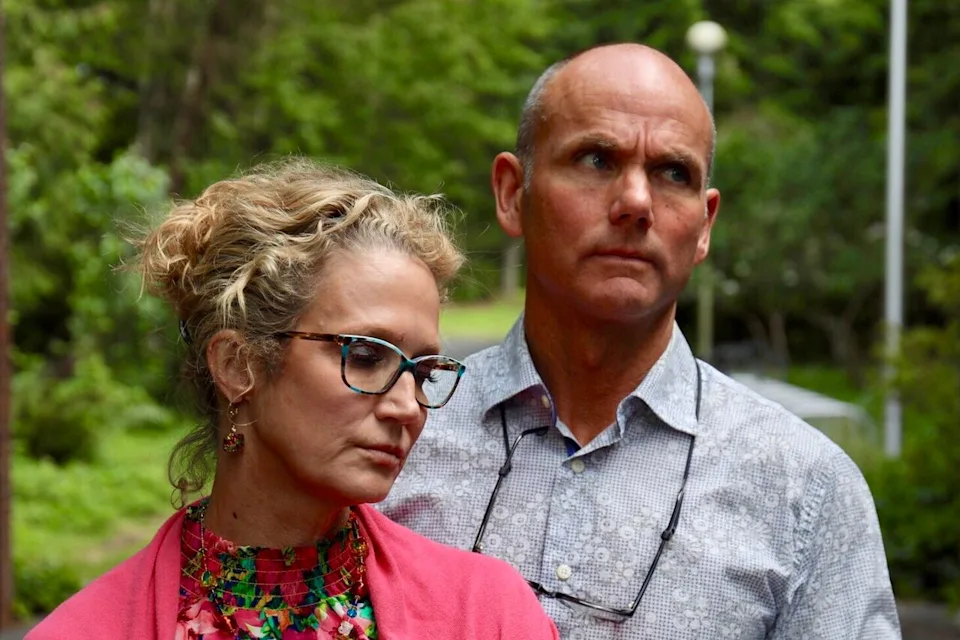
Among the parents who spoke at Friday’s event were Brock Eurchuk and Dr. Rachel Staples, whose 16-year-old son Elliot Eurchuk died of an opioid overdose in April 2018.
A coroner’s jury that looked into Elliot’s death ruled it was accidental, and recommended better detection, treatment and transition plans for youth struggling with mental health and substance misuse in schools.

Rachel Staples, left, and Brock Eurchuk, right, are seen in June 2019, reacting to a jury’s recommendations after a coroners inquest into the death of their son. (Mike McArthur/CBC)
“Elliot was in care in a hospital for over a month, and the caregivers were completely detached from Elliot — and Rachel and I — in terms of giving us advice and helping us,” Eurchuk said.
“And I think it was out of fear that they were in a legal environment that they could be in trouble for sharing with Rachel and I medical information about Elliot — that Elliot, at 15 and 16, said, ‘I don’t want my parents to have any of this information.'”

Rachel Staples and Brock Eurchuk are seen with pictures of their son, Elliot, who a jury heard took to taking drugs after a sports injury. (Gregor Craigie/CBC)
Advocates concerned
A previous push to expand the scope of involuntary care for youth drug users was scrapped by the province in 2022, over concerns that youth would be at greater risk of overdose once they left treatment.
Dr. Ryan Herriot, co-founder of Doctors for Safer Drug Policy and a family and addictions physician in Victoria, said that in his experience, parents who have had their child involuntarily admitted due to drug use are often left disappointed in the results.
The new guidance, he said, “amounts to a bold and dark experiment, frankly, on young people and with likely disastrous consequences that might be felt for years and years to come.”
Leslie McBain, who founded the Moms Stop The Harm advocacy group after her 25-year-old son Jordan died from opioid overdose in 2016, said that there needs to be careful consideration when it comes to how involuntary care is used for youth.
She said that the government should focus on scaling up voluntary treatment, counselling and after-care services instead of focusing on involuntary care.

Leslie McBain, co-founder of Moms Stop the Harm, says there needs to be an expansion of voluntary care instead of a focus on involuntary care. (Mike McArthur/CBC)
“The evidence shows that involuntary care doesn’t work for … reasons of a mistrust in the system, broken relationships with family,” she said.
“I know with my own son, who did die from an accidental prescription drug overdose, if he had been involuntarily held, that would have been a disaster for me.”