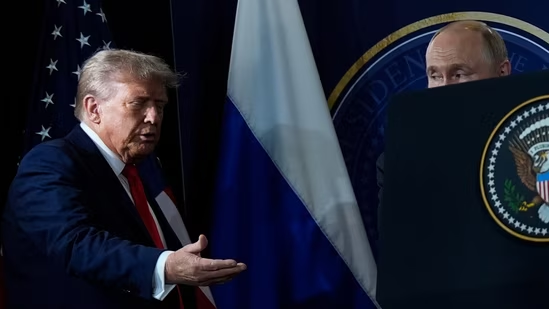
Of the many things Donald Trump has brought about, is the world witnessing a resumption of nuclear tests too? The US President’s assertions ever since he began his current term early this year have drawn a response from the other global powers, such as Russia, heightening fears of a new nukes race.

In short, with the US and Russia both threatening to resume nuclear testing, the global norms against such tests face a mega-ton challenge.
But the ramifications go way beyond, even drawing in South Asian nuclear powers such as India and Pakistan, the far-from-friendly neighbours who were engaged in military hostilities as recently as mid-2025.
What Trump, Putin have said
Trump said in a post on his Truth Social social network at the end of October: “Because of other countries’ testing programs, I have instructed the Department of War to start testing our Nuclear Weapons on an equal basis. That process will begin immediately.” He was implying other countries’ actions forced his hand.
Not unconnected is the fact that he has renamed the Department of Defense to Department of War — all this while insisting he stopped wars, including a “very possible nuclear war between Pakistan and India”.
Moscow quickly responded. President Vladimir Putin told his Security Council: “Russia would be under obligation to take reciprocal measures.”
He mentioned the Comprehensive Nuclear-Test-Ban Treaty (CTBT).
When were tests conducted in the latest?
- The US conducted its last nuclear test in 1992.
- Since 1996, only 10 nuclear tests have been conducted by three countries: India, Pakistan and North Korea, who never signed the CTBT and have faced sanctions for testing.
- The vast majority of nuclear tests — approximately 2,000 — occurred before 1996, mostly by the US and the Soviet Union.
What happens to treaty against nuclear testing?
It’s been nearly eight decades that concerns about the negative effects of nuclear weapon tests peaked in the 1950s, after the US and Soviet Russia carried out multiple tests in the atmosphere.
A limited test ban treaty was negotiated, which said underground tests were still fine. It took another decades to ban all nuclear tests with a comprehensive treaty adopted by the UN General Assembly in 1996.
But there remains a hitch.
Even when 187 states signed the treaty — and 178 ratified it — it remained only a norm. For the treaty to officially take effect, 44 specific states, listed in an annexe to the treaty, must ratify it. Nine of them have not yet done so.
These include the US, besides China, Egypt, Iran and Israel.
India, North Korea and Pakistan neither signed nor ratified the treaty. Pakistan’s first public test of nuclear weapons came in 1998. It was a direct response to India’s second nuclear test the same year.
What about Russia, then? It had signed and ratified the treaty, but revoked its decision in 2023, citing an “imbalance” and “the current international situation”.
A Comprehensive Nuclear-Test-Ban Treaty Organisation is headquartered nonetheless in Vienna. It detects nuclear tests worldwide, operating 307 monitoring stations.
Who has how many nukes?
- The global nuclear arsenal has come down from a high of 65,000 bombs in the late 1970s to less than 12,500 today, as per a report in The Hindu.
- There were concerns initially that at least two dozen states would get nuclear weapons, the official total number of countries with atomic bombs is nine.
- Of the nine, five (US, Russia, UK, France and China) are permanent members of the United Nations Security Council. All of them tested before the non-proliferation treaty (NPT) came into being.
- Four others developed their nuclear arsenals later: Israel, Pakistan, India and North Korea, said the report.
How India and China could profit if n-tests resume
Analysts link the US and Russian decisions with India and China, even Pakistan.
Daryl Kimball, executive director of the Arms Control Association in Washington, told news agency PTI that a resumption of US atomic tests would “open the door for states with less nuclear testing experience to conduct full-scale tests that could help them perfect smaller, lighter warhead designs.” This would “decrease US and international security,” he said.
Joseph Rodgers, fellow at the Washington-based Centre for Strategic and International Studies, said states such as China or India stand to profit. “It makes more sense for them to test” than it does for the US or Russia, Rodgers opined.
China and India have officially not said anything about any plans for resumptions.
As for Pakistan, Trump recently said it was possibly Islamabad was testing nukes in secret.
Not all atomic tests create explosions
The White House has so far not clarified what kind of tests Trump meant and what other countries he was referring to in his statement. US Energy Secretary Chris Wright even said the new tests would not include nuclear explosions.
There are two types of tests: The type banned under the treaty are so-called supercritical tests, which create an explosion. These tests give a nuclear yield, which defines a weapon’s destructive power.
In contrast, subcritical nuclear experiments produce no self-sustaining chain reaction and no explosion. Nuclear weapon states, including the US, conduct these experiments routinely without violating the treaty.
Hydronuclear tests with extremely small yields conducted underground in metal chambers are “undetectable” by the treaty organisation’s monitoring system, say experts. The organisation’s monitoring network successfully detected all six atomic tests conducted by North Korea between 2006 and 2017.