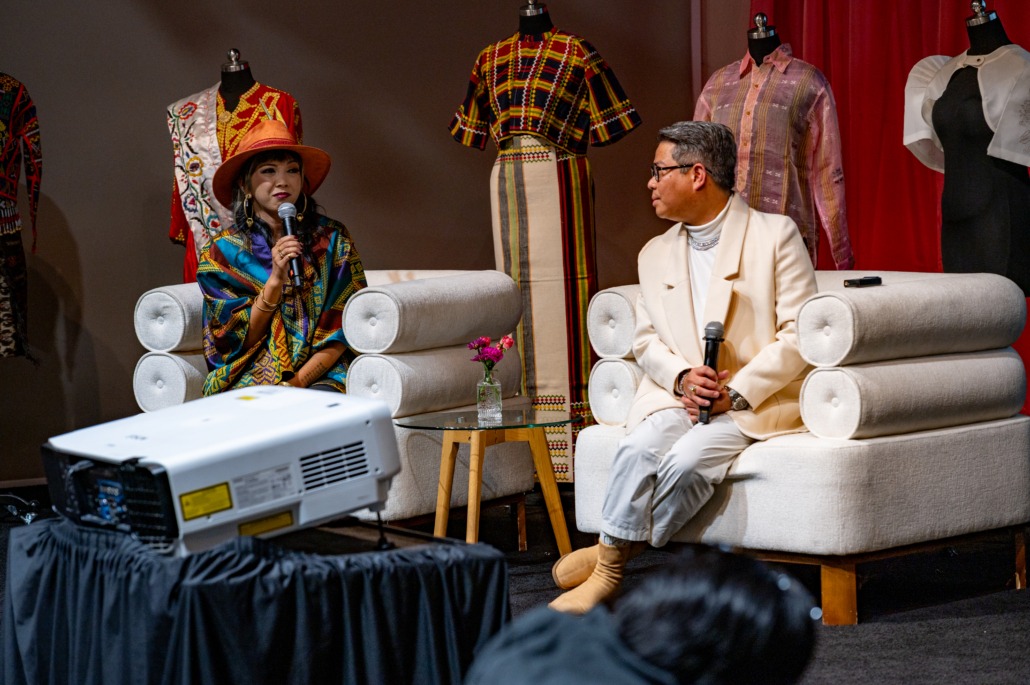
Long, white gowns adorned with silver flowers, light pink trench coats stretched to the calves and puffy cream skirts complemented by stiff black bows were just some of the items showcased at “Threads of Identity: Telling Filipinx American Stories through Fashion,” an event organized by USC Visions and Voices at the USC Pacific Asia Museum on Saturday evening.
In conversation with moderator Eleanor Lipat-Chesler, co-founder of Ube Arte — a collective of musicians, dancers and academics with a mission to advance Philippine cultural research — designers Marybelle Bustos and Puey Quiñones discussed how they broke into the fashion industry and beyond.
As a first-generation immigrant, Puey Quiñones, a fashion designer who won the “People of the Year” award from People Asia in 2024, said he stumbled into the fashion industry after coming to the United States and working under seamstresses. Experimenting with extra fabric scraps, swatches and a spare sewing machine, he soon found his passion for the work and landed a job with his boss’ recommendation.
Daily headlines, sent straight to your inbox.
Subscribe to our newsletter to keep up with the latest at and around USC.
“Coming from a very humble beginning, I was kind of hesitant to tell [my boss] or my friends that I wanted to become a fashion designer because I believed that fashion is only for the rich people, and I wasn’t,” Quiñones said.
According to Quiñones, his documentary, “The World’s Most Fashionable Prison” (2012), was his greatest achievement in fashion. In the documentary, Quiñones taught inmates about art, fashion and design, finding meaning in giving back to a community without the resources to improve their lives.
“It’s not only about sharing my talent, it’s about giving chances to the people who need them,” Quiñones said. “We’re all human beings that make mistakes, and we deserve second chances.”
Through a different project, Quiñones designed and manufactured protective personal equipment, precautionary yet fashionable clothing donned to prevent contamination during the COVID-19 pandemic.
“Fashion is not all about glamor, and you have to be creative with how you can help the community, especially in times of crisis,” Quiñones said.
In joining each other for a final discussion, both Quiñones and Bustos discussed the Filipino weaving industry, which draws from long-established indigenous practices. Each highlighted the tension between business and cultural preservation.
“It’s important for us to support the weavers and these artisans, to encourage them to continue the craft. With commercialization of fashion and fast fashion, the craft is starting to die. The youth is losing interest,” Bustos said.
Quiñones approached the subject from a different angle, highlighting the importance of using new technology to modernize the industry while maintaining a dedication to cultural practices.
“The best idea is to globalize the design of the [weavers]. Especially in the South [Philippines], they’re very conservative and sensitive because what they do is very spiritual for them,” Quiñones said. “We can preserve the culture and tradition, but at the same time, to make a living, we have to create a different department.”
To the artisans of “Threads of Identity,” fashion is not only a form of creative expression but also a mode of cultural preservation.
After pursuing a diverse career in costume design, product development, music video styling and international sales, Bustos, a Filipino American fashion designer, established Bárû Mu, a project combining storytelling, sustainability and cultural awareness. The company sells barong hoodies, traditional garments that draw from the bárû — a blouse top that translates directly to “clothing” or “new.”
“[The bárû] has a complex history, but it’s evolved through each generation. It used to be made with pina and natural fibers, but it’s been evolving,” Bustos said. “Because of our community here, they wanted something more easy to wear every day. I [was] like, ‘Let’s make a hoodie.’”
In the exhibition, Bustos styled her family members, who modeled in the show wearing her signature garb and later gathered to take photos together.
“It’s so important that I am dressing them. They’re my inspiration. They’re my muses,” Bustos said in an interview with the Daily Trojan. “I want to release things that make them feel proud to wear [the items], and it’s a part of their identity. I didn’t grow up with anything like that, so it’s nice to create something like that for the next generation.”
Following the discussion was an exhibit showcasing the works of both designers and featuring Ancestral Vision Movement, a Los Angeles-based dance group fusing traditional Filipino folk dance with hip-hop. The dance group’s intimate movement, seductive solo moments and symbolist clothing engaged audience members in a tight-knit performance.
After the Q&A portion, models stalked from the museum’s stairwells and down a small runway, catwalking to thumping music with morrocos and cymbals or songs such as “Halo” by Beyoncé and “Night and Day” by Frank Sinatra. Dancers then took to the platform in between fashion segments, showcasing a more agile fashion demonstration.
Pulling people from the crowd, one dancer from the troupe offered how “we all have threads of identity” and asked audience members to talk about where their clothing originated from. The selected individuals then walked down the runway one by one.
Daniela Chico, a senior majoring in cinema and media studies, said that events such as these were important for the community to learn about different cultures and garner greater Filipino representation.
“Fashion is a very big reflection of the place that you’re from, and the resources that you have,” Chico said. “It’s also a very big signifier of your socioeconomic status … Fashion’s always been a big part of culture, and it tells stories that films or paintings can’t tell.”