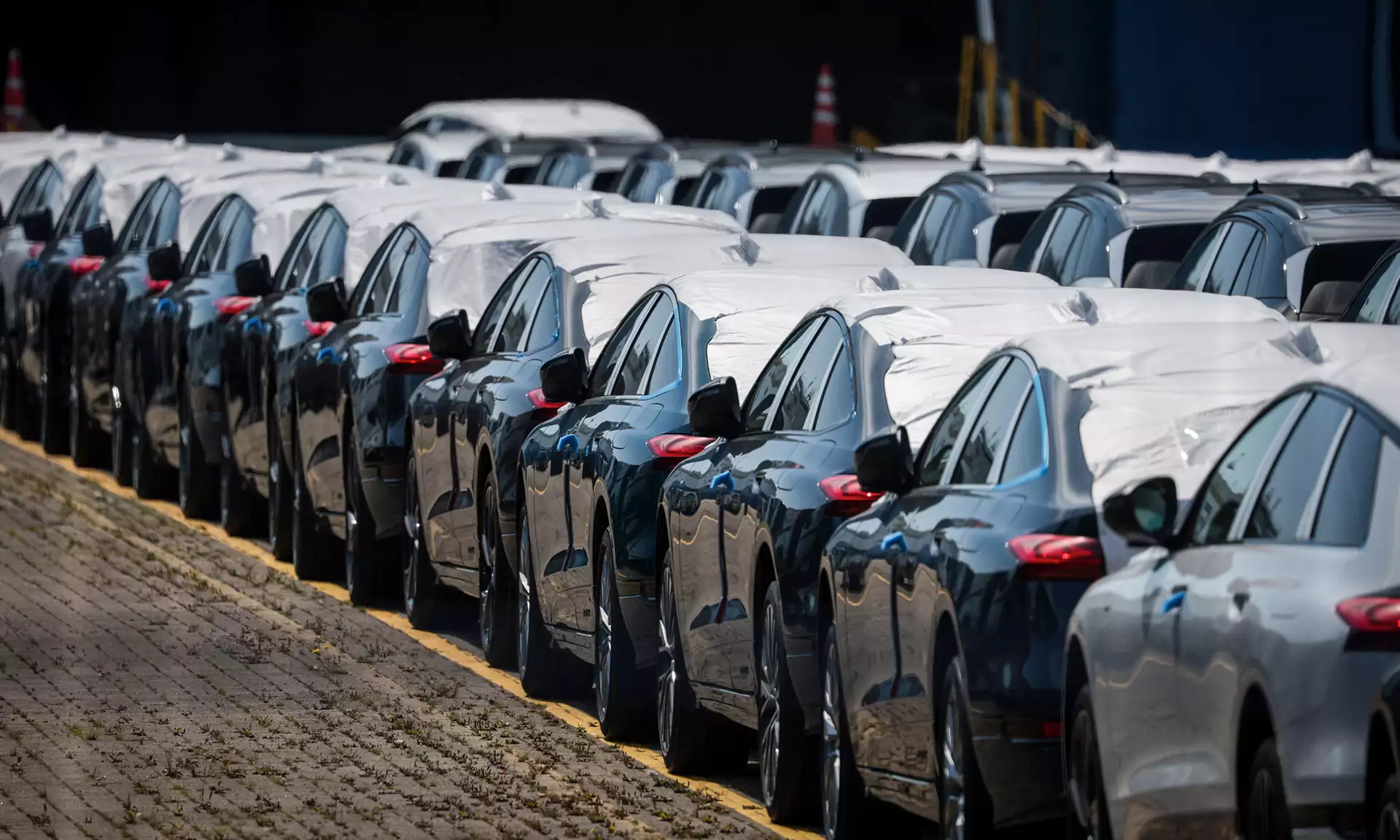
Electric vehicles (EVs) now account for around half of the Chinese new-car market, but sales remain vulnerable to changes in government policy, leading to market volatility. After a slump in early 2025, China’s sales of new energy vehicles (NEVs) have accelerated throughout this year, thanks to lower prices and a rush to beat upcoming changes to government incentives. As a result, EIU has revised upwards its EV sales forecasts for 2025 and downgraded its forecasts for 2026-27.
In September 2025 NEV sales- comprising battery electric vehicles (BEVs), plug-in hybrids (PHEVs) and fuel-cell vehicles (FCEVs) – grew by 15.5% year on year, to about 1.3m units. This helped to drive a 6.6% expansion in the overall new-passenger car market, according to data from the China Passenger Car Association (CPCA). When taken together, China’s NEV sales in the first three quarters of 2025 were up by about 24% year on year, to some 8.9m units.
Based on this, EIU will revise its NEV forecast for full-year 2025 to 13.8m units, implying a year-on-year increase of 22% over 2024 levels. In the last three months of 2025, NEVs’ growth momentum is likely to remain strong, as green-car buyers are bringing forward their purchases ahead of a planned reduction in government incentives for NEVs, starting in 2026.
Eligible NEVs in China are currently exempted from the 10% vehicle purchase tax of up to Rmb30,000 (US$4,217), which is applicable until end-2025. However, the tax-break will be halved to Rmb15,000 for new NEVs bought in 2026-27.
Further, the car trade-in scheme, which offers NEV buyers a subsidy of up to Rmb20,000 for scrapping an old internal combustion engine (ICE) vehicle, is also likely to expire at the end of 2025. Some provincial governments have already suspended the trade-in scheme in the course of this year owing to lower availability of funding.
All these factors bode badly for sales in 2026. Given a likely surge in NEV sales before the end of 2025 and lower government support for NEVs, we will cut our full-year forecasts for 2026 and 2027 to 14% and 3%, respectively, from previously expected levels of 16% and 5%. Based on these revisions, the five-year compound annual growth rate for NEV sales in China will fall from 12% to 8%.
Automotive outlook 2026
The global automotive industry enters 2026 under pressure. Trade tensions, tariff shifts and regulatory uncertainty are compounding the sector’s EV transition, forcing automakers to rethink production, pricing and market strategy. While EVs remain the fastest-growing segment, protectionist policies and supply chain reconfiguration will test resilience and profitability across key markets.
Download the summary report for a global view of automotive risks and opportunities in 2026—from Chinese OEM disruption to regional sales forecasts, EV affordability, and policy risk.
Join us on February 3 for our live webinar, where EIU analysts will explore the factors reshaping the industry—from tariff trends and localisation strategies to demand outlooks and the future of EV incentives.