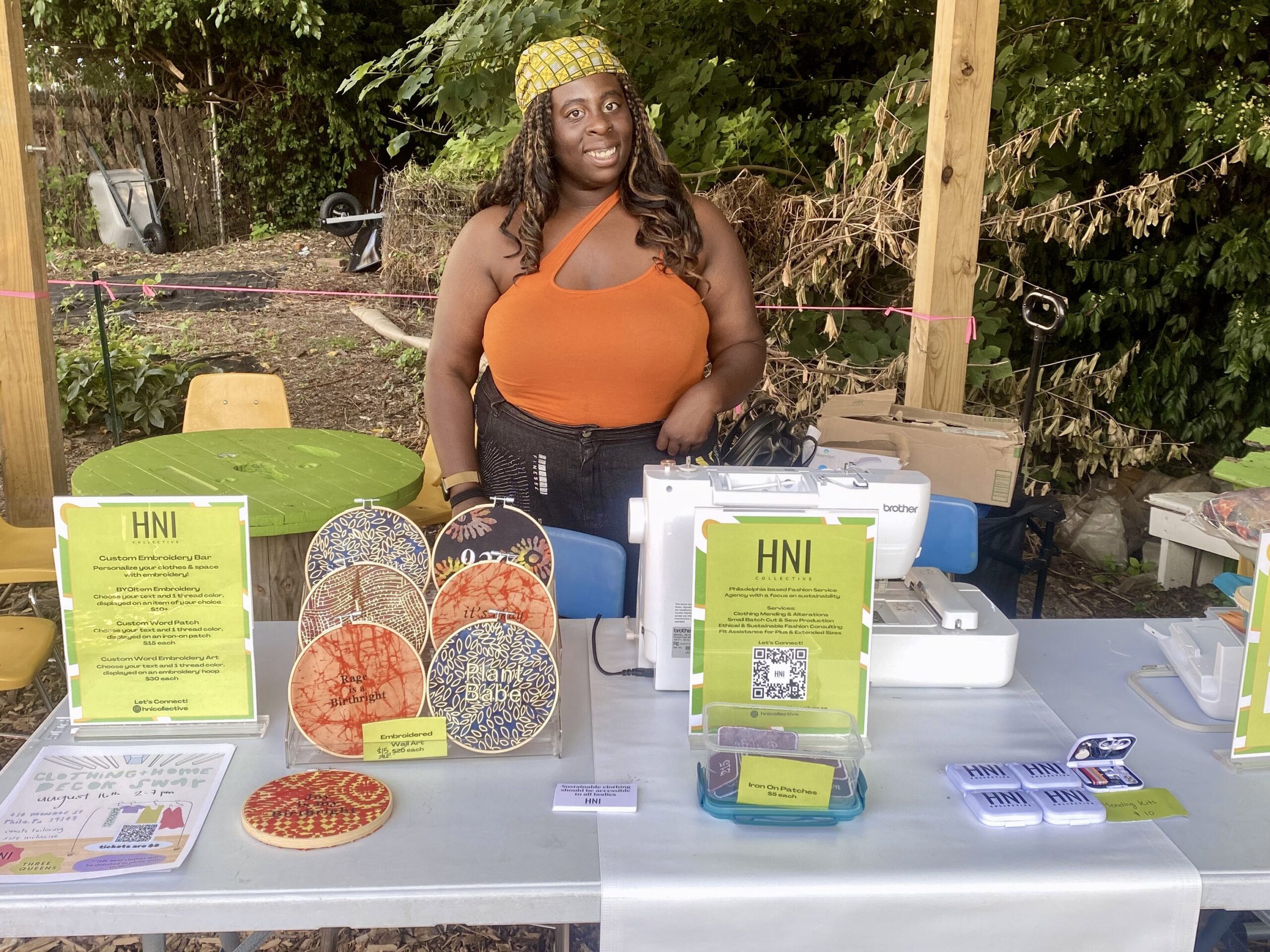
Itohan Asemota at a pop-up with her small business, HNI Collective. (Photo provided by Asemota)
In mid-October, Germantown local Itohan Asemota announced on Instagram that her small business, HNI Collective, had been included in Billie Eilish’s Sustainable Fashion Guide, which accompanies the pop star’s ‘Hit Me Hard and Soft’ Tour on her website.
“I thought it was a scam…” Asemota joked, giving GIH her initial reaction to learning the news. But she said the inclusion is a lesson to always be on your Ps and Qs because you “never really know who’s watching.”
The guide allows folks at each participating tour city to engage in fashion more consciously in a curated selection of secondhand shops, sustainable brands, and community repair spaces. It was curated by BLACKPEARL, a cultural sustainability agency.
Altogether, there are 27 picks on the Philly list with four in the Northwest — three in Mt. Airy and Asemota’s repping Germantown.
Other Northwest Shops within the Guide
HNI Collective is a mobile fashion service agency, focused on sustainability and size inclusivity. “I provide a variety of services… basically ensuring that things people love stay with them,” she said.

The Passion-for-Fashionaire has called Germantown home for the past eight years and says the greenery and community feels keep her grounded here. She got to the neighborhood after attending what was Philadelphia University, now Jefferson University, for fashion design.
And it was there, while learning the general process of how clothes are made, that Asemota began to see a clear need to blend her passion for fashion with a stride for sustainability.
She said: “…I just started to see how much waste was being produced… that’s now even thinking about what a small business is making or even what a company that makes fast fashion would make.”
Following her announcement, GIH spoke with Asemota for a quick Q&A about sustainable fashion.
Q: What is sustainable fashion to you?
Itohan Asemota: “Yeah, so I guess in an umbrella term, sustainable fashion to me is clothing that is made to exist for a good time and a long time… so it’s like in a perfect world it would… it’d be clothes that are made from like non-synthetic fabrics. The cottons, the linens, things of that sort, the wools… But then that could also mean, you know, things that are secondhand because like those are… things are getting multiple life cycles because, you know, multiple people are wearing them.”
Q: Why is this an important topic to be talking about, specifically in 2025?
IA: “I mean, I feel like it’s an important topic to talk about in 2025 because we all wear clothes. Like the short end of it is we all wear clothes… So how you treat and maintain and even have or even think of a relationship with the clothes you have does matter.”
Q: Do you find that when you are doing these pop-ups, people are usually familiar with the concept of sustainable fashion?
IA: “It all depends. Like some of them are and some of them aren’t. It’s almost like a 50/50 situation. Usually no matter how much I advertise, like where I’m going to beforehand, 90 percent of the clientele who walks up to me at my booth have no idea what I do or no idea that here are people who like actually repair clothes — which is like a whole thing in itself because people just don’t get clothes repaired anymore.
Like people legitimately don’t consider like repair as a form of sustainability or like something that is even like possible. You’ll be surprised at things that people give me that are like, ‘Oh, like I’m not sure if this is possible to fix…’ it’s just like a button is slipping off and I’m like…”
Q: What are some things that people don’t necessarily associate with sustainability around fashion that might surprise them?
IA: “The most tangible way is to talk about the environment… it just started getting cold and it’s late… in October. That’s not normal. I feel like… a major thing that people don’t consider in the conversation of, you know, climate change and the climate crisis that we have is clothing. A lot of the clothing that is made today is made out of polyester.
Polyester is literally made from oil. So those clothes are literally sitting in landfills for 200 plus years because that’s how long they take to break down… But we’re having mountains of clothes of people who bought something once that was cute and then kept it moving. And now… they’re sitting in landfills… and it’s literally heating up the planet.”
Q: What would be your go-to for sustainable fashion in Germantown?
IA: “So my go-to thrift store is Bargain Thrift. I haven’t been there in a while… but the last time I was there was maybe a few weeks ago. And they just have a little bit of everything there. I’m generally anywhere between like a 1x to a 3x. And like, I can be able to find things over there… I’m also one of those people who like… one of my favorite sections in the thrift store is kitchenware.
Yeah, kitchenware, home décor… One of the things I use the most is literally a red crock pot that I bought like six years ago that I still use on a regular basis. And yeah, Bargain Thrift has a little bit of everything. So she’s that girl…
And I’ve also heard good things about Whosoever Gospel Mission on Chelten… so it’d be good to shout them out, too.”
Q: What do you think a local guide by a celebrity can mean to sustainable fashion, now and in the future?
IA: “I mean, ultimately, it just proves the level of class consciousness that we all have a society to be like, you know, actually I should start caring about this. I don’t mean to say I have to care about it as much as other people, but like, you know, maybe I actually should start thinking about like how I’m participating in things.
Because even for me, I’m an avid concert goer. I’m always going to shows. And have you ever seen what the aftermath of a concert or music festival looks like? It literally looks like a trash tornado has hit everything within a block radius.
So from that to like, literally seeing the pipeline of clothing items that go directly to the thrift store after a major concert is… it’s kind of absurd to see. Like when the ERAS tour happened.
Literally you can tell when the show happened because a month or two later from that date, there’s a whole bunch of sparkly things in the thrift store. You know, after Cowboy Carter, it took about like three months, but that’s all you needed to start seeing cowboy boots and shoes at all the Goodwills, chile.
Because like, even festival fashion is a demographic of a season. Because from, you know, individual artists’ world tours to music festivals, like Coachella and whatnot, here’s literally companies, like fast fashion companies, where all they’ll do is make clothes for that specific period of time and know that chances are [customers] are not going to be wearing a fringe vest forever.”
Q: Is there any piece of media that you would recommend that people read, listen to, or watch, to learn more?
IA: “Brandy Hellville is a good one. Ironically, me and my friend Ruby Gertz from Slow Fashion Academy, which is also based in Germantown, we did a movie screening of that like a… like almost a year ago at this point.
The True Cost is another good documentary to kind of just get an idea of the background of just general labor that’s involved in producing clothing and just getting an idea of the amount of waste that is included in, like, the fashion industry. That’s usually like, one of the default documentaries that people watch.”
Enjoying what you’re reading? From now through Dec. 31, Germantown Info Hub is raising $14,500 — and every gift is matched dollar-for-dollar through NewsMatch. Your support helps us keep reporting with our neighbors, not just about them. Give here.