Nate Delacruz finds Temple’s fashion encapsulates an entire spectrum of style that has little to no limits. During his sophomore year of high school, he took a risk with style and decided to begin dressing more in line with his aesthetic vision instead of chasing trends.
“You will never know who could be living in a city as deep as Philadelphia, so expect diversity and full expression,” said Delacruz, a junior advertising major. “That’s probably the biggest differences towards suburban colleges that have weaker diversity, where it feels like you must stick with the base trends.”
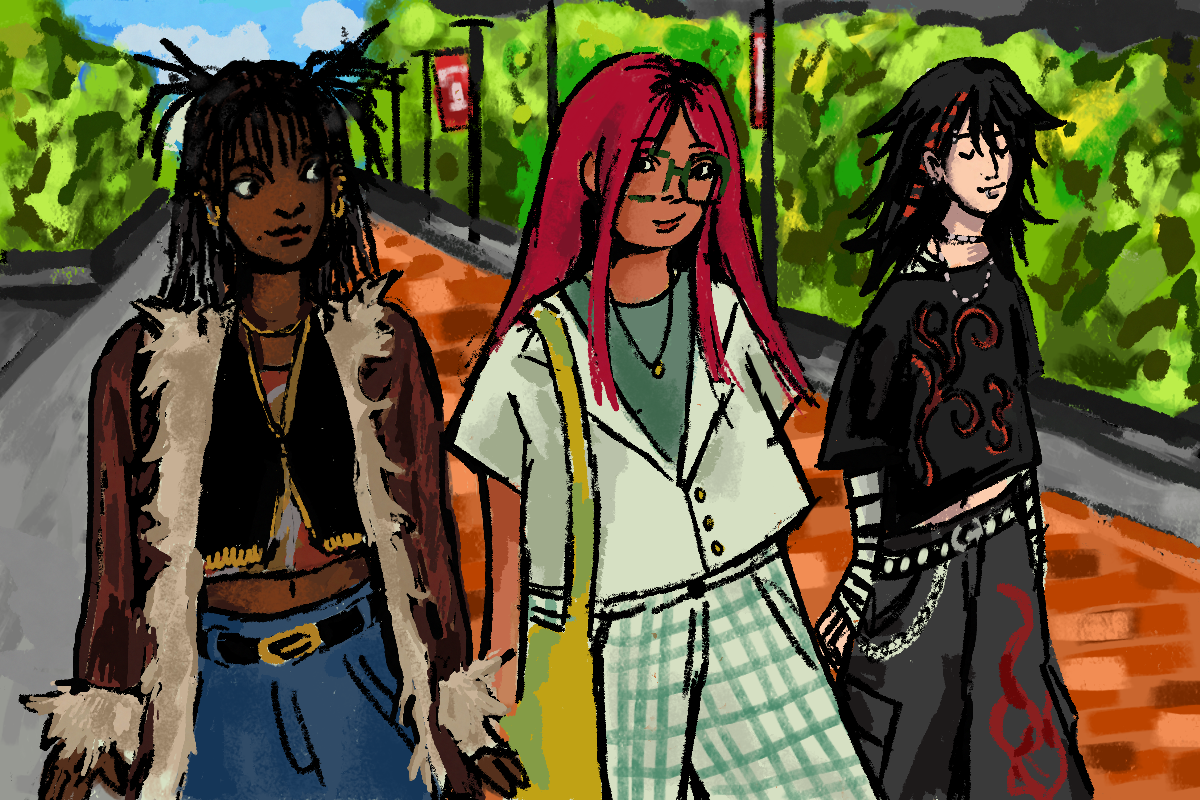
On Temple’s diverse campus, clothes are an expression of identity and way to establish a sense of belonging. From thrifted streetwear to cultural clothing, the student body creates a sense of style that challenges uniformity. Temple was even named America’s second most fashionable campus in an October 2023 study by Style Seat.
Fashion goes beyond looks; it can show who a student is and what they stand for. In an era plagued by clean aesthetics and minimalist looks, students should embrace diverse and creative fashion as a form of self-expression. Embracing this sense of fashion can signal rebellion against minimalism and belonging.
Feather Chiaverini, the residency director of the Queer Materials Lab, believes that self-expression is for everyone and taking some time to put effort into appearance is always worthwhile.
“I just think it’s nothing cooler than wearing what you want to wear. I think of like, I think of video games, and I think customizing your avatar,” Chiaverini said. “And I think when you’re in control of what you like, what you’re interested in, and you put it on, like, that’s you actively living your life how you want to live it.”
Philadelphia is a diverse city. Black residents make up more than 40% of Philadelphia’s population, 15% of people are Hispanic and 7.2% are Asian, according to the 2023 census.
Clothes can also help people connect with their community and embrace their own culture. There are traditional and ethnic clothing that express identity like kimonos from Japan, saris from India and kente cloth from Ghana.
Temple students reflect the city’s vast spectrum of identity through their clothing. They tend to blend practicality, sustainability, culture and individuality. Recognizing student fashion as more than surface-level helps to see the depth of expression and variety that characterizes the city.
Fashion might be often dismissed as a frivolous hobby but ignoring what students wear is ignoring who they are. Seventy-one percent of students say clothing is a primary they express their identity, according to a May 2024 study by the International Journal of Scientific Research.
Throughout history, fashion has been used as a tool for resistance and identity. Fashion activism is a powerful tool and a mechanism for students to reflect on what they stand for. During the Suffragette Movement in the early 1900s, women wore white to symbolize purity and to protest for their right to vote.
Minimizing the importance of clothing overlooks the personal and cultural significance; clothing has always carried meaning far beyond materialism because people have given it meaning and turned it into a form of expression.
Students can signal rebellion against minimalism and puritan culture by embracing certain fashion trends like the Y2K revival with the low-rise jeans, chunky boots and bold accessories. These trends don’t only bring nostalgia but convey messages of self-expression and individuality.
It’s important to pay more attention to remember that what people wear is a way to embrace individuality and represent possible values or creativity.
Students can showcase their priorities through fashion. Thrifting is an effective way for people to be sustainable and showcase opposition to fast fashion and overconsumption.
Many students at Temple are turning to thrift stores, secondhand apps like Depop or Posh mark, and clothing swaps as alternatives to fast fashion.
Lucas Garcia often thrifts his clothes as a way to avoid fast fashion and to express himself through better quality, one-of-a-kind pieces.
“I guess it’s sustainable if you’re buying something that’s already created, rather than buying something that needs to be created like fast fashion, I think fashion should be sustainable and good for the planet,” said Garcia, a junior global studies major.
Fashion isn’t superficial; it’s one of the clearest ways students communicate when words might fall short. It is important to remember that clothing is one of the first things people may notice when looking at others, students have the freedom to be able to express themselves how they choose through their sense of fashion.