Everybody has a horror story about a delayed flight. Of sitting on the tarmac waiting for a departure slot from air traffic control, or spending hours in the terminal looking mournfully at a departure board. Perhaps you’ve been delayed so badly that it involved staying overnight. That happened to me in Bari, Italy, in 2022, when the plane developed a technical fault and 150 passengers were deposited into arrivals at midnight with no plan and no hotel rooms.
Often delays are for more prosaic reasons, like bad weather. Last month I landed at Gatwick airport at midnight, three hours later than planned, due to storms in the Balearics. In the past year I’ve been delayed due to air traffic control strikes over France, been held up due to minor plane faults, or because there was a storm cloud somewhere on the south coast. The list goes on. To many regular travellers it feels as if delays are getting worse. But is that actually the case?
What is true is that there’s more British air traffic than ever before. In the first half of this year 141 million passengers travelled through UK airports, according to figures from the Civil Aviation Authority (CAA), the regulator. And this summer was busier than ever. The aviation stats agency Cirium says it was the busiest June to August on record, with 52 million people flying during that period, to destinations from Cape Town to Chicago and from Hong Kong to Helsinki. It’s only going to get busier: next year Eurocontrol, which looks after European air traffic control, is forecasting a 3.1 per cent growth in traffic, with more than 11 million flights to and from the Continent. British airspace, however, is not getting any bigger; neither are the airports — or at least, not yet.
Is crowded airspace to blame?
It’s true that there is increased pressure on European airspace. “We are now at traffic levels that have never been seen before across Europe, particularly on peak days,” according to Martin Rolfe, the chief executive of National Air Traffic Services (Nats), which looks after UK airspace, in an interview with The Times. “We can expect to handle about 8,300 planes a day on the busiest day in the UK. That’s just in the UK. It’s about 39,000 across Europe.”
The UK also plays an outsized role in European airspace: “In a tiny geographical area, nearly 25 per cent of European air traffic comes through the UK. Everything is working pretty much at capacity.”
The London airport system — made up of Heathrow, Gatwick, Stansted, Luton, London City and Southend — is also the busiest in the world, handling 60 per cent of the UK’s air traffic. Planes take off or land at Heathrow every 45 seconds, which means there are 1,300 aircraft “movements” every day. Which means that even with a 20-minute ATC outage, as Nats had in July, can mean hundreds of knock-on delays and cancellations.
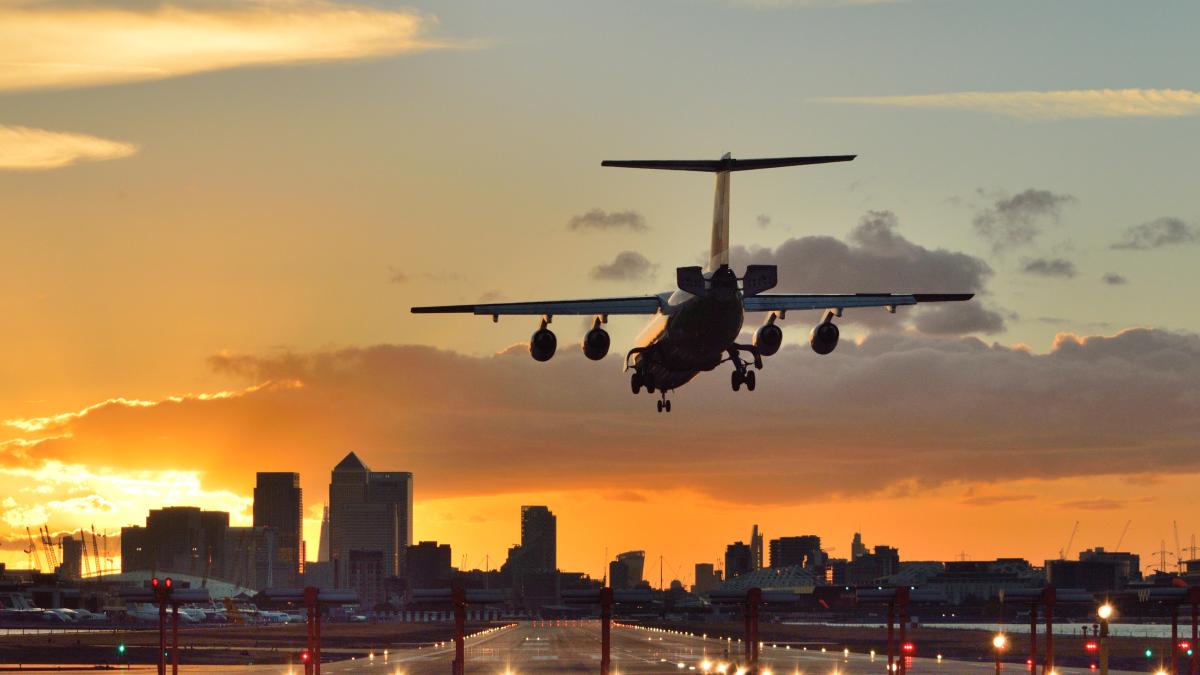
There is more British air traffic than ever before
GETTY IMAGES
“If you were to draw a line across from Birmingham, east to Stansted and then south down to Bristol, that whole area is the most complex in the world,” Rolfe says, adding that it’s even busier than the east coast of the US, which includes hubs such as New York JFK, Newark, Boston, Philadelphia and Washington DC. “It’s some of the safest airspace in the world, but it’s equally so busy that any delay ends up being a big deal.”
Other air traffic control issues are at play too. The war in Ukraine has “taken away probably 25 per cent of the airspace in Europe”, Rolfe says. “But it doesn’t just extend into Ukraine. There’s parts of Poland you can’t fly over any more. It’s quite a big chunk of airspace.” Flights from Europe to Asia are particularly affected, as they have to avoid flying over Ukraine and instead route south across Greece and Turkey. This can add up to seven hours to a return trip from Europe to Asia, according to the tracking site Flight Radar.
Impact of air traffic control strikes
Strikes by air traffic controllers can have an outsized impact on delays. While the October French ATC strikes were called off, Eurocontrol found that more than one million passengers were affected by the industrial action over two days in early July, with more than 10 per cent of all flights cancelled. French strikes have a larger impact on European operations as so many flights from the UK to Europe travel through French airspace.
Ryanair, Europe’s biggest budget airline, has been particularly outspoken in its criticism of air traffic control, setting up atcruinedourholiday.com with a league table showing which countries have the worst delays — plus a natty graphic featuring the EU chief Ursula von der Leyen.

Passengers have been affected by air traffic control strikes
GETTY IMAGES
Flight delays are getting worse
In September a Which? report, using CAA data, found that flights are more likely to be delayed this year than before the pandemic, leaving more than 15 minutes after the departure time.
The consumer champion ranked Tui the worst offender with just 59.2 per cent of flights being on time between May 2024 and April 2025, compared with 67.2 per cent in 2019. Tui was followed by Wizz Air (66 per cent this year compared with 66.8 per cent in 2019) and Ryanair (66.5 per cent compared with 77.8 per cent also in 2019). British Airways, which has employed a raft of AI forecasting tools to cut delays, was ranked as the most on-time airline, with a punctuality rate of 68.7 per cent in 2024-5, versus 71.5 per cent six years ago.
Tui told Which? it prioritised operating the flight, even if it was delayed, to get holidaymakers to their resort; while Wizz said its “completion rate” last year was “one of the best in the entire industry”.
British Airways puts most of its delays down to issues beyond its control, such as bad weather and ATC restrictions; while easyJet acknowledged the crowded airspace and says it “does everything possible to get our customers to their destinations on time and minimise any delays despite flying in some of the most congested airspace in the world”.

According to Which? Only 59.2 per cent of Tui flights were on time between May 2024 and April 2025
ALAMY
What measures are being taken?
While a paucity of air traffic controllers has been the story in several airports, including blackouts at New York’s Newark hub, or the terrifying incident of the Corsican controller falling asleep, forcing the Air Corsica jet to circle for an hour, Nats says it is staffed “where we expect to be”, with 4,000 applicants for its next intake of 130 air traffic controllers. Each year it is inducting between 130-150 new controllers to towers across the UK, a rate that will continue for the next five years.
Other initiatives are helping to cut delays. At Heathrow and Gatwick, the UK’s two busiest airports, a new system called Pairwise separation has been introduced, which spaces aircraft landings based on time intervals (130 seconds) rather than distance. In essence, it means planes spend less time circling before landing, which leads to fewer delays. Since the system was implemented at Heathrow a decade ago, Pairwise has cut 1.5 million minutes of airborne delays, says Nats.

Heathrow uses a system called Pairwise to cut airborne delays
ALAMY
What can passengers do about flight delays?
Book an earlier flight. Taking the 6am service to Portugal isn’t everybody’s cup of tea, but statistically, the earlier you fly in the day, the lower the chance of your flight being late as delays back up through the day.
Smaller airports tend to suffer less disruption. CAA data from this spring showed that Gatwick was ranked the UK’s worst airport for flight delays, followed by Birmingham, Stansted and Manchester. At the other end of the scale, Belfast City airport, a tiny city-centre hub, was named the most punctual.
Follow the advice of the airline even if your flight is showing as late; delays can sometimes be made up, or aircraft swapped in at the last minute.
Know your rights. If your flight is delayed by two hours, you’re eligible for food and drink and a phone call. If your flight is delayed by more than three hours, compensation up to £550 can apply — although this depends on the reason for the delay. It must be within the airline’s control — so strikes, bad weather and other force majeure events such as a bird strike or medical emergency do not count. Technical faults, however, do. Make a note of the reason for the delay, and if necessary, escalate a compensation claim to the Alternative Dispute Resolution (ADR) scheme.
• Everything you need to know about compensation for delayed and cancelled flights
Have any of your holidays been impacted due to a delayed flight? Share your experiences in the comments below