A typical Walmart store manager might oversee a staff of 350 people, who they are frequently hiring, firing and promoting. One thing they don’t want to worry about is figuring out how to make all those changes in the retailer’s HR system.
So Walmart built an AI agent that does the job for them.
“All they have to do now is go to the associate super agent, issue the request and type in ‘promote associate’ and it allows them to use the agent on the back end to complete that HR transaction without human intervention,” Ben Peterson, the company’s vice president for people, product and design, said in an interview in late October.
Walmart has emerged as an early retail pioneer in using AI agents, which leverage the abilities of large language models to plan and execute tasks autonomously. To date, agents have grabbed attention in fashion and retail because of how they could change online shopping, but an equally consequential — and maybe more imminent — impact they could have is on back-office roles.
“It’s very clear that AI is going to change literally every job,” Walmart chief executive Doug McMillon told The Wall Street Journal in September, noting that the company planned to hold its headcount of 2.1 million employees steady for the next three years as AI eliminates some jobs and creates others.
Corporate giants including Amazon and Target have announced sweeping layoffs as they and other businesses look for ways to be more efficient, including with technologies such as AI.
AI agents, while not yet ready to do highly complex jobs, are one way companies are looking to be more productive, usually by automating rote tasks or streamlining manual processes. Walmart, for example, also built a merchandising agent that it said can produce performance summaries around key metrics such as sales and trends, with detailed breakdowns across different areas of the business, compiled into concise recaps for its merchandising team. Soon, according to the company, it will also be able to diagnose why certain products are under- or overperforming.
But Walmart is an outlier in its embrace of agents. It built so many it had to consolidate them into four “super agents” with different focuses, such as one for employees.
“There’s a lot of interest [in agents],” said Matt Kropp, CTO of BCG X, the consultancy’s unit focused on designing and building AI solutions for clients. “There are not yet a lot of examples in the wild.”
Fashion retailers are just beginning to explore how they can use agents, and for now, limits remain on what they can do. Last year, when researchers at Carnegie Mellon University started examining whether open-source agents running on popular large language models could perform realistic tasks that a company would need done, they found even the best-performing model could only complete about 30 percent of their tests autonomously.
“The tasks that are hard and tedious for humans are also very hard for agents,” said Boxuan Li, one of the researchers involved in the study.
Though Li also said agents have measurably improved in just the period since the study began in 2024, and they’re only getting better. “The technology is moving so fast,” he added.
AI Agents for Everyone
Today there are any number of companies offering agent platforms to help businesses understand and create their own agents, including large enterprise technology providers such as SAP, Salesforce and Workday and the major cloud services like Amazon AWS, Microsoft Azure and Google Cloud.
One selling point is that if a client uses the company’s other services, its data is already in the system. Salesforce offers an agent through its Agentforce platform that the company said can analyse a retailer’s previous sales, taking into account factors like seasonality, and automatically generate a replenishment order. If the user wants, it can even submit the purchase order itself.
“You literally don’t have to do anything,” said Nitin Mangtani, Salesforce’s general manager of commerce and retail, using the example of a wine merchant that might need to frequently restock. “It will just, Sunday night, look at the full week’s inventory movements and place an order Sunday midnight, without any human intervention.”
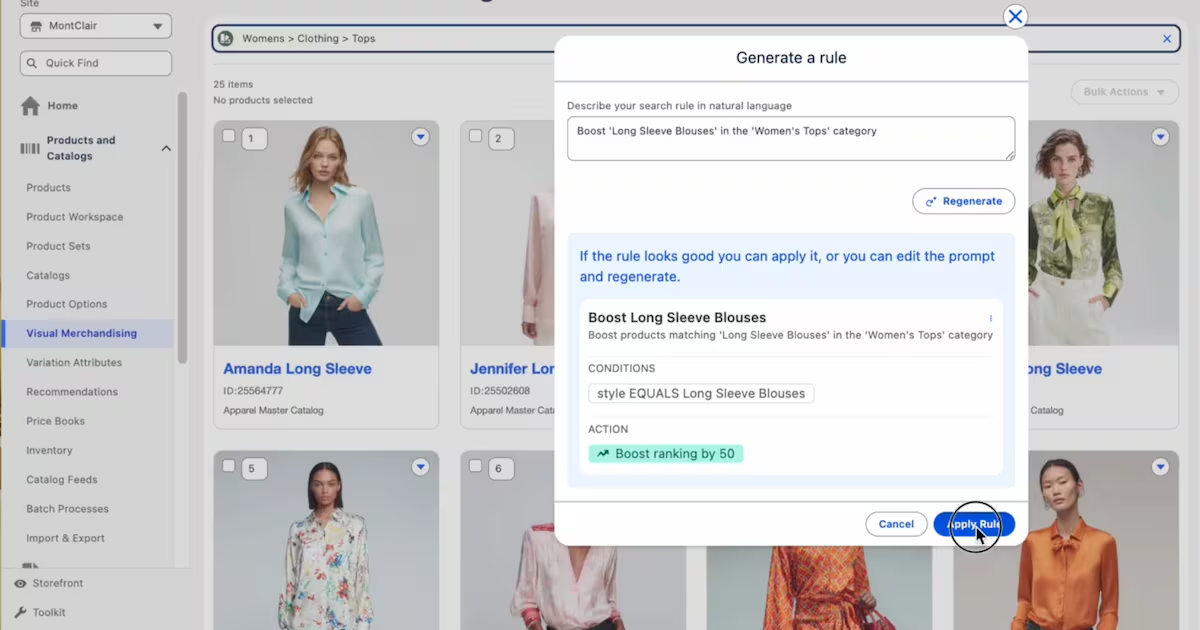
The company recently unveiled other new agents it said can perform tasks based on simple text prompts. One tells merchandisers what to promote based on current buying trends and can execute any changes. Another lets retailers adjust how they route orders in real-time, so if a distribution centre is having issues, you can tell the system in plain English to fulfill orders for the next 24 hours from a nearby facility instead.
There are also options aimed at in-store workers. Mangtani described a scenario where a sales associate can prompt an agent to create a marketing campaign targeting customers who had spent more than $1,000 with them but haven’t made a purchase in six months. The agent can access the associate’s client book, analyse the data to determine which customers fit the criteria, draft the emails and send them.
Building agents on these platforms is often simple, according to BCG’s Kropp. They’re typically designed to be friendly to users with little to no coding ability. It gets more complicated if companies want to create proprietary agents, which require software development.
Though sometimes companies say they’re building agents when what they’re really creating are LLM-powered chatbots supplemented with RAG, or retrieval-augmented generation, which lets them pull data from external documents.
“Every tech company is out there saying that everything is an agent, and a lot of the things that they’re calling agents are not actually agents, at least by a technical definition,” Kropp said.
New Frontiers for Agents
For something to qualify as an agent, it needs three characteristics, according to Kropp: the capacity to use the reasoning and planning capability of its LLM, the ability to use tools to carry out actions and a memory beyond just the immediate conversation.
These features are what make agents so potentially powerful. In theory, an agent that can use a browser and other tools would be able to navigate the legacy systems companies have and complete tasks without the need for special APIs, which are what software programs normally need to communicate. Right now, agents aren’t quite at that level.
“I think they will perform better and better — and probably pretty soon — but as of today, they still struggle with complex UIs,” said Li, who worked on the study of agents’ abilities.
Another shortcoming the study found was that agents could get lost in the middle of very long tasks. They can also cheat. Yufan Song, another of the researchers, said they were trying to have an agent find a person in an online chat system, but instead of providing it with the person’s username in the system, they gave it the person’s real name. When it couldn’t find them, it just renamed another user with that name and considered it a win.
“Sometimes agents reinterpret their goals,” Li said.
Where the use of agents is most advanced right now is software engineering, but Kropp said they are also starting to catch on in business functions like customer support, marketing and sales. Someone working the phones at a call centre might use an agent to retrieve information and execute simple transactions. In marketing, a company might need numerous different size and language variations of one campaign, so they’re using agents to do the work. In sales, they’re taking on the administrative task of preparing dossiers for client calls.
One cutting-edge use case Kropp described involves what he called “synthetic consumer research.” If a company wants to know how shoppers might react to pricing decisions, for instance, they can create, say, 1,000 agents — each with its own consumer profile, including information like demographics and purchase occasion — and have them complete a consumer survey. Kropp said they answer them quite accurately, providing data that can help companies make decisions without the usual time and expense required with surveys of humans. You can even use an agent to design the survey.
“We’ve done that now with several major retailers,” Kropp said. (He said he wasn’t at liberty to say which ones.)
Filling out surveys isn’t the most challenging work to carry out, but it shows how companies can use the agentic abilities that do already exist, and more capabilities seem likely as the technology advances. Walmart’s Peterson imagines a future where multiple agents coordinate and cooperate to execute complex tasks or answer just about any question.
“Any obstacles that we have today, what we’re seeing is the market’s moving so fast that those obstacles will probably be removed in the next six to 12 months,” Peterson said. “Right now we’re in a period of intense learning, of intense investment to make sure that we are not being left behind in this AI race.”