Avi Gold’s visit to Syria stands out for the unexpected affection he received from locals, including a special encounter with one of Damascus’s last Jews.
Jewish globe-trotter Avi Gold said that in a recent trip to Syria, rather than experiencing any hostility, he encountered people who expressed affection for the Jewish people and Israel.
Gold, who spoke about his Syria trip to Walla last week, said people hugged him and gave him sweets. He recounted that locals told him that they wished Jews with Syrian heritage would return.
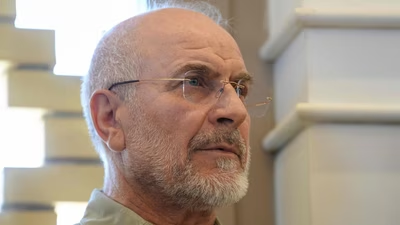
While visiting an ancient synagogue in Damascus, Gold said he met Bechor Sinmentov, believed to be one of the last Jews still living in Damascus. As the visit preceded the Jewish High Holy Days, Gold gave Sinmentov a shofar.
Gold went on to describe how Sinmentov was an “optimistic and positive” local figure, and that members of the public called to him, shouting, “Am Yisrael Chai (the people of Israel live).”
“It was clear [the locals] understood I was Jewish because I was with Sinmentov,” Gold said.
Avi Gold (L) gifting Bechor Sinmentov (R) with a shofar in Damascus. (credit: screenshot/instagram/@avigold100/via walla)
The Syrians he met “radiated with so much love for Israel,” Gold said, describing his visit to Syria as “the trip I will never forget.”
Gold recounted meeting people from all different ethnicities and that everyone was “incredibly welcoming.”
“To almost everyone, I openly stated that I am Jewish and Israeli, and I received only positive reactions,” he told Walla.
Meeting a Jew moves Syrians to tears
Gold went on to recall how he met several Syrians who had never met a Jew, and were moved to tears by the new experience.
He compared his experiences in Syria to those he had in other Muslim countries, including Afghanistan, Pakistan, Bangladesh, and Brunei, where people who rarely see Jews “perhaps imagine them with long noses, dirty clothes, and a bag of gold coins.”
One of Gold’s personal highlights was being accompanied during a visit to an ancient Damascus synagogue by a small group of Syrian-born Jews who fled the country in 1994. After the synagogue had been closed for decades, the doors reopened, allowing the group to hold a prayer service inside.
Orthodox and traditional Jewish prayer services require 10 adult men to form a quorum. The local Damascus Jewish community is too small to hold such gatherings.
While inside the synagogue, Gold said the Jews he was with were “visibly distraught,” and showed him where they used to celebrate the Simchat Torah festival.
Pointing out where their parents used to sit, the Syrian Jews “were simply crying when they told me about it,” he said.