Sport is business and business is sport. There’s no doubt that the stakes are just as high off the pitch and away from the racing track.
Where sport and business mix, the law is not far behind. This week, former Ferrari driver Felipe Massa stepped up the pressure in his legal battle against Formula 1, its former boss Bernie Ecclestone, and the FIA governing body over the 2008 driver’s World Championship.
Massa is claiming at least £64mn over an alleged cover-up of the controversy surrounding Nelson Piquet Jr’s crash at the Singapore Grand Prix that year. The Brazilian would miss out on the world championship by a point, as Sir Lewis Hamilton triumphed.
The defendants argue that the lawsuit shouldn’t go to a full trial.
The court was told that Massa’s performance was to blame for his lack of points in Singapore.
Separately, we bring you more on Real Madrid’s efforts to claim more than €4bn from European football’s governing body over the European Super League saga.
Maybe a law degree is the best training for a career in sport.
Do read on — Samuel Agini, sports business correspondent
Send us tips and feedback at scoreboard@ft.com. Not already receiving the email newsletter? Sign up here. For everyone else, let’s go.
Real Madrid’s €4.5bn battle
Real Madrid claimed victory against Uefa in the courts this week, in another clash between the most successful team in the history of the Champions League and the organiser of the elite club tournament.
The dispute goes back to the failed launch of the European Super League, the closed shop of 12 elite football clubs, including Real Madrid, that collapsed almost as quickly as it launched in 2021.
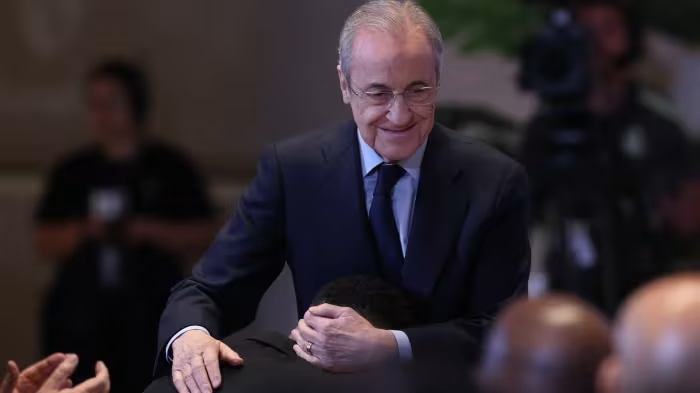
But Real Madrid president Florentino Pérez isn’t one to stand down without a fight. The ESL’s backers have long contended that Uefa, which is European football’s governing body and competition organiser, abused its position in its efforts to block the breakaway threat.
This week, Uefa — alongside La Liga and RFEF, the Spanish football league and national governing body respectively — lost an appeal at the provincial court of Madrid.
Following the ruling, Real Madrid threatened to file a claim for “significant damages”. The FT revealed that the club estimates it has lost out on revenues of between €4.5bn and €4.7bn since the ESL was vetoed. But someone with knowledge of Uefa’s position contends that the Swiss body can take the appeal to the Spanish supreme court, delaying Real Madrid’s claim.
Scoreboard spoke to people on either side of the debate. Both say the size of the claim could be a tactic to bring Uefa to the negotiating table.
A22 Sports Management, the company behind the Super League, says it has held talks with Uefa throughout the year, centred on “modifying, rather than replacing, existing competitions”. The group says its proposals are aimed at “enhancing fan experience, modernising governance and improving clubs’ long-term sustainability”.
“Importantly, there were no proposed changes to the method of qualification via domestic leagues,” it added.
A22 has won this round at the Spanish court. But the governance and business of European football is moving fast.
European Football Clubs, in effect a trade association, and Uefa have formed a joint venture called UC3 to manage its commercial rights. Paris Saint-Germain boss Nasser Al-Khelaifi, who opposed the ESL in 2021 and now plays a key role in the governance of European football, is vice-chair of UC3 and chair of EFC.
UC3 has hired Relevent Football Partners, a division of the sports agency formed by Miami Dolphins owner Stephen Ross, to increase media rights and sponsorship revenues. Separately, Uefa expanded the Champions League and embraced the so-called Swiss model for the tournament.
Relevent is also seeking out streaming companies as it attempts to increase media rights revenues. Yet A22 has another idea: to launch its own streaming platform. “Unify”, as it is known, would screen ESL matches free of charge to fans, according to its backers.
But heed the warning made by someone who has walked this path. World Wrestling Entertainment, the fighting soap opera that made Dwayne “The Rock” Johnson a star, was early with launching its own streaming platform in 2014. But it was “expensive”, as Nick Khan, who joined WWE as president in 2020, recently told the FT.
“When I started at WWE, I said it would be too much of a financial investment for a company like ours, with our market cap at the time, to compete against the Amazons and Netflixes of the world.”
These days, WWE is part of TKO Group, which also owns mixed martial arts series Ultimate Fighting Championship, and reaches its audience via Netflix, Peacock and ESPN. Unify is a bold vision, but will it work in practice?
Real Madrid isn’t just in favour of upending the way European football is run. Pérez last year set out plans to reorganise the club’s own corporate structure. Real Madrid is still owned by its members (known as socios), but changes could permit outside investment firms to buy equity for the first time.
Analysts at Football Benchmark value Real Madrid at €6.3bn including debt, higher than any other football club. The assumption is that A22’s proposals can unlock further value for a club that has already crossed the €1bn mark for annual revenue.
For a club whose history goes back more than 120 years, Real Madrid wants change. The ESL legal war continues. But the longer Spain’s richest and most successful team remains outside the fold, the more UC3 and Relevent can effect their own vision.
Cricket’s new auction
English cricket is emulating India and the US after The Hundred confirmed plans to introduce its first player auction in March next year.
The Indian Premier League, the world’s richest cricket competition, already uses an auction to great effect, with teams bidding millions of pounds on players.
Last year’s IPL auction was a glamorous spectacle. The event was held in Jeddah, Saudi Arabia, sponsored by Tata, and broadcast live to the world.
Lucknow Super Giants, the team owned by Sanjiv Goenka, signed India wicketkeeper Rishabh Pant for 27 crore, or roughly £2.3mn at current exchange rates, a record price. Overall, teams spent 639 crore on 182 players.
Now, Goenka can get bidding in another competition after agreeing to buy the Manchester franchise that takes part in The Hundred, the tournament created by the England and Wales Cricket Board.
The auction isn’t just about determining who plays where. The idea is to create the sort of content that The Hundred’s media partners Sky, the BBC and YouTube can use to build anticipation ahead of next year’s competition.
This is the sort of thing that is also used to great effect in North America.
The National Football League and the National Basketball Association make use of the draft — where teams pick from a pool of eligible players — to captivate fans with off-season spectacles that generate around-the-clock media coverage.
Fans pin their hopes on promising young talent, sifting through “mock drafts” put together by a cottage industry of “draft analysts”.
The NFL Draft has become something akin to a travelling football festival, moving between different host cities each year. This year’s draft in Green Bay, Wisconsin, drew 600,000 people over three days, according to the NFL.
Fresh from raising hundreds of millions of pounds from investors by selling off stakes in franchises, the ECB and The Hundred are planning ahead.
London could be in the frame to host the event. Organisers have recognised that action off the field can drive interest in the competition itself. It’s also an excuse to put the spotlight on players and the teams signing them.
It also provides an insight into how teams approach The Hundred. Do they pay big for one or two players? Spread out the spend? Go heavy on fast bowlers?
Every team has the same budget: £2.05mn to spend on the men’s competition and £880,000 to spend on the women’s. The money goes to the players as salary.
Football has the transfer window. Cricket has its own answer.
Highlights

-
The Los Angeles Dodgers turned a wild double play to defeat the Toronto Blue Jays last night, setting up a decisive World Series Game 7 tonight at the Rogers Centre. Could the stakes be any higher for Canada’s only Major League Baseball team? A Blue Jays title — in a sport considered “America’s pastime” — would come at a time when President Donald Trump has raised political tensions with the US’s northern neighbour. Should Toronto win, don’t count on an invitation to the White House.
-
This is the story of how sports gambling took over prediction markets in the US.
-
The owner of Fulham FC is betting a £350mn investment in its stadium will help the Premier League team narrow the gap with its rivals. But how much can a private members’ club and pier development boost its revenues? “I think it’s going to go a long way towards making Fulham competitive and compliant with [financial] fair play rules,” Shahid Khan told the FT.
-
In a polarised world, sport still unites us. Read Simon Kuper’s take on fandom, isolation and belonging.
Transfer Market

-
John Malone is relinquishing his full-time board role at Formula 1 owner Liberty Media, the FT’s Kieran Smith revealed this week. The 84-year-old also stepped back from Liberty Global, majority owner of electric car racing rival Formula E.
-
Premier League chair Alison Brittain is set to stand for a second three-year term, Sky News reported, even with the outcome of its case against Manchester City Football Club unresolved.
Final Whistle

When he’s not mercilessly swatting shots, French basketball phenom Victor Wembanyama has used his 7’4’’ frame to pull off some all-time Halloween costumes. But the NBA didn’t schedule his San Antonio Spurs to play last night, depriving fans of a follow-up to last year’s Slender Man look. Scoreboard wonders if Wemby used his off night to do some trick or treating . . .
Scoreboard is written by Josh Noble and Samuel Agini in London, with contributions from the team that produce the Due Diligence newsletter, the FT’s global network of correspondents and the data visualisation team. It is edited by Benjamin Wilhelm in New York and Lee Campbell-Guthrie in London.