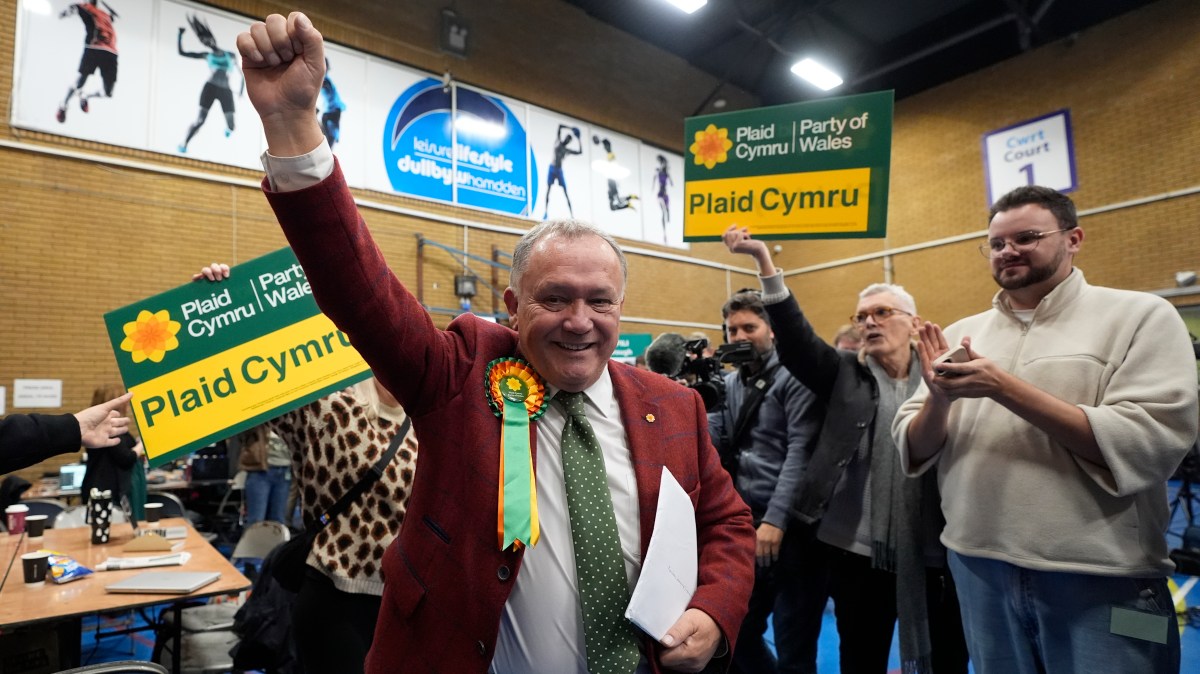
The Plaid Cymru leader said the party will not “rest here” and will continue building momentum.
“We’ve shown here that we can win anywhere,” Rhun ap Iorwerth told BBC Wales.
“This is a historic night for Caerphilly, it’s a historic night for Plaid Cymru, it’s a historic night for politics in Wales. We are seeing that things can be done differently under Plaid Cymru leadership.”
Rhun ap Iorwerth, doing media interviews as the count continued
ANDREW MATTHEWS/PA WIRE
Labour faces difficulties in next budget vote
The victory for Plaid Cymru comes in the run-up to a vote on the Welsh Government budget, which has been a source of anxiety for the Labour administration.
When passing its last budget in March, Labour needed the help of an opposition member to get it through by a tight margin.
While Labour is the largest party, it does not have a majority, and the next budget vote in January 2026 will be even more difficult after losing the Caerphilly seat.
Labour held exactly half of the Senedd’s 60 seats, so had to strike a deal with the sole Lib Dem member Jane Dodds, who agreed to abstain.
‘Historic realignment in Welsh and British politics,’ says Reform UK’s Zia Yusuf
Reform UK’s head of policy has said next May’s elections would now be a battle between Reform and Plaid.
Zia Yusuf congratulated Plaid Cymru on victory and described his own party’s performance as “remarkable”.
“This is a historic realignment in Welsh and British politics. The Senedd elections next May are now a battle between Reform and Plaid,” he wrote in a post on X.
He added: “Who would have thought Labour would fall to just 11 two per cent and the Tories to just two per cent”
Please enable cookies and other technologies to view this content. You can update your cookies preferences any time using privacy manager.
Support for Reform UK ‘died tonight’
Plaid Cymru’s winning candidate claimed the surge in support for Reform UK “died tonight”.
“They poured everything into this campaign,” Lindsay Whittle told The Times. “Literally everybody’s Facebook pages were flooded, people were complaining they are fed up of Reform letters coming through the door, delivered by the Royal Mail or delivery agencies.
“People can see through that. All our leaflets were delivered by individual members. They will see us walking down the streets and talking to them and saying, ‘Hello Mr George, here is your leaflet’.”
Whittle, a local councillor, said Plaid had seen a surge in younger activists wanting to oppose Reform UK.
“Young people don’t like Reform, that came across on the doorstep,” he said. “Older women also don’t like Reform. That was evident all the time.
“I think they have seen what has happened in the country and they are a bit afraid.
“We are not like ‘get the refugees out and stop the boats’. We are a welcoming place. We have been a nation of sanctuary since the Second World War.
“We are welcoming people, we really are. My grandfather was from Bolton.”

Whittle celebrates winning the Caerphilly seat
MATTHEW HORWOOD/GETTY IMAGES
Reform: We took a lot of Labour votes
Llyr Powell, the Reform candidate, declined to make a speech at the podium after coming second to Plaid Cymru, but told reporters that he was “impressed with how we managed to get the campaign up and running”.
“We have taken a lot of votes from Labour here tonight, momentum is building and we look on to [Senedd elections] next May,” he said.
Powell said he was “a bit disappointed” but said the party’s “ground campaign is going to get better”.
“Next May, we are going to form a Reform government… Moving forward, you can see Labour in decline. There is one party that is surging.”
Whittle: I’m not used to speaking first on election night
In the end, Plaid Cymru won a decisive victory over Reform by almost 4,000 votes, whilst Labour slumped to a disastrous low of 3,713 votes, down from 13,289 in 2021.
Lindsay Whittle has stood for the Caerphilly parliamentary seat in every general election since 1983 and in every Welsh Assembly election since 1999. This by-election marks his 14th attempt.
Delivering his victory speech, he joked: “You will have to forgive me, I am not used to speaking first on election nights.”
Whittle paid tribute to Hefin David, the Labour Senedd member whose sudden death in August caused the by-election. He said: “I will never fill his shoes but I promise you I will walk the same path that he did.”
The Plaid winner called on the Labour governments in Cardiff and Westminster to “listen now”. “This is Caerphilly and Wales telling you we want a better deal for every corner of Wales.”
‘We proved we could stop Reform’
Rhun ap Iorwerth, leader of Plaid Cymru, said there was an element of voters “wanting to stop Reform and showing that we could stop Reform here in Wales”.
He said there was “deep, deep disillusionment with Labour, both on the UK level and at a Welsh government level, and the people are looking for new leadership”.
Reacting to the surge in votes for Reform, he said: “We have to show in Wales that that is not the politics that reflects our values as a nation.”
He said the party wanted to show people that “there is a positive alternative to opting for that simple answer that Reform seems to offer to very, very complex questions”.
Lindsay Whittle comfortably beats Llyr Powell
Here is the breakdown of results as they were announced.
• Steve Aicheler – Welsh Liberal Democrats – 497
• Anthony Cook – Gwlad – 117
• Gareth Hughes – Green Party – 516
• Gareth Potter – Welsh Conservatives – 690
• Llyr Powell – Reform UK – 12,113
• Roger Quilliam – UKIP – 79
• Richard Tunnicliffe – Welsh Labour – 3,713
• Lindsay Whittle – Plaid Cymru – 15,961
Plaid Cymru wins Senedd seat
Lindsay Whittle is Caerphilly’s new member of the Senedd. He beats Llyr Powell of Reform UK, with Labour’s Richard Tunnicliffe coming in a distant third place.
The polls expected the seat to go to Reform, but in the end, Whittle won fairly comfortably. He earned 15,691 votes, with Powell taking 12,113 and Tunnicliffe well behind with 3,713.
Speaking prior to the result, Whittle said the Labour vote in the constituency had “vanished”.
He said: “I’m very buoyant, excited, the count is looking OK, we’re not allowed to say much more than that.
“Very pleased, not over yet, of course, so don’t count chickens before they’re hatched.
“I can only see glimpses, but, yeah, it’s close.
“The Labour Party vote has just vanished into thin air.”
Reform hoping to emerge from obscurity
In 2021, when the seat was last contested, Labour’s candidate, Hefin David, received 13,289 votes (46 per cent), while Plaid Cymru’s candidate, Delyth Jewell, received 8,211 (28 per cent). The Reform candidate, Tim Price, came sixth (and last) with just 495 votes (2 per cent).
In 2016, before Reform’s conception, Labour won by a slimmer majority of 9,584 votes (35 per cent) to Plaid Cymru’s 8,009 (29 per cent).
The candidates in this year’s by-election include Lindsay Whittle for Plaid Cymru (who also stands as Plaid’s candidate in general elections), Llyr Powell for Reform, Richard Tunnicliffe for Labour and Gareth Potter for the Conservatives. The Green Party and UKIP have both entered candidates too.
It was called after the death of Hefin David in August, who was elected as a Senedd member in 2016.
Labour ‘has six months to fight Reform’s doom and discord’
Huw Irranca-Davies, the deputy first minister of the Labour Welsh government, said his party needs to do “some really rapid reflection” on the reasons behind the collapse in their vote.
He said Reform had sown “division and discord” during the campaign, even though “immigration is not on the ballot tonight, but so many conversations have been dominated by that”.
Irranca-Davies said Welsh Labour needed to focus on the “cost of living, jobs and opportunities” and deliver a “compelling story” about how they defended public services and “support for the disadvantaged” during the years of Tory austerity.
“Somehow we haven’t got that message across,” he said.
The veteran Welsh politician said they have until the next Senedd elections in May 2026 to deliver improvements in people’s lives, and said recent cuts in ambulance waiting times and investment in rail infrastructure were good news stories.
“Our challenge is to say things will get better and we can do it when we have two Labour governments working together,” he said.
“It’s a big challenge, some people are writing us off, but as Mark Twain once said, ‘rumours of our demise are greatly exaggerated’.”
Irranca-Davies said Reform “is utter doom, utter misery and other people’s fault”.
“The best leaders are those who can lift people’s heads up and say we can be better than this,” he said.
“People on the doorstep have said, ‘you have six months to persuade us to come back to Labour’.
“It’s all to play for. I have no problem with being the underdog. Underdogs can bite back.”
‘I’ve never known an election like it’
John Taylor joined Plaid Cymru in 1968 during a previous Caerphilly by-election and has been involved in local politics ever since.
“I have never known an election like this,” Taylor, 75, said, as the sports hall at the Caerphilly leisure centre filled with 83 members of the media.
“Normally, we get a token one from the BBC and someone from the local press.”

The collapse of support for Labour in their Welsh heartlands and the prospect of Reform UK winning their first Welsh election have brought a spotlight on this devolved by-election.
Taylor, who is the election agent for the Plaid candidate, said the Labour vote has “sunk without a trace”.
“I have never seen a reaction on the doorsteps like it,” he said. “One of my canvassers came back from one area and said ‘no one said they were voting Labour’. It was a couple of streets of pre-fabs, council flats and former council houses.”
Asked why people were turning away from Labour, he said in large part it was a reaction to the policies of Sir Keir Starmer’s government, such as the cuts to winter fuel payments.
“People didn’t expect a Labour government to launch an attack on old age pensioners,” he said.
Locals liken Caerphilly to a ‘third world country’
Canvassers on the doorsteps of Caerphilly have said there is “a lot of anger” in this traditional Labour heartland.
Gareth Hughes, the Green candidate, said the “further up the valley you go the more the anger is”.
“The area is so poor, it’s like a third world in some places,” the Caerphilly local said.
“It’s run down, shops are closed, it looks as if there is a lack of investment, and I think that traditional Labour vote is looking for a place to go.”
Hughes thinks most lost Labour votes will go to Plaid but “a lot will go to Reform”.
“The Labour vote is going to crash for certain,” he added.
Left lending votes to stave off Reform
Left-wing voters in Caerphilly have been lending their votes to Plaid Cymru in a bid to stop a resurgent Reform UK from winning their first Senedd election.
With a collapse in support for Labour expected, supporters of smaller parties such as the Liberal Democrats and the Greens have been telling their candidates they are voting tactically for Plaid to thwart the party of Nigel Farage.

Rhun ap Iorwerth, the leader of Plaid Cymru, is hoping to receive votes from other left wing parties
ANDREW MATTHEWS/PA
Steve Aicheler, 50, the Lib Dem candidate, said: “Our supporters want a liberal democracy and we see Reform as a threat to our democratic system. They’ve been saying they will vote for me next time, but they are voting for Plaid to stop Reform.
“When you look at what is happening in America, Trump’s party is eroding the democratic system and Farage is copying them, and I think it’s a genuine fear.
Reform master their ground campaigning
Reform UK has used the by-election to “master” their ground campaign and train their activists ahead of next year’s nationwide Senedd elections.
Llyr Powell, 30, the Reform candidate in the Caerphilly by-election, said they had started the campaign with a “blank slate” and had “to go out there and find a lot of voters”.
“A big part of what we were trying to do here was to master our campaigning,” he said.
“We’ve trained so many people up on our systems. The professionalisation of the party shows we’re no longer just what people used to call us, the ‘air war party’. We’re now a grassroots campaigning party. So I’m really excited.”
Powell said he has suffered “attacks on my property, attacks on my campaign office, threats made against me” during the campaign.
He said there has been late-night intimidation at his private home, with people ringing his doorbell and banging on his door into the early hours of the morning. Someone also targeted his campaign headquarters and poured glue in the door locks.
“It’s quite sad that our democratic process has come under attack from a militant group out there,” he said.
“I’m proud of the positive way that my activists went out there. To support, to oppose, and to reach people across the constituency, leafleting through doors. Whatever the weather threw at us, and whatever the fears and attacks the others threw as well.”
Labour struggling in a traditionally safe seat
The South Wales Valleys seat of Caerphilly has elected a Labour MP ever since it became a constituency in 1918, but all of Wales’s key indicators — on education, health, productivity — lag behind the rest of Britain.
Labour’s vote is now fracturing between support for the left-leaning nationalist party, Plaid Cymru, and Nigel Farage’s Reform UK, which has been winning voters from both Labour and the Tories.
A Survation poll for the Senedd seat put Labour in a distant third place behind Reform on 42 per cent and Plaid Cymru on 38 per cent.
When the seat was last contested in 2021, Labour won 46 per cent of the vote, Plaid came second with 28 per cent, and Reform UK won less than 2 per cent.
Highest ever Senedd election turnout in Caerphilly
People in Caerphilly have tuned out in big numbers for this by-election.
After the counters verified all the ballots cast, the returning officer said the turnout was 50.43 per cent, the highest ever for a Senedd election since devolution began in 1999.
The previous highest Senedd election turnout in the constituency was 44 per cent in 2021.
This is close to a general election turnout. Caerphilly had a 52 per cent turnout in the last general election, where Labour were the clear winners, followed by Plaid and Reform.
Humiliation beckons for prime minister
The sports hall of Caerphilly leisure centre is likely to be setting for Labour’s most humiliating by-election defeat in its Welsh heartlands, as voters are set to abandon the party for Reform UK and Plaid Cymru.
Polls suggest that Labour could win as little as 12 per cent of the vote in the South Wales Valleys seat, which it has consistently held since devolution in 1999.
It could be the first domino in a potentially existential reckoning for Sir Keir Starmer and will have immediate implications for Labour’s ability to pass its budget in the Welsh parliament next year, as it would hold less than half of the 60 Senedd seats. The result would also be seen as a bellwether of Labour’s loss of support in Wales before all-out elections for the Senedd next year.
Caerphilly has elected a Labour MP ever since it became a constituency in 1918, but all of Wales’s key indicators — on education, health, productivity — lag behind the rest of Britain.
Labour’s vote is now fracturing between support for the left-leaning nationalist party Plaid Cymru and Nigel Farage’s Reform UK, which has been winning voters from both Labour and the Tories.
A Survation poll put Labour in a distant third place behind Reform on 42 per cent and Plaid Cymru on 38 per cent.
When the seat was last contested in 2021, Labour won 46 per cent of the vote, Plaid came second with 28 per cent and Reform UK won less than 2 per cent.