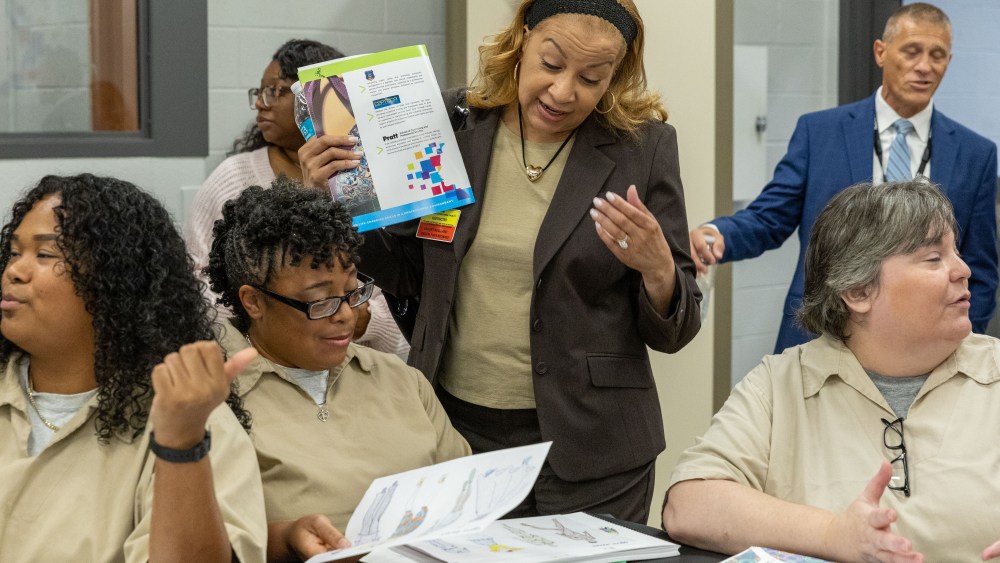
The New Jersey Department of Corrections has teamed up with Pratt Institute to debut a fashion design and workforce development program at the Edna Mahan Correctional Facility.
“The Design Studio” will offer incarcerated women a structured curriculum in fashion design, apparel construction, digital design and business planning. Organized with equipment to resemble a professional environment, the EMCF Design Studio uses a curriculum that was developed by faculty from Pratt’s fashion program, which was one of the first fashion programs in the U.S. During the 10-month program, participants will complete 40 weeks of structured instruction that will be led by Pratt faculty, and also supported by NJDOC staffers.
Sketching, garment fitting and creating mood boards are among participants’ tasks. They will then move on to draping, pattern-making, garment construction and digital design that will require proficiency in Adobe Illustrator, InDesign and other professional tools. They will learn to create prototypes, prepare technical packs and refine designs through fittings. Coursework extends into branding, niche markets, supply chains and ethical sourcing, before culminating in production readiness.
Ten women are participating in the inaugural program that will focus on redesigning the institution’s uniform for women. That apparel has not been updated in decades and they are the same as the men’s uniforms. The aim is to have between 12 and 20 women going forward. Participants will receive a certificate of completion from Pratt Institute’s School of Continuing and Professional Studies. Advancing rehabilitation and reentry through education and vocational opportunities, and collaborating with leading academic and industry partners, are in line with the NJDOC’s mission.
The NJDOC approached Pratt with a program proposal and faculty from the fashion design department were “very passionate” about the prospect so the plan moved forward, according to Maira Seara, dean of Pratt Institute’s School of Continuing and Professional Studies. She described the school as “a natural partner — creativity, design and innovation are at the heart of what we do, and those values translate powerfully into helping people build new futures.”
“Together, we’re opening doors, fostering dignity and investing in safer, stronger communities,” she said.
The aim is for the incarcerated women to learn practical skills and gain confidence that will be put to use in real-world situations. The experience is also meant to help foster collaboration, accountability and problem-solving habits — all of which are meant to be used later in one of the garment-production opportunities in New Jersey, New York City and beyond in other facilities. Local manufacturers and fashion houses routinely need trained technicians for patternmaking, garment construction and digital design. The initiative is also designed to support the regional economy.
Sketching and mood boards are among participants’ tasks.
Photo Courtesy
The program is one of the few that is operating in the U.S., Milan and London. In 2014, Making for Change was established as training program for women in the HM Prison Service Downview and has since expanded to reach the wider community in East London’s fashion district. Making for Change’s other partners are London College of Fashion, the Ministry of Justice, Poplar Works, Poplar HARCA and The Trampery. The Pratt team spoke with representatives at the University of the Arts at the London College of Fashion about their experience, Seara said. “However, our programs are quite different, although the audience is similar.”
Another initiative, Prison Blues, was started Stateside in 1989, after Oregon was challenged to create work skills programs for adults who were in custody at the Eastern Oregon Correctional Institution. After a selection process, individuals are trained by managers with private industry experience at a 47,000-square-foot factory to help prepare them for reentry into communities. Two years ago the program was expanded to the Coffee Creek Correctional Facility to make Prison Blues accessories. The company hails itself as “made on the inside to be worn on the outside.”
Helena Tomé, assistant commissioner of the NJDOC’s division of women’s services, said The Design Studio embodies the culmination of four years of work with the the department’s DeptCor and its division of women’s services. DeptCor has provided vocational training to New Jersey’s incarcerated population since 1918 and the division of women’s services manages an array of gender specific mental health, educational and rehabilitative services for women incarcerated at the NJDOC.
So far, finding a classroom assistant to work on location Monday through Friday has been the greatest challenge, Seara said. “That is not because of the type of work, but because of the location of the facility. While many of our applicants are from the New York City area, the facility is 60 miles away with little to no public transportation available,” she said.