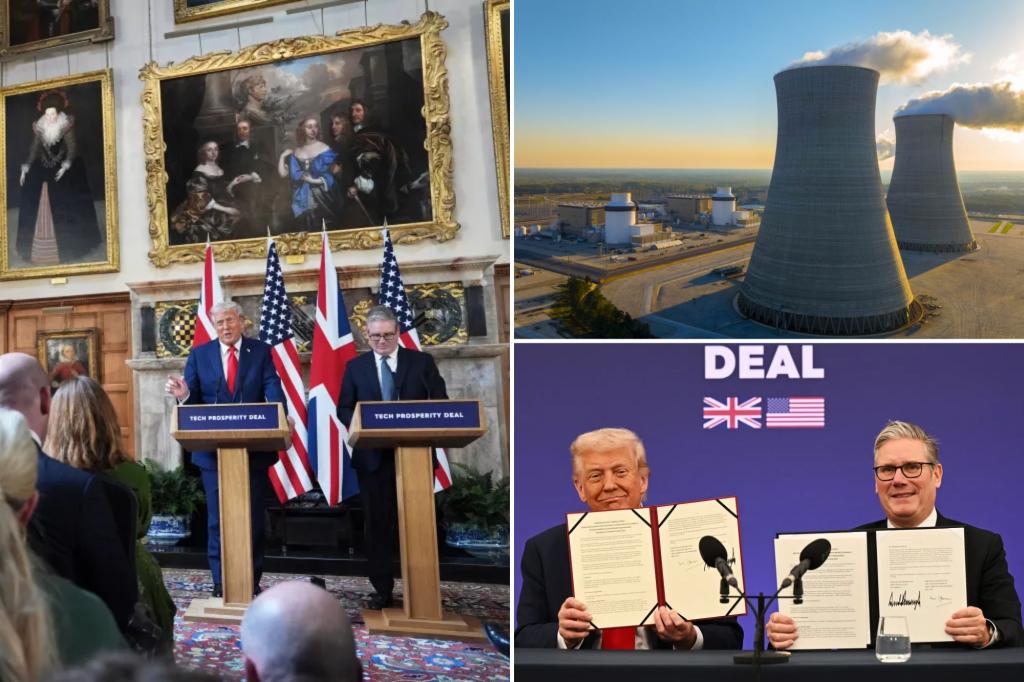
WASHINGTON — President Trump and UK Prime Minister Keir Starmer signed a joint memorandum of understanding Thursday authorizing investment of $350 billion in sectors including artificial intelligence (AI), civil nuclear energy and quantum computing.
The allied leaders announced the Technology Prosperity Deal in a press conference at Chequers, the country manor of the British PM in Buckinghamshire northwest of London, claiming that the “win for both sides” could create up to 17,500 new jobs across both nations.
“This trip has galvanized $350 billion in deals across many sectors, and we’re committed to ensuring that the UK is a secure and reliable supply of the best AI, hardware and software on Earth, and we supply that and make sure we supply it in quantity to the UK,” said Trump.
The president later joked it was “a better deal for you than us,” praising Starmer as a tough negotiator, while the PM described the pact as a “good deal” for both countries.
“It’s a blueprint to win this new era together, shape it according to our shared values, and seize the incredible opportunities that are on offer,” Starmer told reporters.
“We have huge new investments from Nvidia, Nscale, Open AI, Google, Salesforce and many more backing cutting-edge British jobs for years to come.”
The investments are expected to result in around 15,000 jobs in the UK, along with the construction of 12 advanced nuclear reactors in the north of England. The US anticipated 2,500 jobs being created in its territory.
The deal would also provide power for up to 1.5 million homes — with both nations optimistic the civil nuclear project will serve energy needs on both sides of the Atlantic.
Trump touted collaboration on “quantum computing, fusion, 6G and civil nuclear energy,” saying the memorandum balanced deregulatory steps with a push toward innovation in those sectors.
James Burnham, who founded an AI policy council in Washington this past July, told The Post that the investments in AI and quantum computing will lower prices for consumers because they’ll allow many industries to operate “at a speed and scale that humanity is not capable of doing.”
“It just has the ability to make our lives better and easier,” said Burnham, who served previously as the top lawyer at the Department of Government Efficiency.
The innovations will largely benefit consumer-facing sectors of the economy, making travel bookings near-instantaneous and rendering the complexity of self-driving cars an easy and widespread phenomenon.
“You’ll have computers doing work that right now is being done by humans,” Burnham added. “AI is going to be really good for customer service and all the process, back-office functions.”
That will also spur growth in US and UK manufacturing,” he claimed.
“For everything from installing home batteries to building data centers to manufacturing battery cells, there’s a lot of hard, human work that has to happen to enable all of these technologies to exist and grow.”
The AI developments will include joint research programs as well as a space partnership between the US and UK.
There will also be an emphasis on chip and data center exports from both countries, as well as enhanced collaboration between the US Center for AI Standards and Innovation and the UK AI Security Institute, both of which regulate the industry.
New nuclear policies will mainly help power the tech boom but also enhance existing non-proliferation and security programs.
Perhaps most crucially, the UK will move toward “full independence from Russian nuclear fuel by the end of 2028,” according to the White House.
Burnham pointed out that most nuclear fuel is exported from China but produced in Russia, posing a major problem for the West.
“Getting the UK on board with not buying Russian enriched uranium is both good on its own, because we don’t want the Russians to be selling nuclear fuel to one of our close allies, but also good for American companies,” he said.
“It’s another great example of ‘America First,’ selling stuff that we make here,” Burnham underscored. “Step one, kick out the Russians; step two, bring in the Americans to make it simpler.”
Quantum technologies, aimed at speeding up computer processing capabilities, will be deployed to “transform defense, finance, and healthcare, protect [US and UK] citizens, and create high-skilled jobs.”
The agreement is due to be put in effect by mid-March of next year.
Formal discussions between the countries updating each other on implementation will take place each year beginning in 2026.
“Firming up international relationships will be critical to American AI success,” Matthew Mittelsteadt, a tech policy researcher at the libertarian Cato Institute, told The Post of the deal.
“To lead this space, the United States needs markets, capital, and data — ‘resources’ that mutually beneficial trade partnerships and openness can provide,” Mittelsteadt said.
“As the United States continues negotiations,” he added, “we should strongly reconsider our current protectionist stance so we can further deepen ties with the UK and others, and reap the benefits of the resources and openness that will follow.”