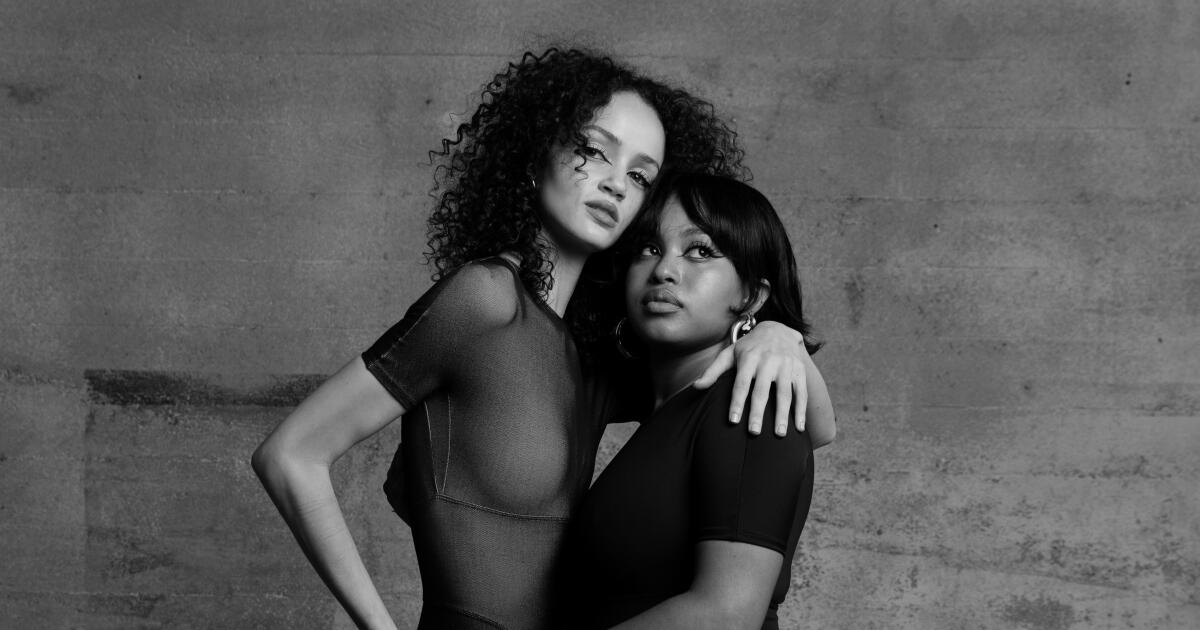
Raiven, left, and Sylvie wear Kwame Adusei Kayco jumpsuits, Stuart Weitzman shoes.

Nana Kwame Adusei moves inconspicuously around his light-flooded Fashion District studio and atelier in a flowing white shirt, wide black shorts, baseball hat pulled low and tabi boots, observing as much as he is guiding. It’s a shoot day, and Adusei is adjusting one of his archive pieces — a corseted jumpsuit with stirrups in distressed industrial gray — on two models. Posing in Adusei’s designs, the women move like they’re wearing a second skin: earth angels in polyamide, comfortably communing with each other and their environment. As a designer, Adusei is known for making these kinds of clothes: the ones that feel like an intrinsic part of a lived experience and only exist as a result of a deep consideration of people’s literal and metaphorical movements. Looking at his designs in action, I have a thought that I haven’t stopped thinking since: “Kwame Adusei likes women.”
Adusei was born in Accra, Ghana, and raised in a house with three older sisters. He’s also the father of a 10-year-old daughter, Rory. Even before he was a designer, his sisters taught him what a garment can do — how at its best it can enhance your life, how at its worst it can stifle it, and how the right piece can support all the different lives you can have in one day alone. “They really made me who I am,” he says. His small creative team is also primarily women, the kind of women, specifically, who make things happen. Shooting off emails, buzzing around the studio in a dialed-in frenzy and nodding in affirmation when affirmative nodding is needed. When I bring up my observation to Madeleine LaRochelle, creative director at Kwame Adusei, she quickly schools me. I’ve been thinking about this too narrowly. “It’s not only that he likes women, it’s that he sees us as people,” she says. “Kwame doesn’t design from the male gaze. He designs to enhance the human experience. Every single one of my dresses has a slip. Everything is conscious of the way that you move, develop your body. If it is a more revealing piece, he makes sure that you can still work in it. He asks questions. It’s not just liking women.”

Sylvie wears Kwame Adusei Kabun dress and Alaïa shoes.


A Kwame Adusei piece can be clocked by its presence. It’s born of a place that exists beyond trend or hype, taking cues from Adusei’s West African heritage and reinterpreting them for L.A. Modernity meets something more metaphysical, something more reverent. There is womenswear and menswear, though the brand doesn’t draw harsh differences between the two. Dresses, denim, suiting, leather are all made for the human form, period. Still, a woman in a Kwame Adusei piece seems to adopt a supernatural power. Structural tailoring merges with soft draping, always with an added element of surprise that pushes it into the category of edgy or androgynous. A strapless and stretchy silk-taffeta evening dress in a deep raspberry flirts with the avant-garde through voluptuous exposed pockets. A reimagined sleeveless plaid button down, corseted and cropped with shoulder pads, becomes a new kind of snatched staple. A mesh column dress that is ruched from top to bottom, has a floral pattern that doubles as a contoured illusion line. An oversize wool blazer with distressed edges holds the contradictions of being put together and coming undone.
A Kwame Adusei piece comes alive on a body, or maybe a body comes alive in a Kwame Adusei piece, but its genius lies in the fact that it could stand on its own without a body at all.
The east-facing atelier in downtown L.A. is 5,000 square feet, with naturally distressed walls and ceilings as high as you might imagine. Adusei is here nearly every day (and sometimes every night, especially if he’s jet-lagged). He lives right across the street and treats this space like an extension of his home and his small team like an extension of his family. The brand is entirely independent and sustainable, releasing limited collections, using only deadstock fabrics and keeping every step of its production in-house. Kwame Adusei is one of only 3% of U.S. fashion brands actually produced in the U.S. Most of Adusei’s team has been with him since he started his brand in 2022, learning his style and perfecting every step of the process after Adusei designs a piece and makes a pattern for it — from cutting to sewing to fitting. All of that magic happens in this space. (They’ve even recently purchased a machine to make their leather tags in-house, which is a utopian skyline blending architectural references from L.A. and Ghana.)
“People don’t trust luxury anymore because everybody’s producing in some obscure place where they’re paying people $2 an hour, even less,” Adusei says. “We keep seeing all these marketing tools where brands specify the making of one bag. Don’t show one bag being done, show the factory and where it’s located. Anybody can paint a white room and put on a glove, anybody can stage it. But we are one of the few brands left that is produced in a city where we actually live and where we make money. We’re employing locals. We’re very sustainable and ethical in that sense.”
The brand’s physical boutiques serve as a kind of third space. There’s one in West Hollywood that opened in 2023 and one in Paris, which officially opened over the summer. The first time I went to Kwame Adusei’s boutique in West Hollywood, it was for a Cine Apartamento screening of the Bill Gunn Blaxploitation vampire film “Ganja & Hess.” Even in this environment, with natural wine flowing and digi cams flashing, the clothes cut their own figure. When you see the clothes in context within their community, you better understand the brand’s identity. Adusei’s brand logo is the symbol for linked hearts among the Ashanti people of Ghana — Adusei’s tribe — known as Akoma Ntoso.
At 38 years old, Adusei stands tall — a former basketball player towering over everyone else in his studio — without being domineering. His demeanor is a specific combination of observant and internal (a byproduct of his Scorpio sun, to be sure) with a childlike curiosity and openness — the little kid who wants to make art in a corner but also be friends with everybody. He approaches his creative process like an anthropologist, a callback to his baby brother identity in Accra. His starting point is often sitting at a coffee shop with a sketchpad and watching the ways people live and move around him. “Any person walking towards me, I can almost tell you their size, what they like to wear, what they’re insecure about,” Adusei says.

Kwame wears Kwame Adusei Kamlo pinstripe button up, Kapli shorts, and Maison Margiela boots
His receptive nature is how he met LaRochelle, who has been with the brand for the last two years. LaRochelle was downtown walking her dog and looking chic when she was stopped by Adusei, who was interested in the cut of her shirt. (With a blunt bob and razor-sharp eyeliner, wearing Kwame Adusei head-to-toe, LaRochelle is basically a walking campaign for the brand.) It turned out LaRochelle had 15 years of experience working in luxury fashion as a buyer and in distribution and was running her own vintage archive. At this point in her life, LaRochelle swore she’d never work with another modern brand again. But there was something about Adusei’s vision — and after trying on the clothes, she was convinced to join his team right before it opened its first store. “You have to step outside of yourself and have a lot of perspective to understand the trajectory that something is going,” she says. “That’s how a lot of our team operates — we see where Kwame is going because we have the experience to understand.”
At this year’s Fashion Trust U.S. Awards, Kate Hudson presented Adusei with the Sustainability Award. On stage in all black, Adusei delivered a short but potent acceptance speech that focused on the importance of working your way up from the bottom in this industry. His namesake label has been in business for only a few years, and if you go by the sharp influx of people wearing his architecturally draped pieces at art openings all over town since, you might get the wrong impression that the brand has blown up out of nowhere, but don’t be mistaken: Adusei is not new to this.
In the world of fashion, there are conceptual creative directors and there are designers. Adusei is a designer’s designer. He has been designing for nearly 20 years. His previous ready-to-wear brand, Charlotte Privé, which was named after his mother, had two stores in Ghana, a deep following and awards to its name. (Before coming to L.A., Adusei also ran a coffee shop and clothing factory in Accra.) If you dig up photos of those Charlotte Privé collections on the internet, the clothes almost seem to exist in stark contradiction to the kind of work he’s making now — back then it was flowing, feminine dresses in bright colors that felt vaguely European — but it’s a part of Adusei’s story as a craftsman.
In many ways, that story is about understanding and respecting the game, in his own way paying tribute where tribute is due. A Kwame Adusei garment calls to the past. In them you see bits of old Mugler, whispers of O.G. Margiela. When he was starting, Adusei obsessively studied the work of designers like Karl Lagerfeld, Alber Elbaz, Pierpaolo Piccioli (he even learned French because of his admiration for Karl). Ten years ago in New York, Adusei ran into Piccioli, who is having his debut as the new creative director of Balenciaga this fall. “I shot my shot,” Adusei remembers. “I said, ‘Hi. I’m a designer, too.’ He goes, ‘Where are you from?’ I said, ‘Ghana.’ He said, ‘Well, what do you design? Do you make Ghana-inspired designs?’ I said, ‘No, I make Italian clothes, just like you.’ He looked at me like, ‘Really? You have a rich culture and rich story and you want to make Italian clothes?’ So that was it. That was a light bulb.”
When Adusei decided to start a brand using his own name, a recognizably West African name, and began using the kind of traditional draping techniques used by women in his home country for years, he wanted to create a reference point for an African fashion house in L.A. that challenged people’s preconceived notions.
Adusei and LaRochelle have clearly thought about that last point a lot: “People will be talking about, ‘Oh, what is the African influence on the design?’ Simply because they’re used to a caricature. A wax print or something like that,” says LaRochelle. To which Adusei adds: “The wax print — I don’t mean to get political — but that doesn’t belong to Africa. There’s no African company that owns a wax print. It belongs to either the Dutch or the Chinese. The only true design concept that you can adopt as an African, especially from Ghana, is the way we drape our clothing, which is a technique for how something should fit on your body.” To which LaRochelle responds: “People associate draping with a Westernized version of luxury, but the truth is there’s a deep, rich cultural context and we apply that to the design. People are jarred by this modernized concept of it, but it’s also subtle. You’re just like, ‘Wow, why does this pant fit better?’ There’s an actual flow that happens when you understand draping and you apply it to a trouser.”


Raiven wears Kwame Adusei Kamrine top, Karune skirt and vintage shoes from Rocotito Archives.
When Adusei moved to the States, he tried New York first but found it impenetrable, lasting only a month. In contrast, L.A. felt like two arms wide open. He had a feeling the city would be fertile ground to receive him and his vision — and he was right. In the last few years alone, his clothes have been worn by everyone from Kylie Jenner to Lori Harvey to Ciara. Adusei has built a community of artists and models flocking to his Doheny Drive store. When you think of the Kwame Adusei brand, a specific visual language conjures in your mind of a high-quality, easy simplicity. But making something look effortless takes skill. “There’s nothing to hide behind,” LaRochelle clarifies. “Everything boils down to this really beautiful technique and that’s why there seems to be such a thread throughout everything we do: It’s the technique you recognize.”
The opening of Kwame Adusei’s Paris store on 15 Rue du Vertbois happened on a hot, humid night in June. The words on the A-frame out front, written in French, were “Pratique, confortable, sensuelle.” Practical, comfortable, sexy. The space, like the West Hollywood flagship, feels like a sort of gallery, with clean white walls and minimal decor, allowing the clothes to shine. Between scanning the racks with Adusei’s new collection, guests smoked skinny cigarettes and caught up, careful not to tip over a magenta flower arrangement that dotted the table outside. From one moment to another, a thunderstorm roared through this part of Paris, drenching the party in torrential showers and forcing all the guests to squeeze together in the intimate space, laughing over glasses of Champagne.
The spontaneity and ambience of the moment felt like a movie. But for Adusei, Paris is the culmination of a long, deeply considered, carefully strategized plan. “We have a team. People that work here have lives. They have kids. They send money back home. You don’t move quickly with their lives — you move with experience and intention,” he says of expanding the business. When you’re a leader, you can’t get caught up in the romanticism of a rainy night in Paris, you have to move with practicality, and for Adusei that’s what this store is: a contingency plan to make sure his team is evolving into bigger opportunities.


Raiven wears Kwame Adusei Katen dress, and Sylvie wears Kwame Adusei Kapli dress and vintage shoes from Rocotito Archives.
But, LaRochelle adds, it’s also a way to inject something new into a homogeneous luxury market in Paris, especially for people who have a range of body types and want to feel good in their clothes. “Those women, those people often get shunned or relegated to fast fashion in terms of the way the clothing fits, and then maybe they’ll buy a luxury bag because they need a new perspective. That’s what we’re trying to offer in Paris.”
Last year, Adusei’s team threw him a surprise birthday party in the studio. The space was filled with a collection of friends that Adusei had met in his classic way: Approaching them on the street and making them an inextricable part of his orbit. “The reason for community is to help each other build,” he says. “You can’t afford to build an isolation. Especially in Ghana — everyone’s involved.” A Kwame Adusei piece shares this tendency with its designer: the ability to draw people in, keep them close and, ultimately, with a sharp shoulder or draped trouser, build them up.

Kwame wears Kwame Adusei Kamlo button up, Kado corduroy pants and Maison Margiela shoes.
Photography Gioncarlo Valentine
Styling Kwame Adusei & Madeleine LaRochelle
Creative direction Jessica de Jesus
Talent Kwame Adusei, Raiven Hallford, Sylvie Sérant
Makeup Paloma Alcantar
Hair James Earl Gilbert
Production Mere Studios
Styling assistants Ronben, Midori Yamamoto
Photography assistant Darttny Ellis
Makeup assistant Sravya Vatsavai
Production assistant Mark Millner
Special thanks April Kosky, Sky Diaz