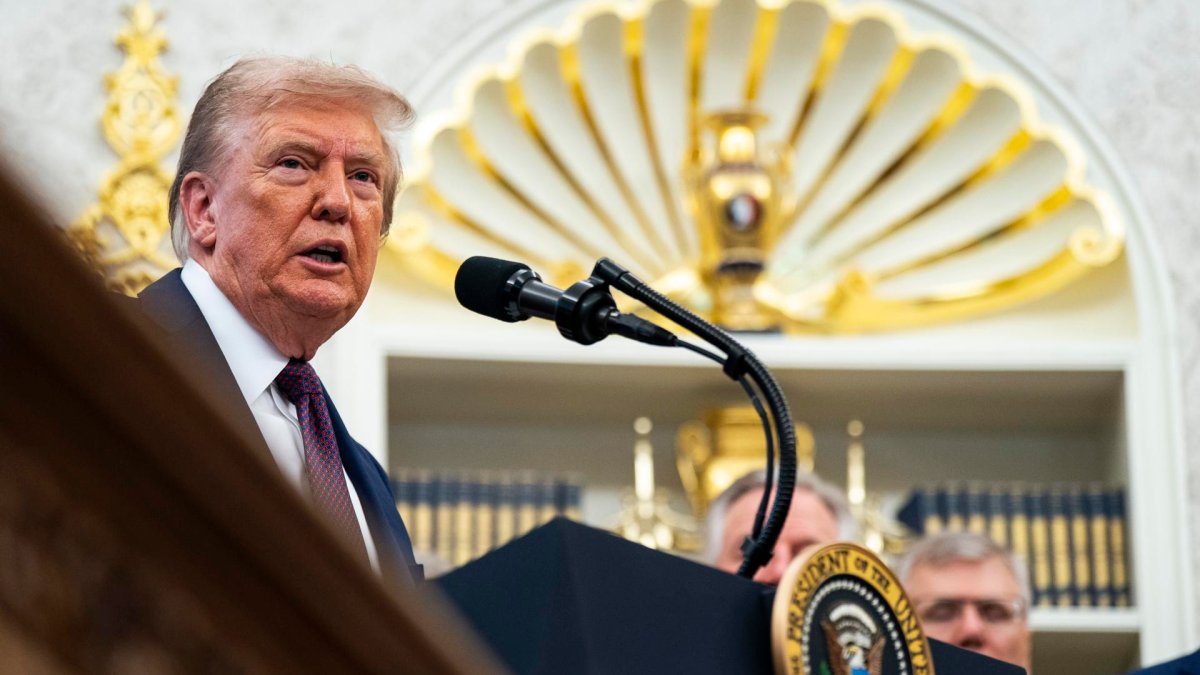
President Donald Trump Wednesday took a step back from talk of sending the National Guard to Chicago, saying Gov. J.B. Pritzker would have to ask for the assistance.
The governor bluntly dismissed such an idea Wednesday.
Pritzker said he will not be calling the White House to ask for federal intervention because of the potential for legal challenges against the deployment of the National Guard.
“He wants to set into the fact pattern that the governor called him to ask for help. Why? Because he’s going to end up in court,” Pritzker said. “He’s going to end up in court, and that will be a fact that they will use in court. That the governor called to ask for help, and I’m sorry I’m not going to provide him with evidence to support his desire to have the court rule in his favor. I’m just not going to do that.”
Just one day after Trump said “we’re going in” when asked about stepping up federal intervention in Chicago, the president seemingly walked back the idea of sending in the National Guard without a request from Pritzker and other local officials.
“We could straighten out Chicago — all they have to do is ask us,” he told reporters. “I want to go into Chicago, and I have this incompetent governor who doesn’t want us.”
On Tuesday, Trump had insisted he could send in the National Guard without Pritzker’s approval.
“Now, we’re going to do it anyway. We have a right to do it,” he said.
President Donald Trump said Wednesday that he’s assessing options for which cities to send National Guard troops, including Chicago, New York and New Orleans.
Instead, Trump said that his administration would consider sending the National Guard to New Orleans or Baltimore, a move that Louisiana Gov. Jeff Landry said he would welcome.
“We will take President @realDonaldTrump’s help from New Orleans to Shreveport!” he said on X.
While the National Guard may not be deployed to Chicago, enhanced federal immigration enforcement operations are still expected, with those resources centered at Naval Station Great Lakes.
Pritzker and other officials attended a hearing discussing preparations for such enforcement actions.
Illinois Gov. J.B. Pritzker said on Tuesday his office believes staging for ramped up federal enforcement in the Chicago area has already begun. NBC Chicago’s Natalie Martinez reports.
“What we’re hearing is that they’ll be assembled, ready to go on Friday, and that they will begin actions on Saturday,” Pritzker said. “And then what we’re doing is, of course, making sure that the CPD and local law enforcement are aware of what they’re doing so they can make sure they’re not standing anywhere near those actions or assisting in those actions, but also being ready for protests that might occur.”
With Mexican Independence Day celebrations getting underway, Pritzker had warned that “unidentifiable agents in unmarked vehicles with masks are planning to raid Latino communities and say they’re targeting violent criminals,” while noting that timing of such a deployment could be intentional.
“We have reason to believe that Stephen Miller chose the month of September to come to Chicago because of celebrations around Mexican Independence Day that happen here every year,” Pritzker said. “It breaks my heart to report that we have been told ICE will try and disrupt community picnics and peaceful parades. Let’s be clear: the terror and cruelty is the point, not the safety of anyone living here.”
Pritzker was asked where he had gotten that information, but declined to elaborate.
“Look, I’m not going to tell you where it comes from, and it’s not because it doesn’t exist. It’s because we’ve got calls from people who don’t want to reveal their names to the public. These are people from inside the administration or inside the military or inside the National Guard who are concerned about what’s happening in this country,” Pritzker said. “These are patriots who want us to know what’s happening. We’re getting no information from the federal government.”
Pritzker also warned residents that city and state officials cannot stand in the way of ICE operations, though they are legally prohibited from assisting with such enforcement actions.
“We cannot stand in the way. It’s not like we’re going to have armed men standing in between. That’s not something that’s legal,” he said. “That’s not something that the state of Illinois can engage in, or the city of Chicago can engage in. What we’re trying to do is to get them to follow the law, and when they are not following the law, we can take them to court, prosecute them if they’re doing something truly illegal.”