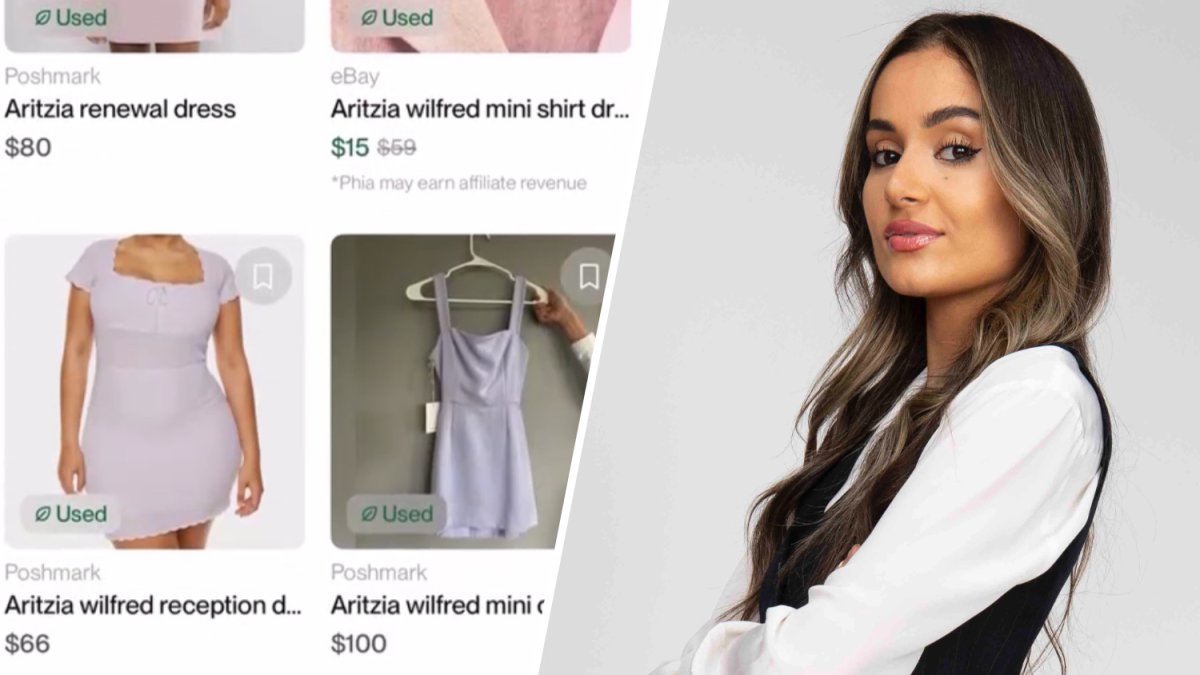
When McLean, Virginia native Sophia Kianni and her roommate Phoebe Gates (yes, that Gates) asked their classmates at Stanford University if they shopped secondhand, they were shocked to see only two people raise their hands.
“We asked them ‘Why?’” Kianni recalled, “And a lot of them were like, ‘I don’t know what resale platforms exist.’”
They realized that while secondhand shopping is growing at an exponential pace – the global market is expected to reach $367 billion by 2029, according to a report by the platform ThredUp – it’s still inaccessible to many. People often don’t have the time to look through hundreds of options on different resale sites to buy a piece of clothing.
In an AI entrepreneurship class, Kianni and Gates came up with an idea for an app that compares prices on items across many retailers and secondhand shopping sites. That way, people could see if an item they wanted to buy was available on a secondhand site for a better price.
“It very much was very buggy, like I would be looking at a black handbag and I’d get a red wallet, but it was in the right direction,” she said. “And so we really saw, ‘Oh my gosh, there is an opportunity to do this.’ And then we decided to move to New York City to go all-in and to go full-time and to see what else we could do and how far we could build.”
The app and website extension, called Phia, launched in April, with Kianni and Gates calling it a kind of Google Flights for fashion. The app now has more than 300,000 downloads, they announced they received funding from Kris Jenner, and Kianni and Gates were on Alex Cooper’s “Call Her Daddy” podcast.
From class to Capitol Hill
Kianni is just 24 but she’s no stranger to turning an idea into a startup. While a student at Thomas Jefferson High School for Science and Technology, in Fairfax County, she participated in a hunger strike for climate change awareness at former House Speaker Nancy Pelosi’s office.
The protest landed her on the cover of the school’s newsmagazine, which she said was “one of the top 10 coolest things to ever happen to me.” It’s high praise from someone who was included in “Forbes” 30 Under 30 list at age 20, sat on a U.N. youth climate council and met Pope Francis.
Kianni continued her advocacy her senior year of high school, when she founded Climate Cardinals, a nonprofit working to make climate change information accessible by translating articles into hundreds of languages.
When Kianni started the organization, she asked high school friends to help her put together a website and got a teacher to let her use a classroom to make calls during lunch and after school. Now, according to their website, Climate Cardinals has 16,000 volunteers across 134 countries.
How Phia works and why to consider shopping for secondhand clothes
With Phia, Kianni pivoted to another way to protect the environment: promoting sustainable clothing choices.
“We think it’s a really awesome way to incentivize people to really align their incentives of both saving money, which is the number one thing people care about, is people care about price, but then also incentivize them to think about how they can be more sustainable in their consumption habits,” she said.
Lisa Bergstrand, the founder of sustainable fashion consultancy Bergstrand, said many people want to buy sustainable clothing but don’t actually do it or don’t know what it takes for an item to be sustainable.
“People are asked like, ‘Would you pay more for a more sustainable garment?’ and most people say ‘yes,’ but then the numbers show that they actually just shop whatever they think is the nicest,” she said.
One of the easiest ways to be sure you’re shopping sustainably, Bergstrand said, is simply to buy secondhand.
While the app does show items from some retailers that aren’t secondhand, Kianni said it’s a way for people to see how secondhand and sustainable shopping could be better for them price-wise.
Next to suggestions in the app, there are price markers that show what a secondhand item costs compared to its cost brand-new. There’s also a sliding range that shows how much the item costs relative to other sites where it’s sold, and to similar items.
“In almost every case, there is an amazing opportunity to purchase a cheaper secondhand option or an alternative that is similar, but ultimately, the agency is up to the customer to make the decision that makes the most sense for them … It is almost always the better deal to purchase an item secondhand,” Kianni said.
Seeing that difference in the context of price can also help customers be more aware of the disadvantages of buying fast fashion.
“So being able to understand if I’m buying like a $500 handbag, what is the price that it’s selling for on the resale market? Like let’s say it’s $400, that’s 80% of its value being held, whereas a lot of fast fashion pieces instantly lose their value and they’re selling for pennies or dollars on the resale market, primarily because it’s lower-quality items,” she said.
Even if you do buy clothes brand-new, Bergstrand said it’s important to focus on basics.
“You can buy new also, but go for more classic garments that you think you will keep for a long time. And then for the more trendy part, buy secondhand and then try to resell it,” she said.
As the app has grown in popularity, Kianni said she received DMs from people showing her what they’ve bought using the app. Purchases have ranged from dresses and jewelry to even toaster ovens.
“People are literally using a product that we just dreamed up when we were in college,” she said. “And now it’s like a real living, breathing thing that is genuinely helping people. So yeah, those are definitely still pinch-me moments I have every single day.”