Summer can be a time for kids to get outside and trade apps for adventure. That’s been the experience of 15-year-old Crow Perine, who has been enjoying outdoor experiences at an Audubon Camp at Buffalo Creek Nature Preserve.
“On a regular day, I use [a phone] a lot more. I find myself scrolling through TikTok or Instagram,” Perine says. At camp, though, “I don’t even have that need.”
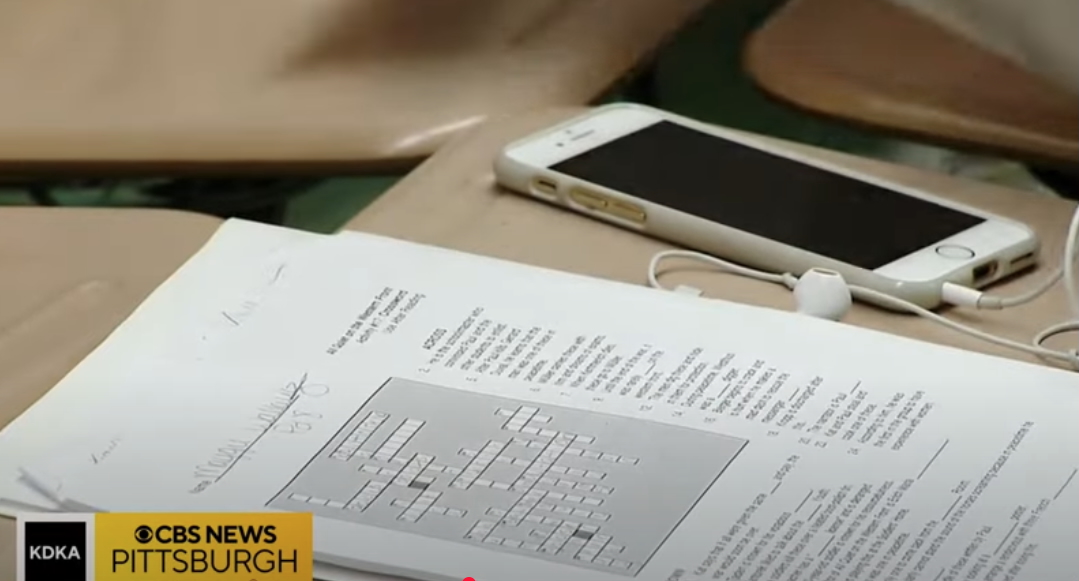
For many students, back-to-school can often mean getting back to screens. But that may be changing when it comes to phones at schools. Some Pennsylvania state senators are introducing a bill to make all schools in Pennsylvania phone free all day.
They have numerous reasons why: “Studies have shown that there is an epidemic. There’s an addiction with cell phones. The cell phones and the companies that make a lot of those applications — they’re in business to get you to keep coming back,” says State Senator Devlin Robinson, a Republican who represents parts of Allegheny County. “And whenever it’s an adolescent, whenever it’s a child that doesn’t understand that type of addiction, the government has to step in.”
State Senator Vincent Hughes, a Democrat representing parts of Philadelphia, points up concerns about students’ mental health and wellbeing: “The psychologists, the counselors all talk about this dramatic increase in suicides and mental health challenges that our children are confronting on a daily basis,” he says. “And we do know that… the stress or anxiety coming from the material that they’re seeing or paying attention to on their phone is contributing to that. We need to limit that.”
The senators also mention that phones are contributing to distraction in class and lower test scores. Almost 2/3 of kids got their first smartphone when they were age 10 or younger. That’s forcing schools to police how and where kids can use their phones.
One study found the median number of notifications teenagers get on their phone is 237 a day, and they use their phone for 4.5 hours a day with 43 minutes of that time at school (median use).
Educators like Gabi Hughes, an environmental educator at the Audubon Society camp, sees how phones are designed to hold the attention of not only kids, but adults as well: “When the screen is in front of them, that is what they’re focused on, and they’re completely ignoring everything around them. But as soon as you take that screen away and they have all of this incredibly rich visuals and things that they’re hearing all around, they completely engage.”
A 2024 study of NEA members found 83% of teachers want phones banned during the entire day. And many parents do too, including Janet Brown from Sarver.
The phones “just take their attention away from what they need to learn,” Brown says. “But also, kids — people in general — can just be a little mean on the internet. So it worries me for bullying and stuff like that, too.”
School administrators say phones have contributed to fights in schools, as well as cheating.
These senators say it will be up to each school board to decide how to implement the phone ban – whether it’s a lockable pouch, a basic folder like Sto-Rox High School uses now for their phone ban, or requiring students to keep phones in lockers or backpacks.
Two-thirds of states have school phone laws or policies, and 17 have laws known as “bell-to-bell” where the phone is away all day. Several countries ban phones in schools including the U.K., Australia and the United Arab Emirates.
“We are trying to make a competitive society,” Senator Robinson says, “and if we are not educating our children properly, or we are allowing them to be distracted at school, we are going to fall behind.”
Some critics want kids to have a phone in an emergency, like a school shooting. However, the National Association of School Resources Officers, which represents school police, is extremely supportive of phone-free school policies and says a school is safer when student phones are not present during the whole day.
Senator Robinson says he believes this bill has a good chance of becoming law because of the bi-partisan support. He says there’s a companion bill being introduced in the Pennsylvania House of Representatives, and he hopes the bill will be passed in the next session by spring.
If you’re curious about this issue, you can find more resources at Fairplay for Kids and Screen Time Action Network.