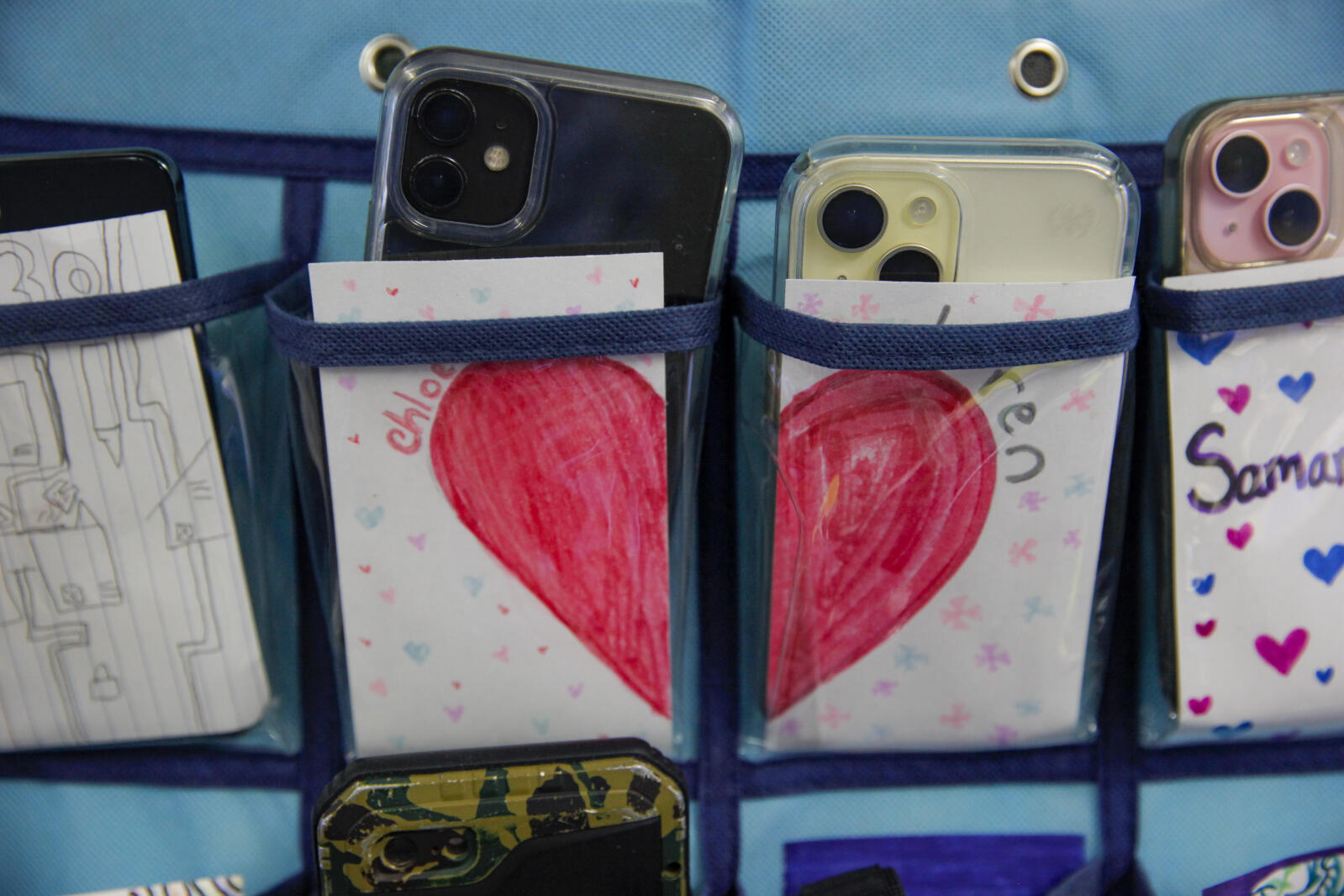
The new policy, which would start next year, restricts use of personal devices on TK-12th grade campuses, with some exceptions.
The Petaluma City Schools board will be taking up a hot-button topic at its next meeting: whether to ban cell phone use on all district campuses, from TK to 12th grade.
There are some exceptions to the proposed “phone-free” rule, which if passed would go into effect on July 1 of next year. The policy comes amid new state legislation giving school districts until July 2026 to “restrict or prohibit the use of mobile communication devices” on campuses during school hours.
The five-member board discussed the topic during its June 24 meeting, but decided to push back formal adoption to its Tuesday, July 22 meeting due to concerns that some of the policy language was “over-broad.”
“I’m just hoping that we’ll have more concrete (language) about what this is going to look like for the upcoming school year,” said board member Joanna Paun during the June meeting.
Board member Ryan Williams added to Paun’s sentiments, saying he was “concerned about how a violation of this policy will be treated at each school and in each classroom.”
Board member Ellen Webster, who sits on the district’s Cellphone Committee, responded that the committee is discussing ways to clarify those aspects in an updated version of the policy.
Overall, the district’s committee on cell phone use recommended adopting the phone-free policy, which would create a universal requirement that all students put their mobile devices away during regular school hours.
Currently, elementary and junior high schools already do not allow the use of cell phones during the school day, but high schools allow cell phone use during breaks and lunch periods. Under the new policy – as written as of the last board meeting – students would be allowed to use a mobile device on campus only in the case of an emergency, if a healthcare provider deems it necessary, or if a teacher or administrator gives special permission.
Another exception is if an individualized educational plan team determines that a student needs to use a mobile device at school.
Grassroots movement
Locally, parents and teachers have been calling for stricter control over cell phone use on school campuses, saying that giving kids a break from their phones during school hours will “give them some amount of time, eight hours a day, where they can have in-person relationships, focus on their studies, (and) develop psychosocial skills,” said Rachel Thomas, a Petaluma mom who helped spearhead a movement for phone-free schools at McKinley Elementary School, in a previous interview with the Argus-Courier.
Thomas joined forced with Melinda Hepp, another Petaluma mom, to form the group Phone-Free Schools Petaluma and advocate for change, particularly to the Petaluma City Schools district board and administrators.
Their efforts helped lead to the district establishing its Cellphone Committee in 2024, which is composed of parents, teachers, staff and administrators assembled to “review current practices” and provide feedback and recommendations to district officials.
Hepp said the committee met throughout the year to ultimately bring its recommendation to the board.
“We reviewed studies and research, consulted with other districts and schools that have successfully implemented cell phone-free campuses, and analyzed the district-issued survey to parents, students, and educators,” Hepp said.
She noted that according to a survey conducted by the district, the top concern regarding restricting cell phone use is safety during emergencies – as both parents and students want to be able to communicate should a school threat or similar incident occur, as happened at Penngrove Elementary School last October.
Given this, Hepp said, the committee consulted with Petaluma Police Department leaders and with Sonoma County Office of Education Superintendent Amie Carter, all of whom supported a cell phone-free policy.
“Putting resources into parent education on the benefits of cell phone-free schools will be key to successful implementation, and the schools will need to make some shifts to accommodate parents’ abilities to contact their kids while at school and vice versa,” Hepp told the Argus-Courier. ”It can be done.“
Student discipline
Under the recommended policy, students who use a mobile communication device in an unauthorized manner while at a school site or under the supervision of a district employee may be disciplined, and the district employee may temporarily confiscate the device.
“The employee shall store the device securely until it is returned to the student or turned over to the principal or designee, as appropriate,” the policy reads.
It also states that a student’s personal device is not allowed to be searched without the consent of the student’s parent or guardian, “except pursuant to a lawfully issued warrant, when a school official, in good faith, believes that an emergency involving danger of death or serious physical injury to the student or others requires access to the electronic device information.”
Students may also be subject to discipline for off-campus use of a mobile communication device that “poses a threat or danger to the safety of students, staff, or district property or substantially disrupts school activities.”
The district will not be responsible or liable for a student’s mobile communication device which is brought on campus or to a school activity and is lost, stolen or damaged, the policy states.
The board will review and, as necessary, update the policy at least once every five years.
Amelia Richardson is a staff writer for the Argus-Courier. She can be reached at amelia.richardson@arguscourier.com or 707-521-5208.