From the 1890s through the World War II, battleships ruled the waves. These steel leviathans projected naval power across all the world’s seas, clashing with other ships or bombarding enemy forces onshore with their giant guns. However, by the 1940s, battleships were becoming obsolete. While some other classes of warships built for World War II are still in service around the world, the rise of aircraft carriers and precision-guided missiles turned battleships into gigantic targets and floating liabilities. The age of the great ironclads has drawn to a close.
While there is some debate over what a 21st century battleship could look like, the world’s navies have moved on. This eventually included the US Navy, which mothballed the world’s last four active battleships in the 1980s and 1990s. These four, along with four other US battleships, now enjoy a second life as floating museums, serving to educate the public and to connect the people of today to the sailors who served aboard these ships during both World Wars, the Korean War, and beyond.
Visitors can stand beneath the mighty guns and walk the decks worn smooth by the passage of thousands of crew. They can marvel at the crowded living quarters and try to imagine being called to general quarters, racing through narrow corridors and up and down ladders to get to battle stations. These museum ships preserve not just the hardware but also the lived experience of their crews for future generations.
Read more: Ford Once Made A Mile-Long Factory To Build Bombers Faster Than Anyone Thought Possible
USS Texas

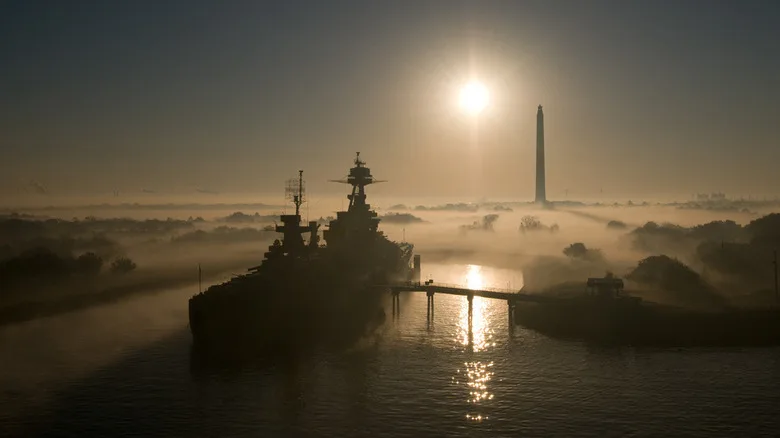
Battleship USS Texas seen from a high distance front port side view in morning fog with San Jacinto Monument in background – Louis Vest/Wikimedia Commons
The USS Texas is the world’s last surviving dreadnought, a class of early-20th-century battleship characterized by “all-big-gun” armaments and powerful steam-turbine propulsion. The Texas was commissioned in 1914 and served for 34 years, fighting in both World Wars. She participated in the invasions of North Africa and Normandy before transferring to the Pacific, where she fought at Iwo Jima and Okinawa. At Okinawa, the ship’s commander, Captain Charles Baker, kept his crew at battle stations for over 50 consecutive days to make sure they wouldn’t be caught off-guard by Japanese planes.
The Navy decommissioned her in 1946 and donated her to the state of Texas to be converted into a war memorial and museum. In 1948, she arrived at the San Jacinto Battleground near Houston, receiving her new commission as a memorial on April 21st, the date when the Texas Republic won its independence more than a century earlier. Unfortunately, time and salt water aren’t kind to an iron-hulled ship, and the Texas needed to be refurbished. In 2022, she was moved to a dry dock in Galveston for extensive renovations and repairs.
When the process is complete, Texas will remain in Galveston, permanently moored at a site called Pier 15. The facilities at that site are being upgraded to handle 19-foot storm surges and hurricane-force winds, ensuring that the ship will be safe in her new home. The shoreside infrastructure will be upgraded to handle crowds of visitors, too. Pier 15 lies within walking distance of Galveston’s historic Strand District, making the USS Texas easily accessible to tourists. The Battleship Texas Foundation hopes to reopen the ship to the public by late 2026 or early 2027.
USS New Jersey

Battleship USS New Jersey seen at night from starboard at her berth in Camden, New Jersey, decorated with lights – Sdwelch1031 – Own work/Wikimedia Commons
The battleship USS New Jersey launched on December 7, 1942, one year to the day after the attack on Pearl Harbor. She would go on to become the most decorated battleship in the US Navy’s history, serving in World War II, Korea, Vietnam, and the Middle East over the course of nearly half a century. The New Jersey is a member of the Iowa class, with a vault-like conning tower and extra-heavy armor throughout the ship, features which distinguished the class. The Iowa-class ships bore 16-inch main guns and were later updated to launch cruise missiles and anti-ship missiles, as well.
In the Pacific theater of World War II, the USS New Jersey fought in the two largest naval battles of the war, the Battle of the Philippine Sea and the Battle of Leyte Gulf. She also participated in every major amphibious operation from the invasion of the Marshall Islands through the Battle of Okinawa. She was decommissioned in 1948, but reactivated for service in the Korean War, the Vietnam War, and the last years of the Cold War. The Navy decommissioned her in 1991, although she remained a mobilization asset in reserve until 1999.
In November of 1999, she returned to the Philadelphia Naval Shipyard, where she was built, for restoration to be ready for public tours. Today, she resides at the Battleship New Jersey Museum & Memorial in Camden, New Jersey. Visitors can take interactive tours of the ship from the bridge to the gun turrets, while immersive exhibits describe the day-to-day operations of this mighty vessel. There are specialty tours, such as evening engine room tours. You can even fire some of the ship’s smaller guns. There’s also an overnight encampment program for youth groups and families.
USS Massachusetts

Battleship USS Massachusetts seen from starboard moored in Battleship Cove, Fall River, Massachusetts, with bridge in background – T.S. Custadio/Wikimedia Commons
The Battleship Massachusetts fired the US Navy’s first and last 16-inch shells of World War II, while fighting in some of the most intense combat on two oceans. Today it serves as the centerpiece of Battleship Cove, a naval museum in Fall River, Massachusetts. From Morocco to Honshu, the Massachusetts served with distinction before being deactivated and sent to join the Reserve Fleet in 1946. In 1962, she was sold for scrap, but her former crew members stepped in to save her and transform her into a memorial.
Moved to Fall River in her namesake state, the Massachusetts opened for public tours in 1965. Today, she’s the centerpiece of Battleship Cove, which features five National Historic Landmark ships and other vessels. In addition to “Big Mamie,” as the Massachusetts’ crew called her, visitors can tour the destroyer USS Joseph P. Kennedy Jr., the submarine USS Lionfish, and the PT Boats PT-617 and PT-796. Other vessels include a landing craft called the LCM 56 and a specialized intel-gathering semi-submersible called Gimik.
The star of the show is the 680-foot Massachusetts, with its complement of nine 16-inch guns and four General Electric steam turbines that generate a combined 130,000 shaft horsepower. The next-largest ship at the Cove, the Joseph P. Kennedy Jr., served from 1945 until 1973 and also featured in the Kevin Costner film, “Thirteen Days.” On the USS Lionfish, visitors can learn about life aboard submarines as well as topics like how diesel submarines work underwater. Battleship Cove is open year-round and offers memberships, group admissions, and free tours for children under age three and on children’s birthdays from ages four through 12.
USS North Carolina

Battleship USS North Carolina aerial view from above and to port side berthed as a museum in Wilmington, North Carolina – Doc Searls/Wikimedia Commons
The battleship USS North Carolina earned 15 battle stars in the Pacific theater of World War II. Her keel was laid in the New York Navy Yard in 1937, and she was commissioned in April of 1941 as the first of two ships in the North Carolina class of battleships. The 35,000-ton ship arrived in Pearl Harbor in 1942, several months after Japan attacked the base. The ship would go on to fight in every major campaign of the Pacific War, and then served as a training vessel before being decommissioned in 1947.
The ship joined the Inactive Reserve Fleet for several years, after which she was slated to be scrapped. However, the people of North Carolina mounted a campaign to save the vessel and move it to Wilmington. In 1961, she arrived at her new home on the Cape Fear River. A new World War II Memorial was dedicated at the site the following year. The site is across the river from downtown Wilmington and surrounded by a walkway that allows spectators to appreciate the exterior of the ship from every angle.
After coming aboard, visitors can tour the living quarters and gun turrets and see technology like early computers. Special events occur regularly, with recent events including the “Hidden Battleship” tour of unrestored parts of the ship and a historical presentation called “Forgotten Heroes: North Carolina’s Black Patriots of the American Revolution.” A recent tropical storm damaged the ship, exacerbating the ravages of age on a vessel that’s far beyond its intended service life. Funds from admissions help to pay for repairs, in addition to regular, ongoing maintenance.
USS Alabama

Battleship USS Alabama seen from front port side fiew berthed in Mobile, Alabama – Ben Jacobson (Kranar Drogin)/Wikimedia Commons
Commissioned in 1942, the USS Alabama began her service career guarding against potential German raids in the Atlantic. In the summer of 1943, the Navy transferred her to the Pacific, where she helped to capture the Gilbert Islands later that year. In 1944, she fought at the Battle of the Philippine Sea and the Battle of Leyte Gulf, as well as several island campaigns. After an overhaul in early 1945, she participated in the last months of the war and the occupation of Japan.
The Navy decommissioned the Alabama in 1947, and stricken from the Naval Vessel Register in 1962. At this point, the USS Alabama Battleship Commission took over, creating a memorial to honor Alabamians who fought in America’s wars, with the ship at its center. The USS Alabama Battleship Memorial Park sits on the Mobile waterfront, not far from the city’s downtown. In addition to its namesake ship, the park includes an Aircraft Pavilion, tanks and artillery on display, and a submarine named the USS Drum. The park also features several memorials for those who served in modern wars, along with memorials to POWs, fallen Coast Guard members, and service dogs.
Every other month, the ship’s Living History crew puts on reenactments of shipboard life during wartime. There are programs for school field trips and overnight scouting events, while group tours, private parties, and children’s birthday parties can all be arranged. Military ceremonies and reunions take place on board, as well. And for enthusiasts of history and military technology, the USS Alabama’s website includes a feature you absolutely cannot skip: an online virtual tour. This lets you wander the main deck from bow to stern, with 360-degree views in all directions. Be sure to stand under the massive guns and look up!
USS Wisconsin

Battleship USS Wisconsin seen from front starboard side view berthed in Norfolk, Virginia – flickr user dbking/Wikimedia Commons
The battleship USS Wisconsin joined the Navy’s active fleet in April of 1944, after being launched the previous December. An Iowa-class battleship, the USS Wisconsin supported carrier operations against the Japanese in the Philippines. She survived a catastrophic typhoon that sank three destroyers and went on to fight in the waters off Southeast Asia, Hong Kong, Taiwan, Okinawa, and the home islands of Japan. She would later serve in the Korean War and Operation Desert Storm. You can watch and hear the last time the Battleship Wisconsin fired its big guns in 1991.
The Wisconsin was decommissioned in September of 1991, although she was restored to the Naval Vessel Register in 1998. She arrived in Norfolk, Virginia, in 1996, where she is berthed as part of the Nauticus maritime discovery center on the downtown Norfolk waterfront. The city of Norfolk owns the ship as well as the grounds and facilities of Nauticus, the latter of which welcomes over 370,000 visitors per year. The exhibits at Nauticus include a schooner named the Virginia. The center’s museum includes the “Norfolk in Time” interactive exhibit, the Aquaticus children’s discovery center, and an aquarium.
Tours of the USS Wisconsin include the 45-minute Battleship 101 guided tour, the VIP Behind the Scenes Experience, and special tours of the command and control areas of the ship and the engine room. Special programs for children include summer camps, scouting events, and Battleship Overnights. There are also corporate retreats and overnights tied into Winterfest.
USS Iowa

Battleship USS Iowa seen from high port side view berthed in Los Angeles – Jonathan Williams – Own work/Wikimedia Commons
The namesake of the Iowa class of battleships, the USS Iowa was launched in 1942 and was soon tested in the crucible of World War II. It saw service in both the Atlantic and Pacific theaters of operation. In the Atlantic, the Iowa secretly transported President Franklin Roosevelt to Africa for the 1943 conference in Tehran. In the Pacific, the Iowa often served as the Navy’s flagship.
The USS Iowa went on to serve in the Korean War. Decades later, she was recommissioned and retrofitted to fire Harpoon missiles and cruise missiles. She also received Phalanx guns for defense against anti-ship missiles. Despite the modern armaments, the refurbished Iowa didn’t serve in combat. Tragedy struck in 1989, when 47 sailors died in an explosion in one of the ship’s gun turrets. This incident led the Navy to retire the Iowa for the last time in 1990.
In 2012, the Iowa moved to a new home in San Pedro, California, where it serves as the centerpiece of the Battleship USS Iowa Museum. Operated by a non-profit called the Pacific Battleship Center, the museum has since expanded to become the National Museum of the Surface Navy. Visitors can tour the ship or participate in special events like scavenger hunts. Special programs include “The Iowa Experience” and crew-led tours of areas like the gun turrets and engineering sections.
USS Missouri

Battleship USS Missouri aerial view from starboard side berthed in Pearl Harbor, Hawaii – US Navy/Wikimedia Commons
Another Iowa-class ship, the battleship USS Missouri, also known as the Mighty Mo, became a part of history as the site of Japan’s formal surrender at the end of World War II. Launched in 1944, the 887-foot Mighty Mo’s engines produced 212,000 horsepower, giving her a top speed of about 33 knots, significantly faster than the 27-knot top speed of Japanese battleships. She saw action during the US Navy’s attacks on Iwo Jima, Okinawa, and Tokyo. She was hit multiple times by Kamikaze aircraft attacks.
On September 2, 1945, Japanese Foreign Minister Mamoru Shigemitsu and General Yoshijirō Umezu boarded the Missouri to offer Japan’s formal surrender. In a brief ceremony, the Japanese officials and officers from the United States and eight allied nations signed the surrender document. Later, in the Korean War, the Missouri provided shore bombardment during the landings at Inchon and the Chosin Reservoir. In the 1980s and 1990s, she participated in actions in the Middle East, including Operation Desert Storm.
Today, the vessel sits at the Battleship Missouri Memorial in Pearl Harbor, Hawaii. Close to Honolulu Airport and other memorials in Pearl Harbor, it has been ranked as one of the top attractions for visitors worldwide. There are four permanent exhibits and a changing roster of temporary exhibits. There’s also an online exhibit called Kamikaze 80th Anniversary. There are community events and signature events, such as the Veterans’ Day Sunset Ceremony. The ship can also host private events, including weddings. There are onboard STEM education programs and overnight camping events, too.
Want more like this? Join the Jalopnik newsletter to get the latest auto news sent straight to your inbox, and add us as a preferred search source on Google.
Read the original article on Jalopnik.