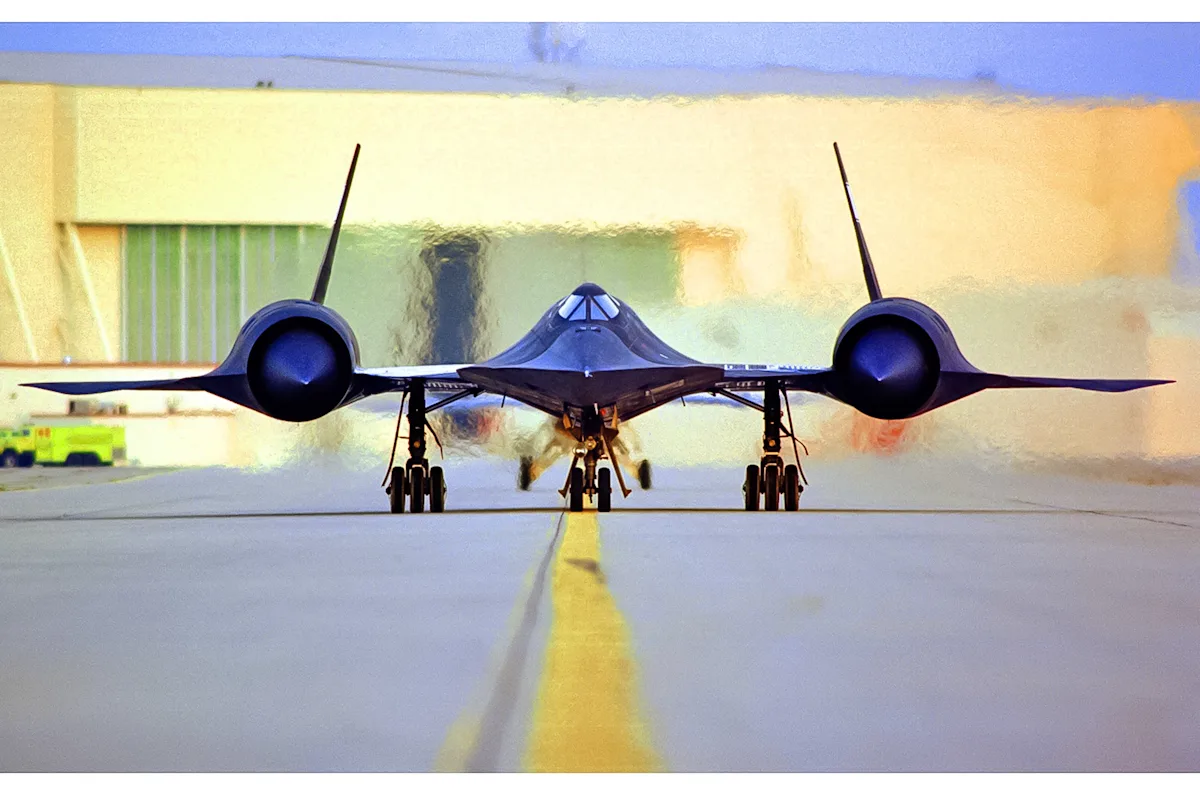
Sleek, black and evil in appearance, the SR-71 Blackbird was THE masterpiece of Cold War engineering.
Flying faster and higher than any fighter, this stealthy reconnaissance aircraft could snoop where it wished with impunity. Despite first flying over sixty years ago, its performance remains unbeaten by crewed air-breathing aircraft today. With its malevolent beauty and almost supernatural performance, the Blackbird was astonishing.
To create such a machine, new technologies and ideas had to be forged; full of ingenious ideas and performing dare-devil missions of strategic importance, here are just 10 incredible features of the SR-71 Blackbird:
10: King of the Cold War
King of the Cold War
The Cold War, held roughly between 1947 and 1991, was a struggle for dominance between the United States and the Soviet Union. With both superpowers armed to the teeth with nuclear weapons and multiple proxy wars across the world, it was a time of great tension. The SR-71 was the capable strategic reconnaissance aircraft of the Cold War.
When I asked former SR-71 Blackbird pilot BC Thomas to explain why the SR-71 was so important, he noted that, “The SR-71 has the deserved reputation of being the most unique air-breathing aircraft ever built. No other could fly as fast, as high, or carry thousands of pounds of equipment above 80,000 feet.”
10: King of the Cold War

King of the Cold War
“It was the primary strategic reconnaissance asset for the ‘West’ during the final 25 years of the Cold War. The SR-71 could sustain continuous Mach 3+ flight for over an hour while obtaining the highest quality reconnaissance information from multiple sensors, and with aerial refuelling (pictured), the aircraft could have circumnavigated the Earth in one flight.
The aircraft was one of the first to employ stealth technology, thereby ensuring that it was almost invisible to radar. Its speed and altitude also cloaked its presence. During this time of sparse reconnaissance satellite coverage over potential enemy targets, the SR-71 could sneak up, gather vital information, and leave the area without warning, and often without notice.”
9: Speed

Speed
The SR-71 was the fastest airbreathing crewed aircraft to fly, able to cruise at three times the speed of sound. To put this into perspective, this is around twice as fast as the fastest US Navy carrier fighter flying today.
“Our maximum speed limit, directed by the Flight Manual, was Mach 3.3, but the SR-71 was not power-limited, so it could fly faster; however, doing so would exceed the compressor inlet temperature limit, as well as other limits both heat-related and structural.”
9: Speed

Speed
“I am certain that no pilot ever put both throttles in maximum afterburner and let the aircraft accelerate to see how fast it would go. That would be a violation of military orders, the flight manual restrictions, and common sense. I, and most probably all other pilots, never purposely violated any published limits while flying the SR-71.”
“The SR-71 could attain Mach 3.5, but the aircraft would be in an untested and prohibited area outside of its flight envelope, and serious damage to the aircraft might occur. The SR-71 was point-designed to cruise continuously at Mach 3.2, which is quite an achievement, but it was not intended to have a lot of margin above that speed.”
8: Survivable

Survivable
The SR-71 combined speed, stealth and high altitude for survivability, but it also had a few other tricks, according to BC Thomas, “The SR-71 was never successfully intercepted by surface-to-air missiles or aircraft. It had a state-of-the-art electronic defensive system which would defeat an incoming missile’s homing and steering.”
“Detectors on board would alert the crew of a missile launch instantly and, since the SR-71 did not normally fly at its maximum speed or altitude, the aircraft’s defence was simultaneously to jam the missile’s guidance while accelerating, climbing, and turning with 45º of bank.”
8: Survivable

Survivable
“No surface-to-air missile could out-turn, and thus hit, an SR-71, a fact demonstrated many times, especially during the Vietnam War. Attempts to shoot down an SR-71 continued until August 25, 1981, which was the last time an enemy (North Korea) fired a surface-to-air missile at an SR-71; that mission was flown by Maury Rosenberg, pilot, and Ed McKim, Reconnaissance Systems Officer (RSO). It missed.”
The SR-71 had no real analogue, the closest counterpart being the far more conventional Soviet MiG-25R. Whereas the Blackbird used a great deal of titanium to survive the temperatures of high-speed flight, as well as an unusual powerplant, the MiG-25 used steel and a more conventional engine. The MiG-25R was slower, shorter ranged and more vulnerable: at least nine were shot down.
7: Missions

Missions
Reconnaissance flights penetrated Soviet airspace, overflew the land mass, and many were shot down. The Los Angeles Times reported in December 1992 that 40 reconnaissance aircraft were lost and 200 American airmen died conducting these flights. That number of lost personnel was confirmed by Paul Glenshaw in the Smithsonian Air & Space Magazine in 2017.
So aerial reconnaissance flights against potential enemies (the Soviet Union, China, North Korea, Cuba, the Middle East) were a top priority. These flights had to be conducted routinely and had to be survivable. The SR-71 was developed to fill that need.
7: Missions

Missions
“From 1966 to 1990, the SR-71 flew over 3500 operational reconnaissance missions while logging 11,000 hours in a flight environment which was most hostile: aircraft skin temperature averaged 620 degrees Fahrenheit (327 degrees Celsius), outside air pressure was 0.4 pounds-per-square-inch (psi), altitude was 15-16 miles (79,200 to 84,480 feet) straight up, aerodynamic damping was low, and true airspeed was typically 2000 to 2100mph, making pitch controllability critical.”
“For operational survivability, the SR-71 was one of the safest military aircraft, as no Air Force crew member was killed while flying one, a testament to outstanding aircraft maintenance and crew training. A remarkable record given its extreme flight envelope and potential attack risk.” (One pilot – Jim Zwayer – did die testing the SR-71 in January 1966, but he worked for Lockheed, not the air force).
6: YF-12 Fighter

YF-12 Fighter
The Lockheed SR-71 was a two-seat reconnaissance aircraft and the most famous member of the Blackbird family. The first member of the family was the single-seat A-12, fist flown on 26 April 1962, which was developed into the M-21 capable of launching the D-21 drone, and perhaps most impressively, the Lockheed YF-12 fighter-interceptor (pictured) first flown on 7 August 1963.
Until the late 1950s each generation of fighter interceptors was faster than the last. It stood to reason that the Mach 2.3 capable F-106 would be replaced by something even faster: the F-108 Rapier. Unsurprisingly, a fleet of Mach 3 fighters that weighed twice the weight of a loaded Lancaster bomber proved too expensive to develop.
6: YF-12 fighter

YF-12 fighter
It seemed a shame to waste the expensive radar, missiles and fire control system developed for the F-108 so they were fitted to the only available airframe of comparable performance, the extremely secret Lockheed A-12 reconnaissance aircraft.
The cost of the war in Vietnam and a less defensive military posture saw the funding for the 93 aircraft the USAF wanted scrapped. Elements of this weapon system eventually found their way onto the F-14 Tomcat.
5: Kit

Kit
Despite flying at such extreme altitudes, the Blackbird was able to photograph items on the ground with incredible detail. It was also able to quietly snoop on enemy electronic signals. It was loaded with the most advanced aerial reconnaissance equipment in the world.
We spoke to Blackbird pilot BC Thomas who noted, “We carried an array of sophisticated sensors and recorders which could glean reconnaissance data with cameras capable of high-quality photographs horizon-to-horizon. We also had radar imagery capable of one-foot resolution.”
5: Kit

Kit
“This was the Advanced Synthetic Aperture Radar System (ASARS), which could deliver readable radar pictures night or day, bad weather or clear. I’m no photo interpreter, but even I could tell what was pictured. The SR-71 also carried electronic intelligence (ELINT) systems which are still classified.”
“We advertised that the SR-71, within 24 hours notification, could be over any target on earth and be capable of surveying 100,000 square miles of terrain each hour. It was no idle boast.”
4: Navigation

Navigation
An SR-71 flying in the wrong patch of airspace could cause diplomatic problems or far worse consequences. But navigating with great accuracy at speeds in excess of 2000mph (3218 km/h) in the days before GPS was no easy thing. The solution was Astro-inertial navigation.
Such a system had been developed for the massive Skybolt air-launched missile. The system known as the Nortronics Division Astroinertial Navigation System was adapted for use in the SR-71 and given the designation NAS-14V2. This enabled an accuracy within half a mile after thousands of miles of high-speed flight, a remarkable achievement in pre-satellite navigation times.
4: Navigation

Navigation
According to BC Thomas, “The Astro-inertial navigation system (ANS), once aligned, could automatically track 61 stars from a catalogue, identifying their position, and through a complicated algorithm, quickly compute the aircraft’s altitude, attitude, speed, ground track.”
“It would continually update the aircraft’s position while directly controlling the aircraft’s ground track (if engaged by the pilot) and providing automatic pointing and control of the cameras and sensors. Even at maximum speed, the ANS could provide course guidance within a quarter of one mile—unbelievable technology before the advent of GPS.”
3: Exotic powerplant

Exotic powerplant
The Pratt & Whitney J58 (known as the JT11D-20 to the manufacturer) was an incredible engine, and the SR-71 had two. At lower speed, these function as normal turbojets, providing the aircraft with all its required thrust. The inlets have movable cones known as spikes.
At higher speeds, air entering the inlet bypasses the engines and is channelled straight to the afterburners and ejector nozzles, making a ramjet. One of the most remarkable things about the SR-71’s propulsion system is how little thrust was made by the engine itself at speed.
3: Exotic powerplant

Exotic powerplant
At Mach cruise, the J58 engine was responsible for a mere 17% of the Blackbird’s thrust: of the remaining thrust, 54% came from the inlet and 29% from the ejector!
The engine pioneered several technologies. It was the first dual-cycle engine, a combined turbojet-ramjet. An afterburner adds fuel to the rear of an engine for extra thrust; for fighter aircraft, this is used sparingly, but the J58 was the first operational engine to be designed for the continuous use of afterburner. The afterburner itself was innovative, using spray bars of variable geometry, another first. The aircraft relied on a special fuel, JP7, which had a higher flashpoint than normal jet fuel, allowing safe use at higher temperatures.
2: Don’t blame friction!

Don’t blame friction!
We asked hypersonic expert Dr Chris Combes his thoughts on what makes the skin of very fast aircraft so hot, and it may surprise you to learn it is not friction: “This is a bit of a minor pet peeve, but something I hear frequently nonetheless. It is common knowledge that high-speed flight leads to aerodynamic heating.”
Famously the Concorde experienced surface temperatures in excess of 212 Fahrenheit (100 degrees Celsius) and the SR-71 saw surface temperatures well above 570 degrees Fahrenheit (300 degrees Celsius). This is not even to mention vehicles returning to Earth from space, as re-entry temperatures can easily exceed 1800 degrees Fahrenheit (1000 degrees Celsius). But where does the heating come from?
2: Don’t blame friction!

Don’t blame friction!
Based on our everyday experience, many cite friction as the leading cause of heating, but this would be incorrect. Similar to the way that air cools when it expands, air heats up when it is compressed.
“Supersonic flight creates shock waves that rapidly compress air and lead to considerable heating. This effect scales with the square of the Mach number, so that atmospheric air can be heated to about 480 degrees Fahrenheit (250 degrees Celsius) with a shock wave at Mach 2 and nearly 2732 Fahrenheit (1500 degrees Celsius) with a shock wave at Mach 5.”
1: Stealth

Stealth
The Blackbird boasted a speed and altitude performance that made it impossible to intercept, but Lockheed wasn’t taking any chances, and the aircraft was also a pioneer of radar stealth. This approach aimed to minimise an aircraft’s chance of being detected by radar involves careful attention to shape and materials.
The overall blended shape and smooth finish of the SR-71 with its long fuselage chines (a chine is a longitudinal line of sharp change in the fuselage cross-section) aids stealth. The rudders are canted in so they avoid forming a 90-degree angle with the fuselage, which can increase the radar signature. The sharp sweep of the wing reflected radar energy away from the hostile transmitter.
1: Stealth

Stealth
Within the Blackbird’s black paint were suspended iron ferrite balls. When radar energy hit the paint, it caused molecular oscillations, which converted the radar energy into heat. The heat was then dissipated into the airframe. The colour of the black paint also aided visual stealth by hiding the aircraft in the inky-black sky found at extreme altitudes.
This ‘iron ball paint’ is a form of Radar Absorbent Material (RAM). Other forms of RAM were used in the Blackbird’s chines, the leading and trailing edge of the wing, the inlet spike and the nose. The Blackbird was the first operational stealth aircraft decades before the word and concept became widely known.
The Blackbird Today

The Blackbird Today
32 SR-71s were built, and 12 in total were lost in accidents. It first entered service in January 1966, and was first retired from the US Air Force in 1989. Three SR-71s briefly re-entered service in 1996 after the US Congress released funds, but it was then permanently retired from the USAF in 1998. NASA operated two SR-71s (which had been loaned from the USAF) between 1991 and 1999, carrying out various experiments around altitude and speed.
The Blackbird Today

The Blackbird Today
20 SR-71s remain in existence today at museums. Notable places to see one are at the National Museum of the US Air Force (near Dayton, Ohio) and The Smithsonian Institution Steven F Udvar-Hazy Center (near Washington, DC). Europeans should head for the American Air Museum at Duxford, near Cambridge in England.
It’s wonderful that this incredible aircraft is being preserved for future generations.
Follow Hush-Kit’s incredible aviation stories on Substack and X
If you enjoyed this story, please click the Follow button above to see more like it from Autocar
Photo Licence: https://creativecommons.org/licenses/by/4.0/deed.en
]]>

