Block by Block is a solutions journalism series that is supported by IFF, CEDAM and Invest Detroit, and is focused on community development leaders and initiatives in Michigan, Ohio and Indiana.
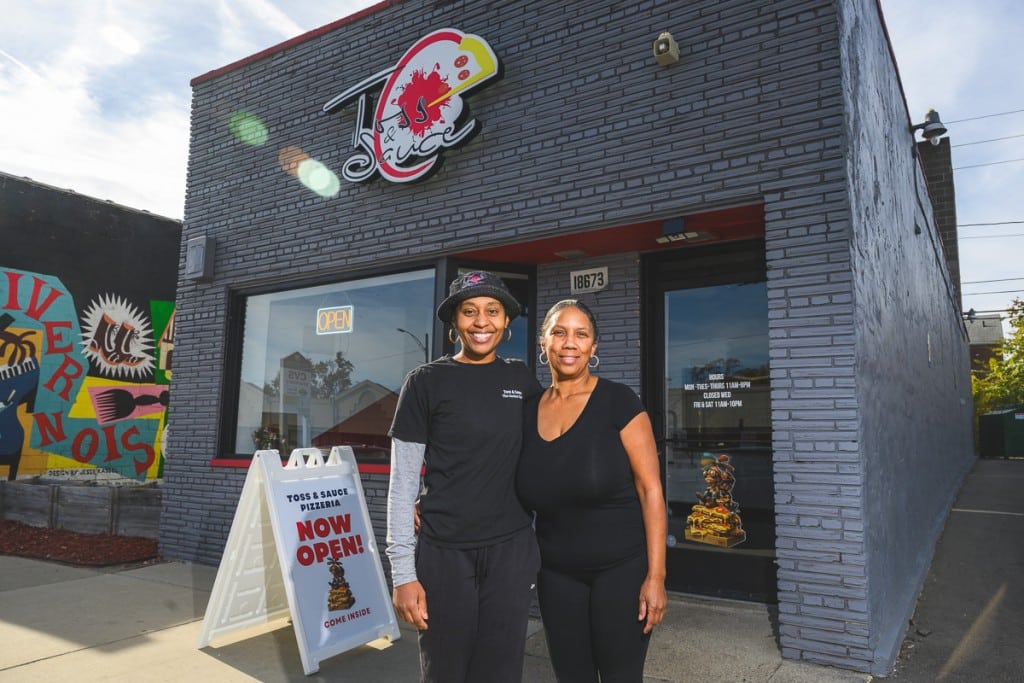
Ashley Guynes thought she’d never return to Detroit. Today, she’s the co-owner of Toss & Sauce, a customizable artisanal pizzeria located at 18673 Livernois. It’s a project made possible by financial support from a CDFI, Invest Detroit. The project is part of a larger, passionate commitment to help lift up historic neighborhoods and their small business ecosystems, including the Livernois McNichols Corridor.
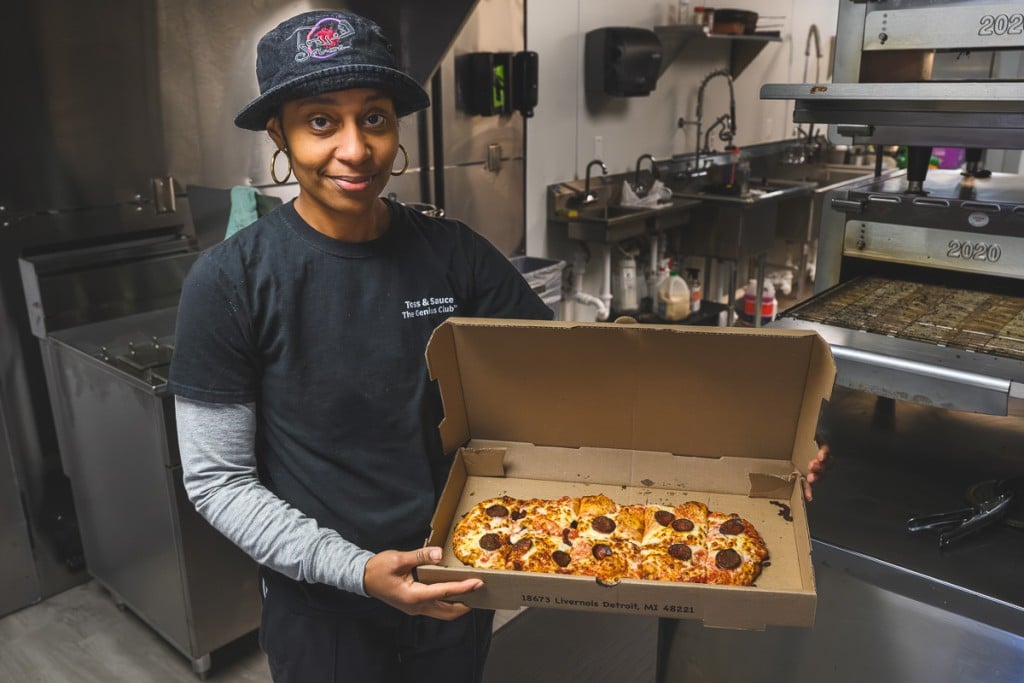
Guynes has an educational background in business and entrepreneurship from Howard University, as well as professional culinary arts experience as a private chef and working in kitchens featured on The Food Network Channel.
“When I left for college, I always said I may consider moving back home if anyone ever buys the Michigan Central Station and rehabs that,” she says. “I said that because at that time, it seemed like a long shot. That building had been vacant for so long, but when I first saw that someone had bought it, I was like, ‘no way, this can not be real.’”
Guynes is a spiritual person and started asking God through prayer if this was a sign she should come back home. After confirmation through prayer, some other signs and specific people coming into her life, she felt inspired to come back to Detroit.
The idea for Toss & Sauce came about in 2018 after finding a similar business model in Washington, D.C.
“We thought we could put a Detroit culture spin to that concept, to bring it back home in the community and be a part of the regrowth of Detroit,” Guynes says.

Two blocks away from Toss & Sauce is the home where Guynes grew up.
Today, she says “the area has grown leaps and bounds since then.” She attributes the success of her own business, in part, to the help of CDFIs like Invest Detroit.
“It’s been such a huge help,” she says. “Without Invest Detroit, we wouldn’t have made it this far. It’s a catalyst to help dreams come true. We’ve invested a lot of our own personal funding, but CDFIs have helped to bring it to fruition.”
Invest Detroit helped with networking, business cohorts, and providing access to capital through a loan. She advises other entrepreneurs to follow their passion, stick to it, and be patient.
“It may take hard work, but as long as it’s your passion, stick to it,” she says. “Network too, because a lot of things are not about what you know, but who you know as well. You never know who you may be bumping into that can help along the way.”
Having been open for a little over two months, the community’s support of Toss & Sauce has been overwhelming, says Guynes.
“The encouragement from the customers that come in, and them knowing that we’ve been a long time coming, it’s been awesome,” she says. “Our goal is to continue to grow our customer base daily, and to introduce a new product line of serving wings.”
The entrepreneur also hopes to serve as a mentor, creating partnerships with different schools in the neighborhood. When she was younger, the entrepreneur seeds were planted as her aunt Cher Slater (co-owner of Toss & Sauce) was an entrepreneur owning different businesses. Now, Guynes hopes to help plant those seeds for the next generation of entrepreneurs.
Jermaine Ruffin is the senior vice president of neighborhoods at Invest Detroit, the largest headquartered CDFI in the state. He works closely on strategic planning and implementation of development, utilizing public-private partnerships, the City of Detroit, philanthropic organizations, and other organizations.
“We focus on neighborhood economic development within 10 different geographies within the city,” he says. “We support real estate development, support infrastructure, improve and support small businesses already there, as well as help new businesses.”

Invest Detroit is no stranger to redevelopment in the Livernois McNichols Corridor, creating retail, commercial and residential space in the tight knit community. The historic Livernois Avenue of Fashion emerged as a luxury shopping spot in the fifties, filled with fashion and beauty stores, hat stores, and beauty salons. The area is currently experiencing a sense of resurgence today. As residents and entrepreneurs bring cultural expression and creativity to the area with restaurants, boutiques, and art spaces — the area is one of the nation’s highest concentrations of Black-owned businesses.
“There was a period of time where the vacancy had increased, and small businesses began to leave the area during the last downturn in the market,” Ruffin says. “Some small business associations located on the corridor have been integral in trying to make sure Livernois could be restored to all its glory and luster.”
Around 2007 and 2008, many local residents lost their homes to foreclosure, and vacant homes began to deteriorate. Following demolition from blight reduction, vacant lots transformed into Ella Fitzgerald community park. Invest Detroit also provided support for a residential development of affordable units for residents in the McNichols area.
Through raised philanthropy and leveraging city dollars, Invest Detroit has been able to support this neighborhood’s economic development within the Livernois McNichols Corridor. Updates include wider sidewalks during warmer months, extended outdoor seating on the corridor, and improved streetscapes.
“Over the past 10-15 years, we’ve seen this slow but steady change from a blighted area to an area where residents and businesses are beginning to thrive,” Jones says. “We’re seeing vacant buildings and lots now being cleaned up, prepared for future development, community use, or are being utilized currently. That’s one of the bigger things that we’re most proud of in our work.”
Because of the intentional investments, Ruffin is also seeing business owners improving their properties on their own.
“One of the biggest fears from Detroiters when it comes to development is the conversation around gentrification,” Ruffin says. “When you’re making an investment and folks don’t see themselves as part of the future vision, there is typically a great deal of pushback — as there should be. One of the things that we pride ourselves on, is that because we’ve had those underground conversations, residents have had a voice or a role in helping to decide what the future of their neighborhood looks like. What we’re seeing and implementing now in the corridor is a realization of that input from those residents.”
Recently, these developments have also sparked future commitment to investment, too. One of Invest Detroit’s key partners and funders, the Kresge Foundation, announced their new headquarters will be in McNichols Corridor. Ruffin considers this a major thing to have one of the largest and most active foundations in the City of Detroit be housed in the Livernois McNichols area.
The community response has been positive, says Ruffin. On a typical day, you can see folks active at the basketball court in Ella Fitzgerald Park, hosting inaugural neighborhood festivals, and pedestrians and bicyclists enjoying the greenway connecting Marygrove College campus to the corridor.
“More than anything, we try to lead with local residents and Detroiters for those small business opportunities,” Ruffins says. “We work with partners who specialize in educating, providing technical assistance and resources similar to what ProsperUs does — to ensure the longevity, success and sustainability of those partners we’ve supported along the corridor.”
Paul Jones is the CEO of ProsperUs, a CDFI focused on community partners, providing business support services like workshops, training, cohorts and one-on-one technical assistance for businesses.
In the Liv-6 community, ProsperUs has made 24 microloans totaling over $557,000 of investment, had 130 business owners graduate from their 12-week entrepreneurial training program, and invested over $170,000 in business support services for 46 small business owners.
ProsperUs aims to help close the wealth gap by providing financial capital, community and social capital, as well as knowledge.
“Everybody thinks about the financial piece, but when we look at supporting a business, we know that having social capital — having a strong network of supporters as well as community capital, are both just as important if not more important to your long-term financial liability.”
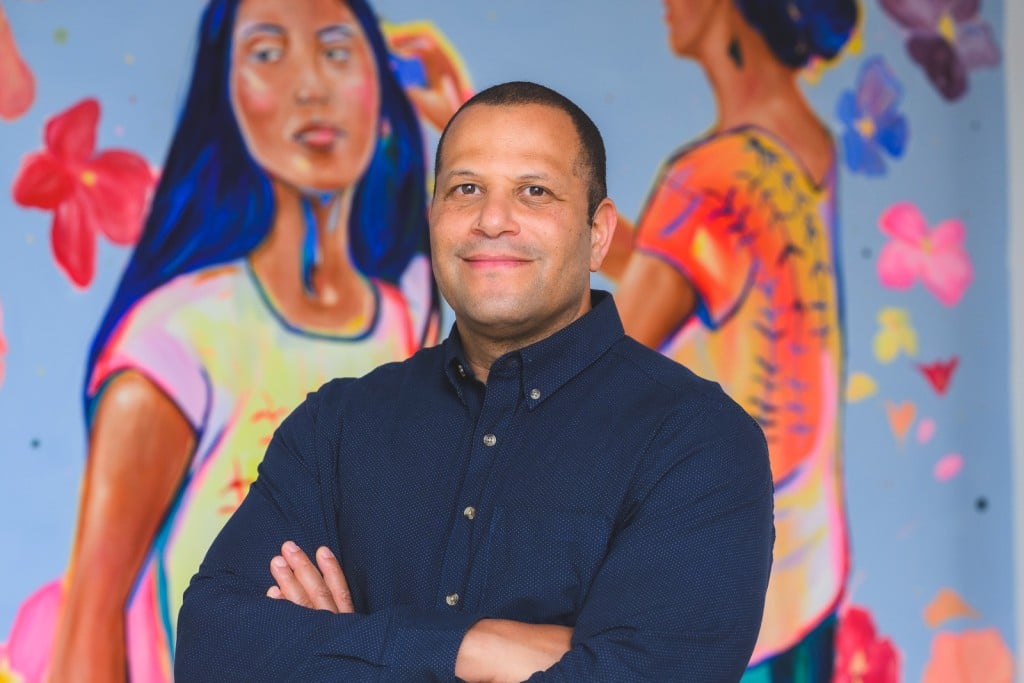
Jones says this corridor is a totally different visible experience as well as energy from 10 years ago. With new multi-unit residential apartments built, and increased traffic patterns and bigger sidewalks brought more foot traffic and businesses.
“All these things have created this level of vibrancy all year round that is unparalleled with any other community in Detroit,” he says. “It also remained true to its influence, so it’s truly a unique space. The Livernois McNichols or the Live-6 area, or Liv-Six, has increasingly become one of those places that you feel really good about being able to shop local, raise a family, and then also have those universities that bring a certain attraction as well. There’s this cross-current of different residential pools in that area, and a really interesting, dynamic mix of businesses —bakeries, restaurants, frame shops, art galleries, hair salons, and estheticians.”
It’s that community density that has enabled a rich tapestry of businesses to create a rising tide, says Jones.
“There’s a saying that you don’t have to leave your community to live in a better community. I think this really speaks highly to our ability to create better communities through providing intentional investment around vibrancy.”
Creating better communities doesn’t have to mean gentrification or pricing out legacy businesses who are community anchors.
“This area has retained a lot of legacy businesses, and hence has retained a lot of this authenticity and culture, which is very rich in this area,” Jones says.
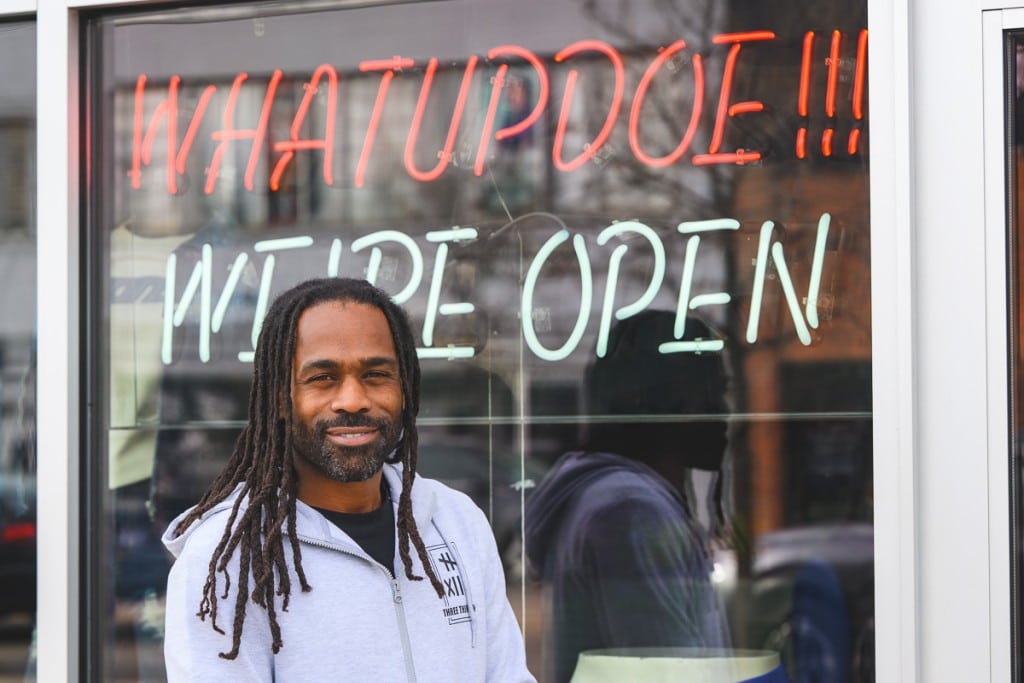
Clement Brown Jr. is hoping to build his own legacy with his business, Three Thirteen, nestled among the Avenue of Fashion.
“Three Thirteen is a Detroit culture shop,” he says. “Back in 2008, when the city was getting on national news for a bunch of negative issues we were facing, I thought it would be valid to show a side of Detroit that was more positive.”
He considers the location of his brick and mortar store as the epicenter for retail, and is proud to be part of the historic designation the area is known for.
“The area of the zip code 48221 is one of the most affluent areas in the city,” Brown says. “It offers a unique mix of homeowners, business professionals, city influencers, employees, and has a college in the area. It’s a special place for engaging community in the city.”
Although Brown was already impressed with the location, the building and the area’s legacy, he still needed help with financing the dream. After hearing of Invest Detroit from a friend, he connected with the CDFI after a traditional loan didn’t help in purchasing the property.
The retail owner hopes to see more of these vacancies filled with other small businesses to help lift up the entire ecosystem. In the future, he hopes to add additional income streams that compliment the foundation of the business. Yearly fashion events, adding a lounge about the store, sharing stories through media, and more ideas are in the works. He hopes to welcome more entrepreneurs as neighbors in this collective, collaborative environment.
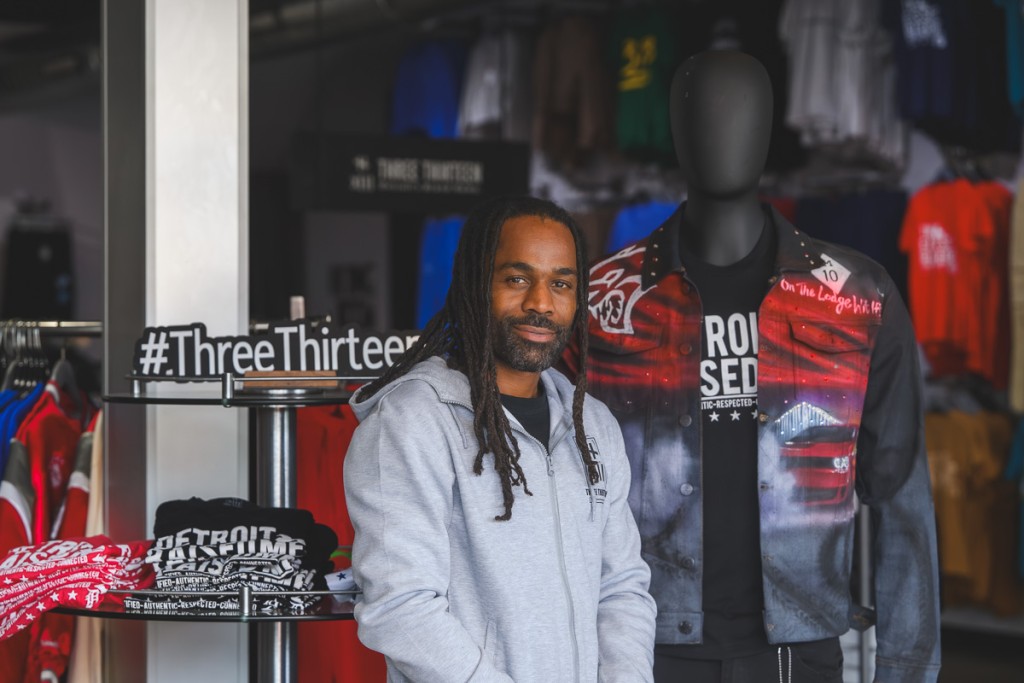
“Detroit is a place that offers opportunities to guys like me that may not have the academia experience or may not have the political relationships, but have the tenacity and the downright resourcefulness to make something happen — to generate something positive out of something negative,” Brown says.