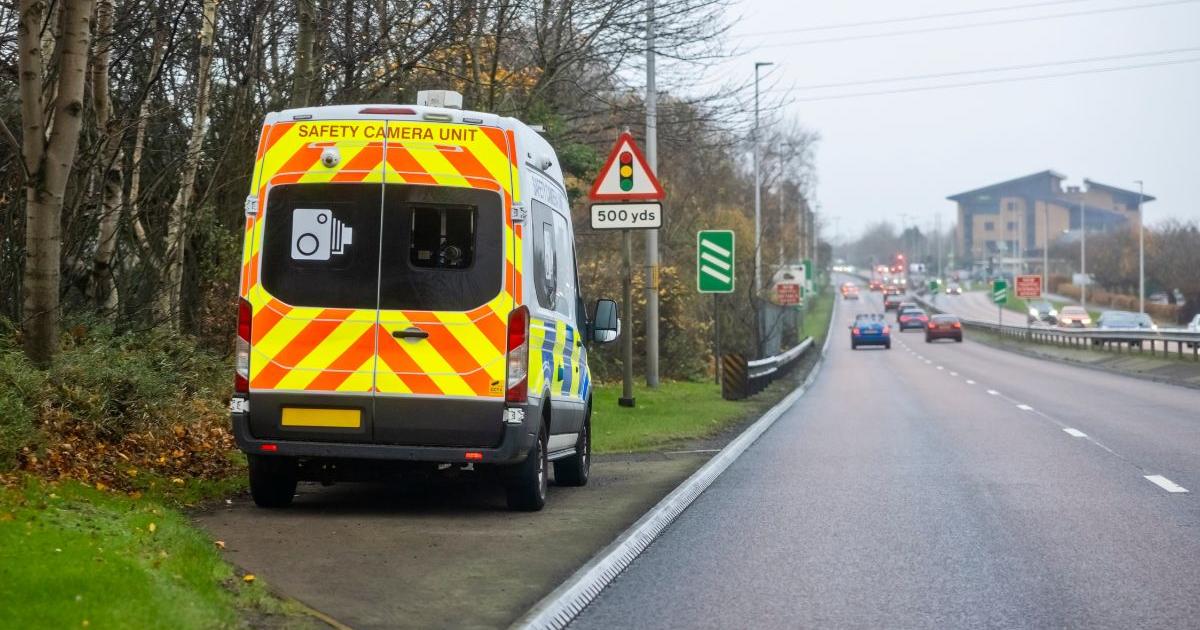
Yet, many drivers still don’t fully understand how these cameras operate, and several common myths persist across the country.
Regardless of what you think you know about speed cameras, with penalties ranging from fixed fines and licence points to potential court appearances, the best approach is simple: don’t take the risk.
This is how speed cameras work, what speed triggers them, and some commonly believed myths.

How do speed cameras work?
Speed cameras work using radar or road markings to monitor a vehicle’s speed and capture evidence of any offence.
While older cameras used film, most modern devices are fully digital and can even track your average speed over many miles.
These digital systems record:
- Vehicle speed
- Time and location of the offence
- Vehicle registration
- Road speed limit
In some cases, they even capture a clear image of the driver and passenger.
What Speed Actually Triggers a Camera?
Contrary to common belief, there’s no universal “10% + 2mph” rule baked into law.
Experts from BigWantsYourCar.com explained: “The idea that you’re safe doing 35mph in a 30 zone is one of the biggest myths we hear.
“Technically, you’re liable for a fine the moment you go even 1mph over the limit.”
While the National Police Chiefs’ Council (NPCC) does recommend a “10% plus 2” margin to allow for officer discretion, this is not a legal threshold and can vary depending on the enforcement area or the officer reviewing the case.
Recommended Reading:
RAC advice adds: “The law states that you are liable for a speeding fine as soon as you exceed the limit, so if you’re doing 31mph in a 30 limit or 71mph on a motorway, you’re breaking the law and could receive a fine.
“It is well worth remembering this is totally dependent on the officer who catches the speeder, and it is up to that officer whether to fine the offender or not.
“The best advice is to not speed full stop.”
Common speed camera myths
Here are some other common speed camera myths :
Is it true that speed vans have to be visible at all times?
No. There are no laws about visibility, so nothing is stopping an officer from operating in the dark. But they don’t often choose to do this and maintain that being visible acts as a deterrent in its own right.
Go Safe Casualty Reduction Officer, Gareth Thomas said: “Legally, we don’t have to be visible. I could camouflage myself if I wanted to – but it’s all about being fair, education and preventing an accident. Even if I parked my van and went for a walk somewhere, it would deter people from speeding right away.”
Is it illegal to flash your headlights to alert motorists of a GoSafe speed van?
If drivers choose to flash to warn others about a speed van, they could be in breach of the law. Under section 89 of the Police Act 1997 it is an offence to “wilfully obstruct a constable in the execution of his/her duty”.
However, Gareth says while it is an offence, it is very difficult to prove. He said: “It doesn’t bother me that people flash to warn them of the speed van – I just want to educate people and the van to act as a speed deterrent.”
What happens if I am caught speeding?
It all comes down to the circumstances within which you were caught speeding, and how much you were more than the limit. The minimum penalty for being caught speeding on the UK’s roads is a £100 fine.
But Gareth explained in some circumstances, police can offer the option of attending a speed awareness course – an alternative to a fine and penalty points. Gareth, said: “An accredited course is far more likely to improve driver behaviour and consequently make our roads safer.
“Courses are available to drivers who respond quickly to the ‘notices’ and who were driving at no more than 10 per cent, plus 9 mph above the posted speed limit.”
So for example, anyone travelling over 86mph on a motorway would not be offered the awareness course. Those who don’t have a clean licence at the time of the office, or if you have been on the course in the last three years, it is unlikely you will be offered the awareness course as an option.