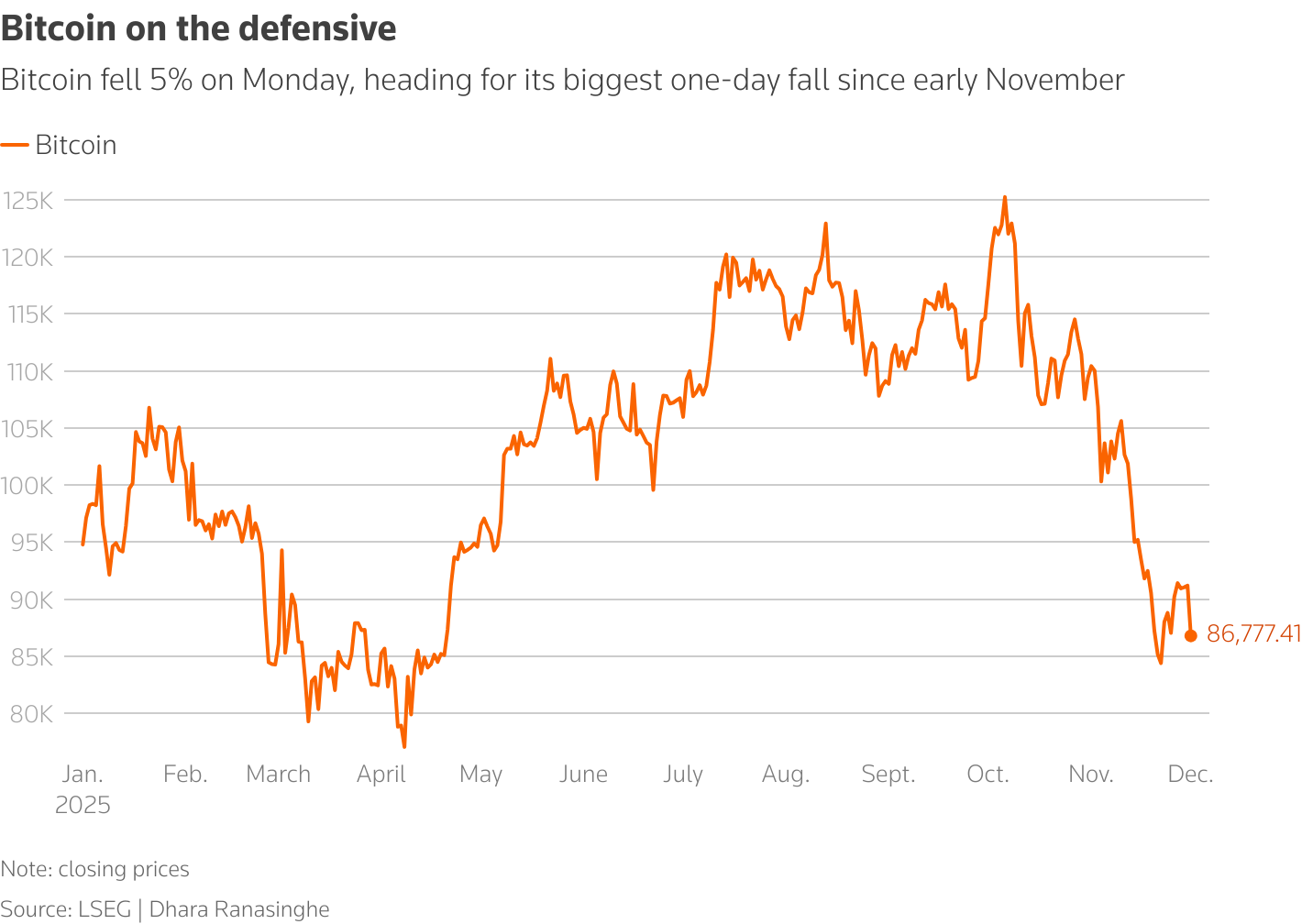
LONDON, Dec 1 (Reuters) – Bitcoin fell below $90,000 on Monday, as a selloff gathered pace following the steepest monthly decline since mid 2021, as renewed risk aversion drove investors out of stocks and digital assets.
The world’s largest cryptocurrency fell by as much as 6.1% at one point. By 1120 GMT, it was down 5.2% at $86,461, set for its biggest one-day fall in a month and hovering near last month’s eight-month low of $80,553.
Sign up here.
Bitcoin shed more than $18,000 in November, as a record amount of money rushed out of the market, making this its largest dollar loss since May 2021, when a number of cryptocurrencies collapsed.
RISK INDICATOR
Given its relatively short lifespan, there is not much in the way of seasonality to guide traders’ expectations for how bitcoin usually behaves in December.
On average, bitcoin has tended to rise by around 9.7% in December, ranking it third in terms of performance, with October being the strongest month, with an average gain of 16.6%, and with September, the weakest month, with an average loss of 3.5%.
“Bitcoin tends to be a leading indicator for overall risk sentiment right now, and its slide does not bode well for stocks at the start of this month,” XTB research director Kathleen Brooks said in a note.
“There is no obvious driver (on Monday). However, the sharp decline in volatility last week, the VIX fell back below the average for the last 12 months, may have unnerved some investors who remain concerned about an uncertain outlook into year-end,” she said.
CME bitcoin futures also show the growing bearishness.
Bitcoin futures that expire in three months’ time are trading at their smallest premium to those that expire this month in at least a year, reflecting how investors are less willing to bank on a sustained rise in the price over time.
Ether , was down nearly 6% at $2,845, having lost some 22% in value in November, the most since February’s 32% slide.
NEGATIVES STACKING UP
Jefferies strategist Mohit Kumar said that a number of crypto-negative factors were adding to the pressure on bitcoin on Monday.
S&P Global downgraded its rating of Tether, the world’s largest stablecoin last week, citing an increase in higher-risk assets in its reserves and “persistent gaps in disclosure,” which Tether said it “strongly disagrees” with. Meanwhile, Phong Le, chief executive of Strategy, the world’s largest corporate owner of bitcoin, told the “What Bitcoin Did” podcast on Friday the company would consider selling its holdings if its “mNAV” metric – the company’s enterprise value against the value of its bitcoin holdings – fell below 1. That ratio is currently around 1.19, according to Strategy’s website.
Given how much Strategy shares have fallen in the last year, with a slide of 60% compared with a 13% drop in bitcoin in that time, the company could already risk being ejected from benchmark indices, which would exacerbate the pressure on the company’s stock and its mNAV metric. Index provider MSCI ends a consultation this month on whether to exclude from its benchmarks those companies whose holdings of digital assets exceed 50% of their total assets.
Since hitting a record of around $4.3 trillion in size, the crypto market has lost over $1 trillion in value, according to CoinGecko.
Additional reporting by Shashwat Chauhan; Graphic by Dhara Ranasinghe; Editing by Louise Heavens and Susan Fenton
Our Standards: The Thomson Reuters Trust Principles.