Claire MawisaBBC Africa Eye, Free State

 BBC
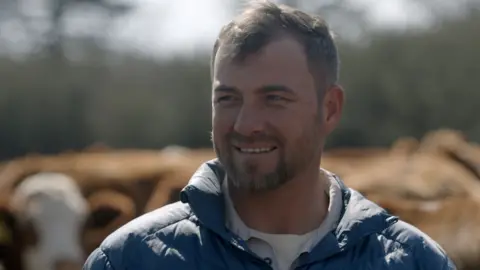
BBCThe 4m-high (13ft) electric steel gates, capped with spikes, creak open as Marthinus, a farmer, drives through in his pick-up truck. Cameras positioned at the entrance track his every move, while reams of barbed wire surround the farm in the rural Free State province in the heart of South Africa.
“It feels like a prison,” he says as the gates clank shut behind him. “If they want to come and kill us they can. At least it will take them time to get to me.”
The fear of being attacked is very real for the white Afrikaner, who manages a farm with his wife and two young daughters. He did not want us to use his full name.
His grandfather and his wife’s grandfather were both murdered in farm attacks, and he lives a two-hour drive from where the body of 21-year-old farm manager Brendan Horner was discovered five years ago, tied to a pole, with a rope around his neck.
Marthinus says he can’t take a chance with his own family and, in February, they applied for refugee status in the US.
“I’m prepared to do that to get a better life for my wife and children. Because I don’t want to be slaughtered and be hanged on a pole,” he says.
“Our Afrikaner people are an endangered species.”
Not all white South Africans agree that they’re being targeted and black farmers are also victims of the country’s high crime rate.
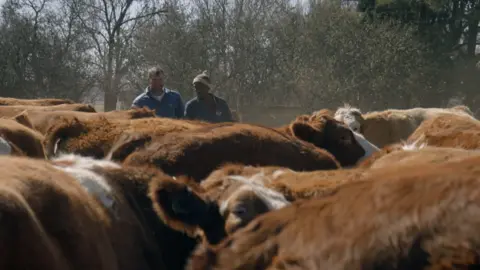
It’s estimated that thousands of Afrikaners – who are mostly white descendants of early European settlers – have begun the lengthy process of applying for refugee status in the US since President Donald Trump signed an executive order earlier this year, although the figures haven’t been made public.
Despite announcing in October that the US would reduce its yearly intake of refugees from 125,000 to 7,500, Trump has made the resettlement of Afrikaners a priority.
A presidential document posted to the official daily journal of the US government stated that those accepted would “primarily” be Afrikaner South Africans and “other victims of illegal or unjust discrimination in their respective homelands”.
For Marthinus it’s a way out.
“I will give my whole life just so that my wife and my kids can be safe. Living in fear, you know? Nobody deserves a life like that.”
Violent crime in South Africa is endemic.
The latest crime figures released in November for the first quarter of 2025 show there was an average of 63 murders every day. While this was a decrease on the same period in 2024, South Africa’s homicide rate remains one of the highest in the world.
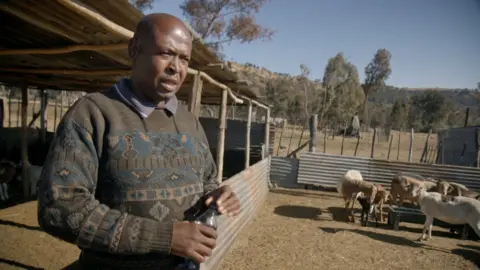
Black farmers are also victims.
On the outskirts of Ficksburg, a town at the foot of Free State’s Imperani Mountain, Thabo Makopo has a small farm of 237 acres (96 hectares), where he tends sheep and cattle. Like Marthinus, the 45-year-old says farm attacks are his biggest problem.
“They are young men. They are armed and dangerous. Whether they will lose their life or take yours, they are going to take those livestock,” he says.
Thabo believes all farmers in the province, regardless of their race, are at risk of attack.
“It’s all of us. I could be attacked today – it could happen to any of us.”
Police response rates to reports of crime are notoriously low, something the police here acknowledge but have said publicly that they are working on.
In the meantime, South Africans are becoming increasingly dependent on private security. According to the official regulatory body for the private security sector in South Africa, there are more than 630,000 active security guards. That is more than the police and army combined.
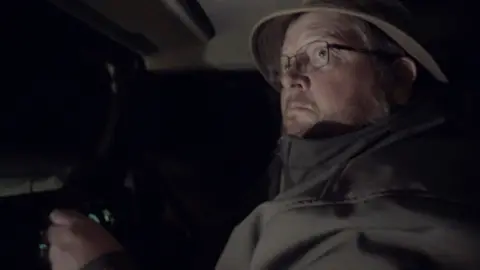
Many farmers, like Morgan Barrett, who is white, employ their own security guards, if they can afford it. He owns a 2,000-acre farm which has been in his family for six generations.
Wrapped up in a thick jacket and hat, he climbs into his car to begin a night patrol. Between Morgan and his neighbours, they are out almost every night. Six of his cattle were stolen the previous week.
“You can call the police, and they may turn up two or three hours later, by which time the thieves will have run away,” he says.
Like Thabo, he doesn’t believe he is targeted because of the colour of his skin.
“I don’t buy that narrative that in this area the attacks are against whites only.”
“If they thought that the black guy had 20,000 rand ($1,200; £880) sitting in his safe, they’d attack him just as quickly as they’d attack the white guy with 20,000 [rand] in the safe.”
Asked about what he thinks of people claiming there is a “white genocide” in South Africa, he says he thinks they “have no real understanding of what a genocide is”.
“What happened in Rwanda is genocide. What is happening to white farmers is very bad, but I don’t think you can call it genocide.”
Viewers in the UK can see more on Global Eye at 19:00 on BBC Two
Trump has repeated the widely disputed claims there is a genocide against white farmers, while South African-born billionaire Elon Musk, has accused South African politicians of “actively promoting” a genocide.
The government here has vehemently denied that Afrikaners and other white South Africans are being persecuted.
The country does not release crime figures based on race, but in May, in order to debunk these claims, Police Minister Senzo Mchunu gave a breakdown of killings on farms.
Mchunu said that between October 2024 and March 2025, there were 18 farm murders across South Africa. Sixteen of the victims were black, while two were white.
Despite these statistics, the theory that white people are being persecuted for their race, once an idea confined to far-right groups in South Africa, continues to be propelled into the mainstream.
Systematic racial persecution is something black people in South Africa, who make up more than 80% of the population, faced for decades.
Under the apartheid system that lasted for 46 years from 1948, the white-minority government legally separated people based on the colour of their skin.
It built on already existing discriminatory legislation.
The right to vote, buy land and work in skilled jobs was reserved for white people. Millions of black South Africans were removed from their land and forced to live in segregated neighbourhoods where education in schools was restricted to maintain racial hierarchy.
The regime was enforced through violence and repression.
Even though apartheid ended in 1994, the profound racial inequalities continue to exist more than 30 years later.
The post-apartheid government did introduce affirmative action policies to try and redress some of the issues, but these have been criticised by some for not being effective and introducing “race quotas”.
Nevertheless, 72% of private farmland is still in white hands, according to the government’s 2017 Land Audit report. That’s despite white people making up just 7.3% of the population.
A land reform programme – based on the principle of willing-seller willing-buyer – has hardly moved the dial. A new law this year does give the state the power to expropriate some privately owned land without compensation for owners, but this is only in rare circumstances, according to legal experts who spoke to the BBC.
And while white farmers own more private land than any other group in the country, victims of farm attacks span across all races.
The political spotlight is on white farmers, yet crime and violence on the ground is indiscriminate.
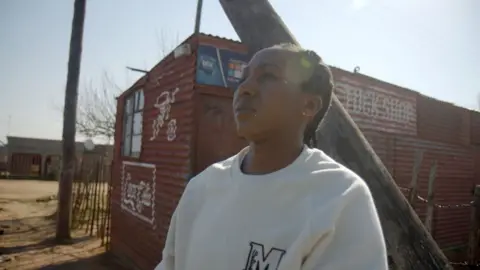
In Meqheleng, a township on the outskirts of Ficksburg where black South Africans were forcibly relocated during the apartheid regime, Nthabiseng Nthathakana owns a small general store.
On 15 January this year, there was a robbery while her husband, Thembani Ncgango, was closing up. He managed to run to a neighbour’s house but his attackers threatened to kill them if they opened the door.
Nthabiseng found Thembani’s body on the ground outside.
“He had bullets everywhere and stab wounds. They had stabbed him and hit him with rocks,” she says.
No-one has been arrested for his murder.
Nthabiseng is now the sole provider for her four children.
“The kids ask questions: ‘Mama who killed dad?’ And you don’t know what to say,” she says.
Two hour’s drive from Ficksburg, Marthinus and his family have just found out their refugee application to the US has been successful.
They’re busy planning the big move, waiting to hear when their flights will be allocated.
He maintains white people are being persecuted in South Africa.
“A lot of people believe that it’s a political thing to get rid of us as white farmers or white people in this country, so they can have this land for themselves and this place for themselves.
“I’m really grateful to be getting away from this feeling of fear. I’m thankful to almighty God for answering our prayers.”
Additional reporting by Isa-Lee Jacobson and Tamasin Ford
 Getty Images/BBC