Toplines
Taiwanese President William Lai Ching-te announced that his government will introduce the Special Budget for Asymmetric Warfare on November 25—the largest special budget in Taiwanese history.[1] The proposed budget would markedly improve Taiwanese warfighting capabilities and its efforts to implement an asymmetric defense strategy to deter a PRC invasion. The proposed budget amounts to approximately 40 billion US dollars to be spent from 2026 to 2033. The budget is twice as large as Taiwan’s second largest special budget passed in October 2025.[2] The budget reportedly allocates funds for arms, including precision artillery, long-range precision strike munitions, anti-aircraft and anti-tank missiles, unmanned aerial and surface vehicles, drone countermeasure systems, and artificial intelligence-assisted command and control systems.[3] Taiwanese media reported that Taiwan would either domestically produce those systems or buy them from the United States.[4]
Lai and National Defense Minister Wellington Koo emphasized the budget’s role in realizing the “T-Dome” air defense concept.[5] The T-Dome aims to integrate low-, medium-, and high-altitude air defense systems with highly maneuverable platforms to increase Taiwanese resilience against PRC missile and drone attacks.[6] PLA writings describe a “joint firepower strike campaign” that the PLA would likely conduct before an invasion of Taiwan, targeting critical infrastructure and command-and-control infrastructure.[7] Fighting in Ukraine and the 12-day war between Israel and Iran have shown that multi-layered integrated air and missile defense (IAMD) networks can be highly effective against long-range missile and drone strikes.[8] Improving the Taiwanese ability to withstand a first strike of this kind without significant losses would complicate PLA plans for an invasion of the island.
Taiwan seeks to bolster its defensive capabilities by integrating drones similar to how Ukrainian forces have. The density of drone use has rendered the Ukrainian battlefield largely transparent, allowing both sides to target exquisite systems and groupings of forces several kilometers from the frontline.[9] The Taiwanese Ministry of National Defense announced in October 2025 the establishment of drone units within certain commands and the restructuring of the 66th Marine Brigade to include dedicated drone warfare formations in place of its armor and artillery.[10] These changes mimicked the Ukrainian decision to create a separate “Unmanned Systems Forces” to scale and mass drone capabilities and coverage of larger operational areas.[11] The special budget would procure unmanned systems that could enable Taiwan to enhance its reconnaissance and surveillance capabilities, which can serve as a force multiplier for its other systems. Koo also said that the budget procurement included precision munitions for use against an amphibious landing or “deep-strike operations.”[12] Long-range precision munitions can devastate a larger military that is concentrating forces for a multi-echeloned offensive, such as an amphibious landing campaign, particularly when paired with drone-based reconnaissance.[13] Taiwan could complicate PLA amphibious invasion plans considerably if it effectively uses precision munitions to degrade PLA forces at long ranges.
Lai acknowledged that the special budget only covers the material side of military modernization and that tactical and operational concepts still need updating.[14] The Taiwanese military would likely benefit from decentralizing its command hierarchy and encouraging initiative at lower command levels if it is to fully and effectively implement an asymmetric defense strategy. A decentralized command hierarchy would make Taiwan’s forces less vulnerable to PLA precision strikes and reduce command-and-control issues.
The Kuomintang (KMT) and Taiwan People’s Party (TPP) are organizing opposition to the special budget, potentially jeopardizing Taiwanese national defense and international perceptions of Taiwanese resilience. The KMT and TPP jointly opposed a proposal from the Lai administration to hold a Legislative Yuan (LY) session to discuss the bill on December 5.[15] Both parties criticized the proposal for lacking details on the systems to be procured and their integration into Taiwanese defense posture. Failure to pass the special budget without significant cuts may prevent the Taiwanese military from adapting to modern warfare and weaken international confidence in the Taiwanese willingness to provide for its own defense. [16]
KMT rhetoric criticizing the bill mirrors CCP narratives framing the spending increase as provocative and servile to the United States. Newly elected KMT Chairwoman Cheng Li-wun echoed CCP rhetoric disparaging the bill as provocative and harmful to Taiwan’s security.[17] KMT lawmaker and co-chair of the LY Foreign Affairs and Defense Committee Ma Wen-chun characterized the Lai administration on December 2 for “taking orders” from the United States.[18] A PRC Taiwan Affairs Office (TAO) spokesperson similarly criticized the Lai administration for “squandering funds” to pander to “external powers.”[19] Ma previously opposed ruling Democratic Progressive Party (DPP) efforts to increase defense spending during her time as a legislator.[20] CCP efforts to influence Taiwanese politics to defeat the bill illustrate the threat that the bill poses to the CCP ability to coerce Taiwan militarily.
Other KMT lawmakers have emphasized delays in US deliveries of purchased military equipment to Taiwan to question further spending on US weaponry.[21] Further delays in US equipment deliveries to Taiwan may undermine Lai administration efforts to bolster Taiwanese readiness.
The indigenously produced Taiwanese Hai Kun submarine faces continued KMT criticism despite conducting successful sea acceptance trials on November 26 and 27. Continued political opposition to the submarine program may undermine the ability of the Taiwanese Navy to adequately respond to a blockade or invasion. Hai Kun has faced delays in its sea acceptance trials, which were previously scheduled for September 2025.[22] The KMT froze funding for the seven subsequent submarines to be built between 2025 and 2038 until Hai Kun completes its sea trials, after which the LY will hold a hearing to consider unfreezing the funding.[23] The KMT has claimed that the submarine program is too expensive for a system that could be destroyed at the outset of a conflict.[24] KMT legislator and co-chair of the Foreign Affairs and Defense Committee Ma Wen-chun said on December 1 that Hai Kun had several equipment deficiencies that the Ministry of National Defense and Navy were unable to adequately explain.[25] PRC state media Global Times echoed these criticisms, along with the rumors that Hai Kun conducted sea trials without a working anchor and defective watertight doors that Ma referenced.[26] Ma previously led KMT efforts to oppose the submarine program and was accused of leaking details about the submarine to the PRC in 2023.[27]
The performance of sea acceptance trials, although delayed, is an important step toward making Hai Kun operational and introducing an important capability to the Taiwanese Navy. Hai Kun will still have to complete further tests in deeper waters before commissioning.[28] Maintaining a modern submarine force would likely improve the ability of the Taiwanese Navy to respond to a PRC blockade by forcing the PLA to disperse forces to find Taiwanese submarines.[29] Diesel-electric attack submarines like the Hai Kun are capable of threatening large surface vessels, such as amphibious assault ships.[30] Submarines likewise would have greater survivability against a PLA first-strike campaign than the Taiwanese surface fleet.
Key Takeaways
- Taiwanese defense spending: Taiwanese President Lai announced the introduction of the largest special defense budget in Taiwanese history. The proposed budget would markedly improve Taiwanese capabilities and efforts to implement an asymmetric defense to deter a PRC invasion.
- Taiwanese defense spending: The KMT and TPP are organizing opposition to the special defense budget, which could jeopardize Taiwanese national defense and international perceptions of Taiwanese resilience. The KMT has echoed CCP talking points framing the spending as provocative.
- Taiwanese submarines: The indigenously produced Taiwanese Hai Kun submarine faces continued political opposition despite conducting successful sea acceptance trials. Continued opposition may undermine the ability of the Taiwanese Navy to respond to a PRC invasion or blockade.
Cross-Strait Relations
Taiwan
A small Taiwanese airline proposed a civil-military partnership to help Taiwan track PRC vessels around Taiwan. Taiwan could use civilian firms and organizations to improve its threat awareness and self-defense capacity while reducing the burden on its military and law enforcement. Reuters reported that Apex Aviation—a Taiwanese airline known for charter flights and pilot training—is pitching a plan to use its planes to conduct reconnaissance flights for the Taiwanese government.[31] Apex converted one of its propeller planes into a reconnaissance aircraft by attaching a US-made synthetic aperture radar and is proposing to use the radar-equipped aircraft to collect data on PRC ships around Taiwan. The Taiwanese government has not approved the cooperation but said that it is open to creative public-private partnerships.
Contracting civilian aircraft to conduct reconnaissance around Taiwan could yield certain advantages. Taiwan could fly a light aircraft for a reconnaissance mission at one-tenth the cost of a military plane, according to Reuters.[32] Private firms can produce and operate drones for this purpose as well. Contracting civilian aircraft in this way is consistent with the Lai administration effort to increase civic and private engagement in Taiwanese defense, though Taiwan will likely have to develop regulations for civilian participation in law enforcement.[33] Taiwan can use radar-equipped surveillance aircraft to detect PRC vessels that sail with their Automatic Identification Systems (AIS) deactivated, which are invisible to standard ship-tracking platforms. These “dark” vessels include most military ships and many ostensibly civilian boats. The PRC has used dark vessels and deceptive tactics, such as AIS spoofing, to obscure its malign activities in Taiwanese waters and to strain the bandwidth and the reliability of Taiwanese threat detection.
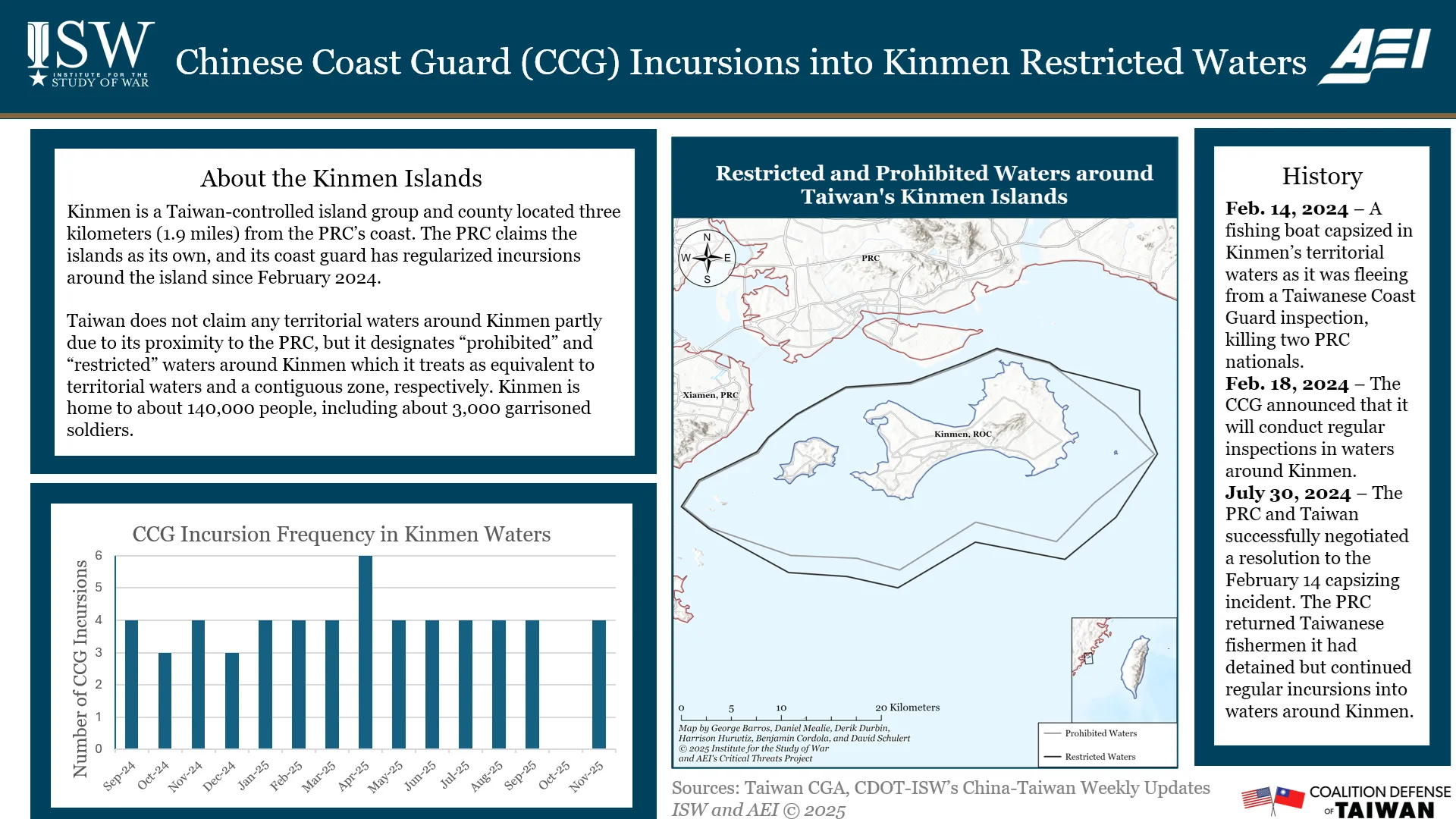
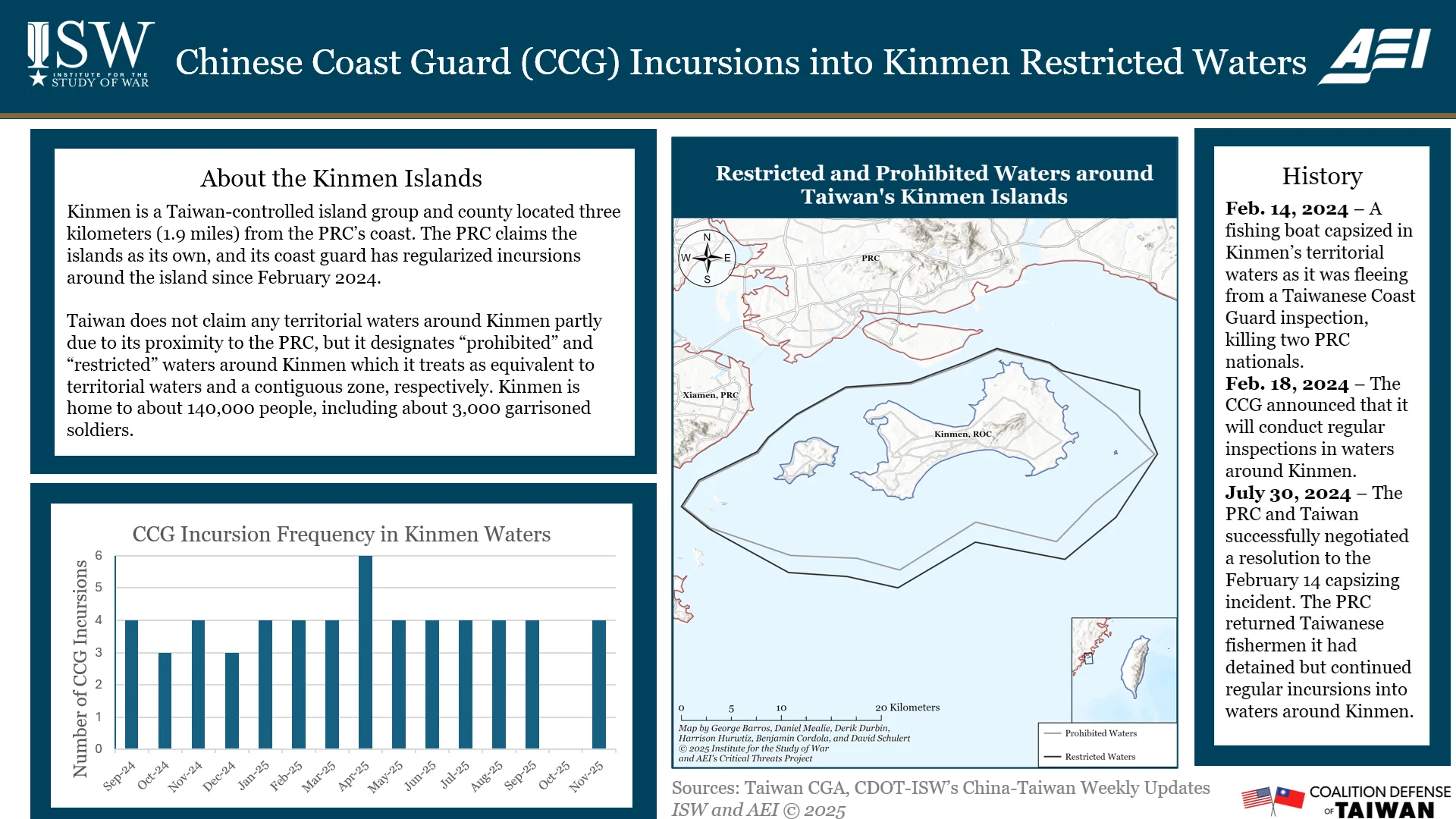
The China Coast Guard (CCG) conducted four incursions into waters around Kinmen in November 2025, following no known incursions the previous month. Four CCG ships patrolled in Taiwanese restricted waters around Kinmen on November 13, twice on November 20, and again on November 28.[34] Kinmen is a Taiwanese archipelago located two miles from the PRC, making it an easy target of PRC coercion. Taiwan does not claim any territorial waters around Kinmen, partly due to its proximity to the PRC, but designates “prohibited” and “restricted” waters around Kinmen, which it considers equivalent to territorial waters and a contiguous zone, respectively.
CCG ships likely intrude into Kinmen’s restricted waters to erode Taiwanese sovereignty over Kinmen’s littoral zone, desensitize Taiwan to the CCG presence around the island, and expend Taiwanese Coast Guard resources. The PRC claims these incursions are legitimate law enforcement patrols within its own territory.
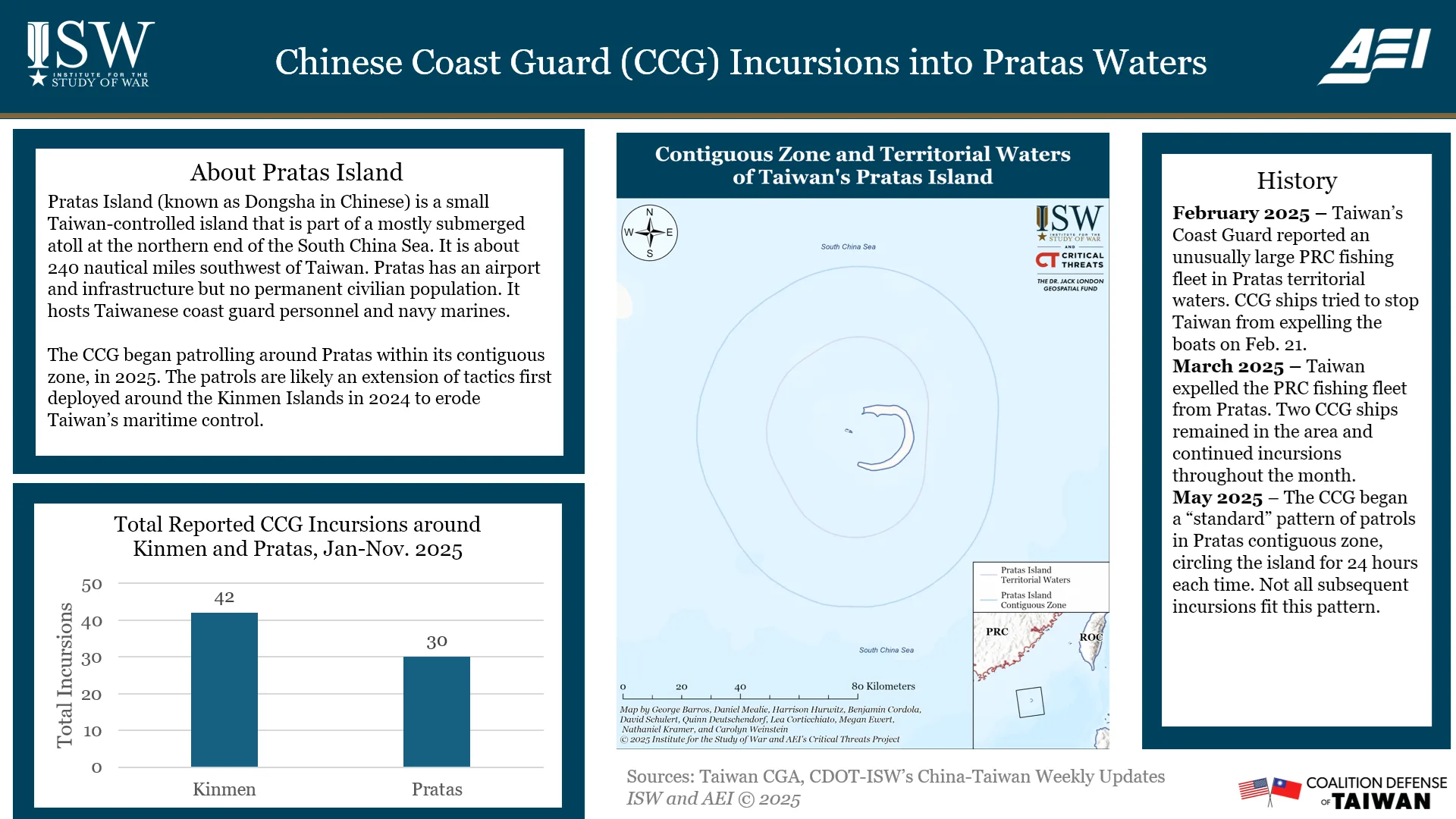
Neither Taiwan nor the PRC reported any CCG patrols around Taiwan’s Pratas Island in November, and CDOT-ISW did not detect CCG activity around Pratas from available ship-tracking data. CCG ships have conducted patrols in the contiguous waters around Pratas an average of three times per month since February 2025, but these patrols have been much less regular in frequency and pattern of operation than the ones around Kinmen.
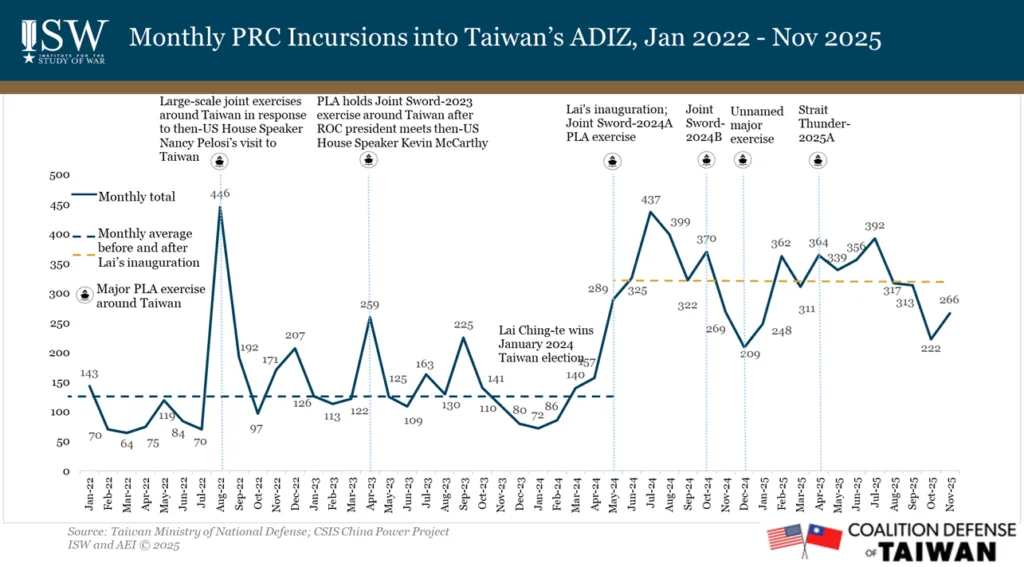
The Taiwanese Ministry of National Defense reported 266 PLA aerial incursions into Taiwan’s Air Defense Identification Zone (ADIZ) in November 2025. This frequency is lower than the monthly average of 321 incursions since President Lai took office in May 2024, after which Beijing intensified military activities around Taiwan.[35] Taiwan has observed nearly double the average number of monthly ADIZ incursions since Lai took office, compared to previous years.
The normalization of more frequent ADIZ incursions by PLA aircraft raises the threshold of coercive activity that would trigger a Taiwanese response, making it more difficult for Taiwan to detect and respond to a real threat in time. Taiwan must put personnel on standby to respond to ADIZ incursions, which strains resources and exhausts the personnel.
The PRC calibrates its military activities around Taiwan to intimidate and deter it from practicing policies that the PRC perceives as supportive of Taiwanese sovereignty. PLA incursions into Taiwan’s de-facto ADIZ are a near-daily occurrence that typically serve as a barometer for PRC reactions to political developments involving Taiwan. The lower-than-average frequency during November could be due to seasonal weather conditions, since incursions were relatively low around the same period last year.[36]
China
The PRC may deploy electronic warfare (EW) drones at a large scale against satellite constellations to degrade Taiwanese communications in a conflict. PRC researchers published a study on November 5 that simulated jamming a large constellation of low-earth orbit (LEO) satellites using drones.[37] The study found that a distributed jamming strategy against a satellite mesh network, such as Starlink, would require between 1,000 and 2,000 EW drones. The researchers are affiliated with the Zhejiang University School of Aeronautics and Astronautics and Beijing Institute of Technology, both of which have strong ties to the PLA.[38]
The PRC produces several drone models with dedicated EW capabilities that may be well-suited to satellite constellation jamming. The FH-95, for example, is a high-altitude, long-endurance drone with electronic jamming payloads and can conduct cluster flights in organized formations to operate in unison.[39]
Starlink LEO satellites have proven invaluable to the Ukrainian military, enabling continual connectivity amid Russian attacks on Ukrainian communication networks. Taiwan is working to enhance the resilience of its own communication networks and operationalize alternatives to undersea telecommunications cables, which the PRC has often tried to sabotage. Taiwan is working to develop a domestically produced LEO satellite as part of its Beyond 5G project by 2027.[40] Taiwan does not currently have access to Starlink.
The destruction of Taiwan’s communication networks would reduce its ability to resist a PLA invasion. PLA writings emphasize offensive operations to weaken, disrupt, and destroy an enemy’s information systems to gain a decisive advantage during conflict.[41]
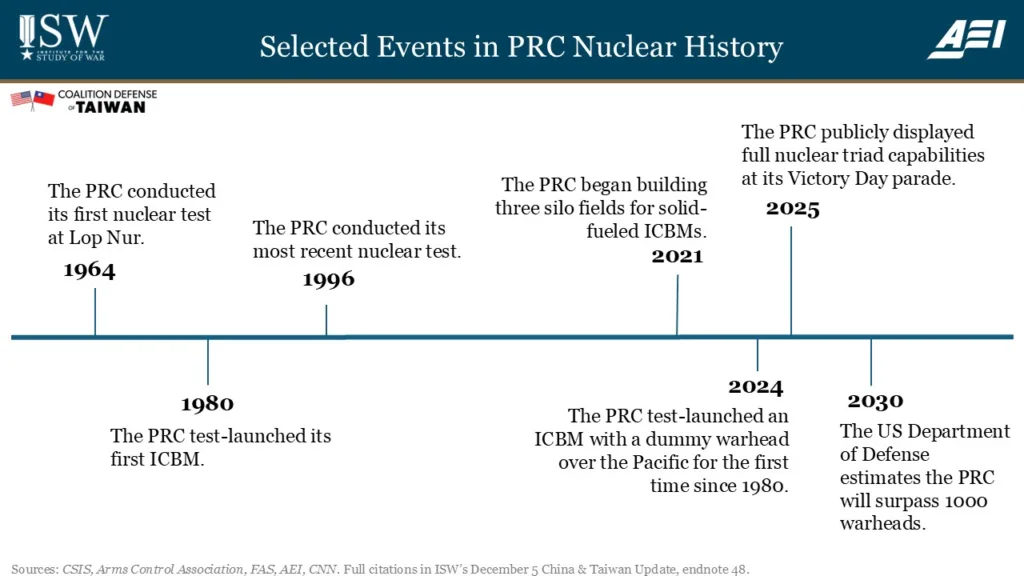
The PRC released its first nuclear white paper since 2005 in a possible attempt to portray itself as a responsible nuclear power, in contrast to the United States, following US President Donald Trump’s announcement on resuming US nuclear testing.[42] The PRC released the white paper on November 27 and highlighted the 80th anniversary of World War II, which is a frequent theme in recent PRC rhetoric to support its claimed international leadership.[43] The white paper calls for arms control mechanisms to protect “fragile” postwar peace. Both the 2005 white paper on the same topic and the 2025 white paper referenced World War II and reiterated the PRC no-first-use nuclear policy.[44] The 2025 paper repeatedly framed the PRC as a proponent of peace and multilateralism and listed nonproliferation treaties of which the PRC is a member.[45]
The PRC likely aims to position itself as a responsible nuclear actor and a leader of the “Global South,” a term it referenced in the 2025 white paper.[46] The paper indirectly criticized the United States and its allies while emphasizing the peaceful PRC nuclear doctrine.[47] The PRC nuclear arsenal is expanding more rapidly than any other country, however, which discredits its assertions.[48] The paper accused “some countries” of bloc formation and escalatory behavior.[49] US President Donald Trump announced in November 2025 that the United States would resume nuclear testing after 33 years, although these tests may not involve nuclear explosions.[50] The white paper also highlighted the deployment of intermediate-range, land-based missiles in the Western Pacific, a likely reference to the US-made Typhon missile system in Japan.[51] This follows Japan’s announcement that it would deploy missiles to Yonaguni Island, which is approximately 70 miles away from Taiwan, amid an ongoing diplomatic spat between the PRC and Japan.[52]
Northeast Asia
Japan
The PRC reiterated its objection to the Treaty of San Francisco and cited selected historical documents to assert its claim over Taiwan on November 27. The PRC is applying additional pressure in the international legal and informational space over Japanese Prime Minister Sanae Takaichi’s remarks that linked Japan’s security to Taiwan. Takaichi said on November 26 that Japan is not “in a position to recognize Taiwan’s legal status” after Japan had “renounced all rights and claims under the Treaty of San Francisco.”[53] The Treaty of San Francisco was signed in 1951 to finalize the terms of Japan’s surrender and re-establish peaceful relations between Japan and the Allied Powers.[54] Japan did not stipulate within the treaty whether it was transferring the territorial sovereignty of Taiwan and its surrounding islands to the PRC or the KMT-governed Republic of China (ROC), which had retreated to Taiwan, however. Japan later signed the Treaty of Taipei in 1952, which returned Taiwan and its relevant islands to the ROC.[55] The PRC has long insisted that the Treaty of San Francisco is “illegal and invalid” since the PRC was excluded from the San Francisco Peace Conference due to disagreements on whether the ROC or the PRC represented the Chinese people.[56]
PRC Ministry of Foreign Affairs spokesperson Guo Jiakun criticized Takaichi’s use of the treaty as the basis of her argument.[57] Guo reiterated the PRC position that the earlier Cairo and Potsdam declarations and the Japanese Instrument of Surrender had “fully resolved” Taiwan’s legal status as part of the PRC.[58] The PRC legal and informational warfare against Japan is part of a broader, multi-pronged coercion effort, which also includes diplomatic, military, and economic coercion. The PRC aims to continue pressuring Japan until Takaichi retracts her remarks on Taiwan and to deter other countries from expressing support for Taiwan.
The PRC is seeking support from the United States and Europe to isolate Japan over Japanese Prime Minister Takaichi’s comments on Taiwan. US President Donald Trump had a phone call with Takaichi on November 24.[59] Trump’s conversation with Takaichi came hours after a phone call with CCP General Secretary Xi Jinping, which the PRC claimed to have focused on Taiwan’s “return to China.”[60] A Wall Street Journal article on November 27 cited anonymous Japanese and US officials who claimed that Trump asked Takaichi to “temper” her tone on Taiwan to not provoke the PRC further.[61] Japanese Chief Cabinet Secretary Minoru Kihara denied that Trump had made such a request, however.[62] People’s Daily, the CCP’s official newspaper, published an article on November 27 urging the United States to “rein in Japan.”[63] The article stated that it is the shared responsibility of the United States and PRC to safeguard the post-war international order and prevent the revival of militarism.[64]
PRC Ministry of Foreign Affairs spokesperson Mao Ning declined to comment on the call between Trump and Takaichi but emphasized that Taiwan is an “internal affair.”[65] The PRC may leverage its recent trade deal with the United States and Trump’s planned visit to Beijing in April to incentivize the United States to limit its support for Taiwan and Japan, as evidenced by Xi’s emphasis on the success of the trade deal during his call with Trump.[66]
The PRC is likely attempting to generate international support for its position by exaggerating Japan’s “remilitarization.” PRC Permanent Representative to the UN Fu Cong sent a second letter to the UN secretary general on December 12 urging the international community to “remain highly vigilant” against Japan’s ambitions to revive militarism and overturn the post-war international order.[67] PRC Foreign Affairs Minister Wang Yi made similar pleas to the diplomatic adviser to the French president, Emmanuel Bonne, and British National Security Adviser Jonathan Powell on November 27 and 28, respectively.[68] These efforts aim to isolate Taiwan and Japan from their Western partners especially given PRC concerns that European countries are forging closer ties with Taiwan.
North Korea
South Korean intelligence suspects the North Korean state-sponsored hacking group Lazarus of hacking South Korea’s largest cryptocurrency exchange UPbit on November 27.[69] Hacking cryptocurrency exchanges has become one of largest revenue-generating activities for North Korea. South Korea’s National Intelligence Service (NIS) and financial authorities identified Lazarus as the main suspect of the UPbit hacking.[70] Lazarus operates as a specialized hacking unit under the Reconnaissance General Bureau, North Korea’s military intelligence agency, according to the US Treasury Department.[71] Lazarus stole a total of 37 million US dollars of cypto assets from UPbit. This is the second hacking incident against UPbit that investigators suspect Lazarus of committing, after the group allegedly stole 40 million US dollars of Ethereum in 2019.[72] Lazarus was also involved in a 1.5-billion-US-dollar heist against global cryptocurrency exchange Bybit in February.[73]
North Korea generated approximately two billion US dollars in revenue only in 2025 through cryptocurrency hacking as of October, surpassing its previous record of 1.35 billion US dollars in 2022.[74] This figure accounts for 13 percent of Noth Korea’s 2024 GDP, an estimated 15.17 billion US dollars.[75] North Korean cyber operations against financial institutions support North Korea’s ability to fund weapons development, including nuclear and missile systems. The US State Department determined that North Korean information technology workers involved in illicit activities may have ties to the Munitions Industry Department.[76] North Korean cyber threat actors conduct operations to obtain sensitive information from South Korea’s security and industrial sectors and phishing against the general public, which they leverage to enable financially motivated hacking operations. North Korean hackers extracted 1,014 GB–nearly 18,000 individuals–of personally identifiable information from a court database from 2021 to 2023.[77]
North Korea revealed footage of a possible long-range air-to-surface missile during Worker’s Party Korea (WPK) General Secretary Kim Jong Un’s visit to the 80th anniversary event for the Air Force on November 28.[78] North Korea showcased the possible long-range air-to-surface missile along with the unmanned aerial vehicles (UAV) Satbyol-4 and 9, which were made public in 2023.[79] The newly revealed missile resembles the bears resemblance to the German long-range air-launched Taurus cruise missile, which South Korea uses.[80] The Taurus missile possesses precision-guided strike capability on targets over 500km away.[81] North Korea test-fired a medium-range air-to-air missile resembling the PRC’s PL-12 in May 2025. South Korea is still in the process of developing its own long-range air-launched cruise missile.[82]
The possible long-range air-to-surface missile would give North Korean the ability to precisely strike the entire Korean Peninsula. A long-range missile would maximize North Korea’s aerial strike power and makes it possible to attack all US and South Korean military assets on the peninsula. Air-to-surface missiles possess the advantage of fighter jets’ evasive maneuvering to increase their survivability against counterattacks, unlike fixed-base ballistic missiles.
The South Korean Defense Ministry assessed in May that North Korean weapons systems have achieved significant technological advances under North Korea’s 2021 “Five-Year Plan for Defense Development,” which stressed the diversification of weapon systems, especially in the navy and air force.[83] North Korea likely aims to showcase its successful military development to the United States and South Korea, despite the sanctions imposed on Pyongyang.
Kim Jong Un’s daughter, Kim Ju Ae, accompanied him to the Air Force event. State media broadcast a scene where female aviators saluted Kim Ju Ae, a 13-year-old without any title, alone. Kim Ju Ae has never appeared independently in North Korean media and is usually shown alongside her father.[84] Kim Ju Ae’s attendance could suggest that Kim Jong Un intended to bolster and extend his succession framework.
Southeast Asia
PRC technology firms are bypassing US export controls on advanced semiconductors to the PRC by building data centers in Southeast Asia. PRC advancements in artificial intelligence (AI) have military and cyber applications. The Financial Times reported on November 27 that PRC firms are moving AI model training overseas, especially to Southeast Asia, to circumvent restrictions on acquiring advanced US-made chips.[85] The report’s findings highlight that these trade measures alone are insufficient to cut the PRC off from the global supply of advanced chips. It is legal for companies outside the PRC to lease computing power to PRC users and firms.[86]
One of the primary goals of US export controls on advanced semiconductors to the PRC is to inhibit the PRC’s development of AI to support its military modernization efforts.[87] The PRC aims to integrate AI into its military decision-making, planning, and logistics as part of a modernization process called “intelligentization.”[88] The technological demands of intelligentization require the PRC to co-opt private sector actors to support its activities as part of the PRC’s military-civil fusion policy.[89] PRC military doctrine emphasizes intelligentization as key to enhancing the PLA’s ability to win future wars, including operations against Taiwan.
Security concerns over the PRC’s use of AI extend to cybersecurity. An assessed PRC state-sponsored hacking group used AI to execute a cyberattack in September 2025 that involved manipulating the AI model Claude, marking what is likely the first reported AI-orchestrated cyberespionage campaign, according to Anthropic, the AI company that built Claude.[90]
Malaysia has the most PRC-owned data centers and is the PRC’s largest trading partner in Southeast Asia, but it has recently taken measures to curb PRC data center expansion.[91] Malaysia announced in July 2025 that it will require trade permits for the export, transshipment, and transit of US-made high- performance chips.[92] This was in part due to pressure from the United States to stop PRC companies from using the country as a backdoor to bypass export controls.[93]
Philippines
The PRC is continually responding to Philippine Maritime Cooperative Activities (MCAs) in the West Philippine Sea with Southern Theater Command (STC) patrols within a day of their occurrence. MCAs are conducted by multiple nations to improve naval cooperation and coordination among participating forces and uphold freedom of navigation—in this case, in the Philippine Exclusive Economic Zone (EEZ). There have been 5 MCAs within the last three months (September through November 2025), and the PLA STC has consistently responded with combat readiness patrols, with one exception on October 31. The STC instead issued a press release on strengthened naval and air patrols in the Scarborough Shoal area that month. These patrols often take place in parts of the South China Sea where the PRC and the Philippines have competing territorial claims, especially around Scarborough Shoal, and are explicitly in direct response to security cooperation between the Philippines and other Western countries.
Below is a timeline of Philippine MCAs and PLA STC responses since September.
| Dates | Event |
|---|---|
| September 2–3, 2025 | Australian-Canadian-Philippine-US MCA |
| September 3, 2025 | PLAN STC patrol |
| September 11–13, 2025 | Japanese-Philippine-US MCA |
| September 12–13, 2025 | PLAN STC patrol |
| October 30–31, 2025 | Australian-New Zealand-Philippine-US MCA |
| October 31, 2025 | PLA STC press release on strengthened naval and air patrols around Scarborough Shoal since October 2025 |
| November 14–15, 2025 | Japanese-Philippine-US MCA |
| November 14, 2025 | PLA STC bomber formation patrol |
| November 29, 2025 | Japanese-Philippine MCA |
| November 29, 2025 | PLA STC and CCG naval and air combat-readiness patrols around Scarborough Shoal |
September 2–3, 2025: https://www.defence.gov.au/news-events/releases/2025-09-04/australia-canada-philippines-united-states-conduct-maritime-cooperative-activity
September 3, 2025: https://www.reuters.com/world/china/chinese-navy-says-it-conducted-routine-patrol-south-china-sea-2025-09-04/
September 11–13, 2025: https://www.navy.mil/Press-Office/News-Stories/display-news/Article/4303807/japan-the-philippines-and-the-us-conduct-maritime-cooperative-activity/
September 12–13, 2025: https://english dot news.cn/20250914/f0d78419b39644a4abd1ca283285ff3e/c.html
October 30–31, 2025: https://www.defence.gov.au/news-events/releases/2025-11-01/australia-new-zealand-philippines-united-states-conduct-maritime-cooperative-activity
October 31, 2025: http://eng.mod.gov dot cn/2025xb/N/T/16419071.html
November 14–15, 2025: https://www.ph.emb-japan.go.jp/itpr_en/11_000001_02087.html
November 14, 2025: http://eng.mod dot gov.cn/2025xb/N/T/16422259.html
November 29, 2025: https://www.afp.mil dot ph/news/ph-japan-hold-3rd-maritime-cooperative-activity-to-foster-defense-cooperation
November 29, 2025: http://www.81 dot cn/ChinaMilitary/rdxw_208665/16424742.html
Iran
The Shanghai Cooperation Organization (SCO) began its five-day “Sahand-2025” combined counterterrorism drills in Iran on December 1. The PRC and Russia sent military delegations to participate in the exercise, which featured Iranian Islamic Revolutionary Guards Corps (IRGC) units practicing with one-way attack, first-person view (FPV) drones. Sahand-2025 is the second combined counter-terror drill involving delegations from all 10 SCO member states, including the PRC and Russia.[94] The PRC hosted the SCO’s first combined drill, “Interaction-2024,” in Xinjiang province in July 2024.[95] Iranian state and state-aligned media heavily promoted “Sahand-2025”, highlighting the IRGC’s reported role in designing the exercise and presenting Iran’s hosting as an example of Iran’s increasing international prominence.[96] The drills reportedly included drone operations, and IRGC-affiliated media published footage appearing to show IRGC troops training with one-way attack FPV drones carrying explosive payloads similar to those used by Russian and Ukrainian forces on the front lines.[97]
It is unclear to what extent the PRC and Russian delegations participated in the drills. PRC and Russian forces have trained together in previous combined drills organized under the SCO.[98] The PRC has also used SCO combined drills to test new military technologies, such as drones.[99] The PRC may leverage participation in “Sahand-2025” to gather further experience and data on the use of FPV drones in combat, a capability that it is studying closely in its observation of Russia’s invasion of Ukraine.[100]
North America
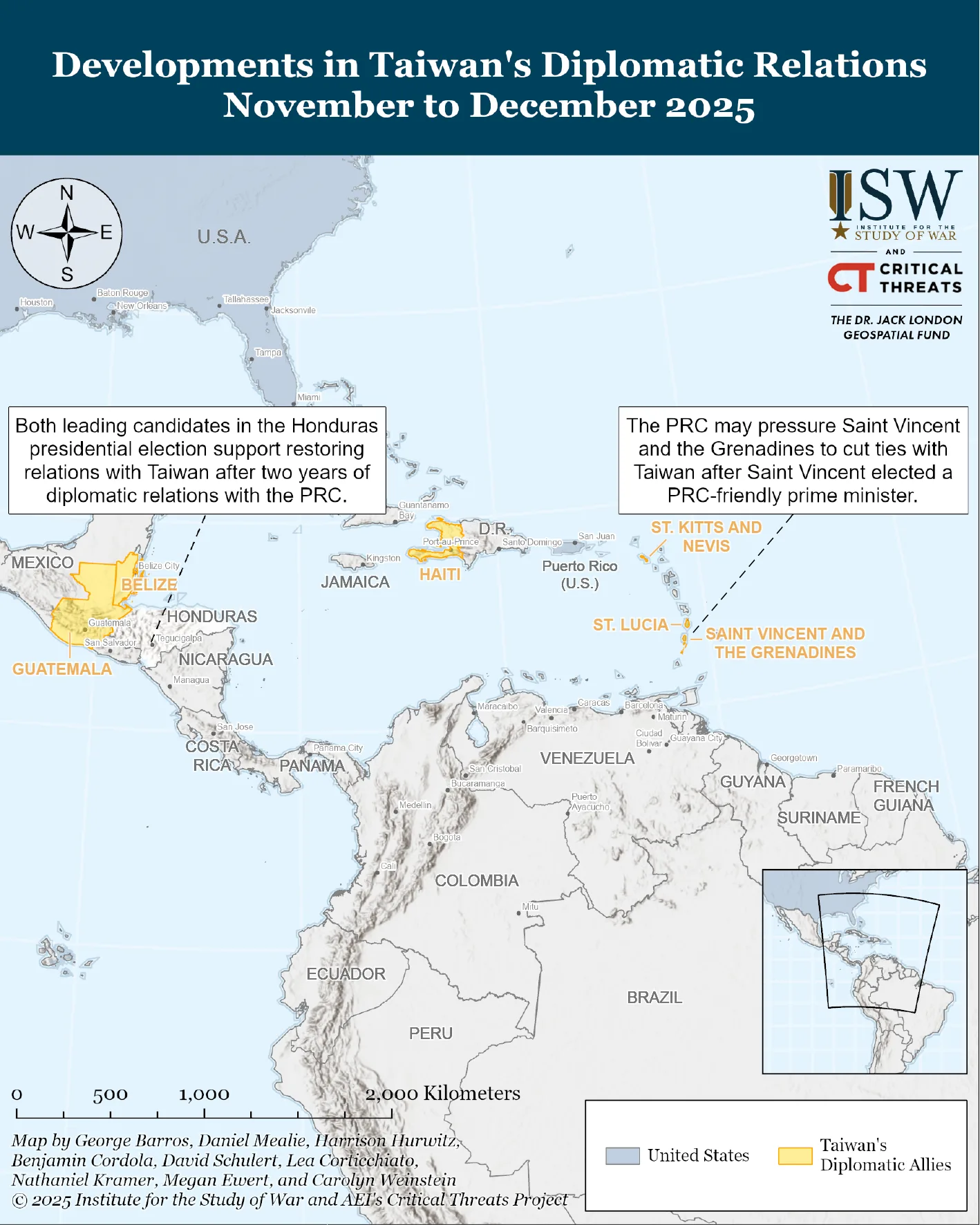
Honduras may switch official recognition back to Taiwan after just two years of relations with the PRC, possibly revealing a weakness in PRC economic influence efforts. Honduras held a presidential election on November 30. Frontrunners Salvador Nasralla of the Liberal Party and Nasry Asfura of the National Party are virtually tied in the ballot count as of December 5.[101] Both Nasralla and Asfura have said they may end Honduras’s diplomatic relations with the PRC and restore relations with Taiwan, even though Nasralla was Honduras’ vice president when the country severed its Taiwan ties in 2023.[102] Incumbent president Xiomara Castro is not eligible for reelection, and the candidate from her LIBRE party is polling in third place. Honduran opinions on the PRC have soured in the two years since Honduras recognized the PRC due to widespread disappointment in the economic outcomes of the diplomatic switch. Castro promised a free trade agreement with the PRC as well as a PRC-financed hydroelectric dam and other infrastructure projects, none of which have materialized.[103] Nasralla and Asfura also blamed the diplomatic shift for a decline in Honduran exports for which Taiwan was the biggest market.[104] A Honduran switch of diplomatic recognition from the PRC back to Taiwan would be a major and rare, though not unprecedented, diplomatic victory for Taipei. The PRC often uses economic incentives to convince countries to break diplomatic relations with Taiwan as a means of reducing Taiwan’s international legitimacy and voice on the world stage.
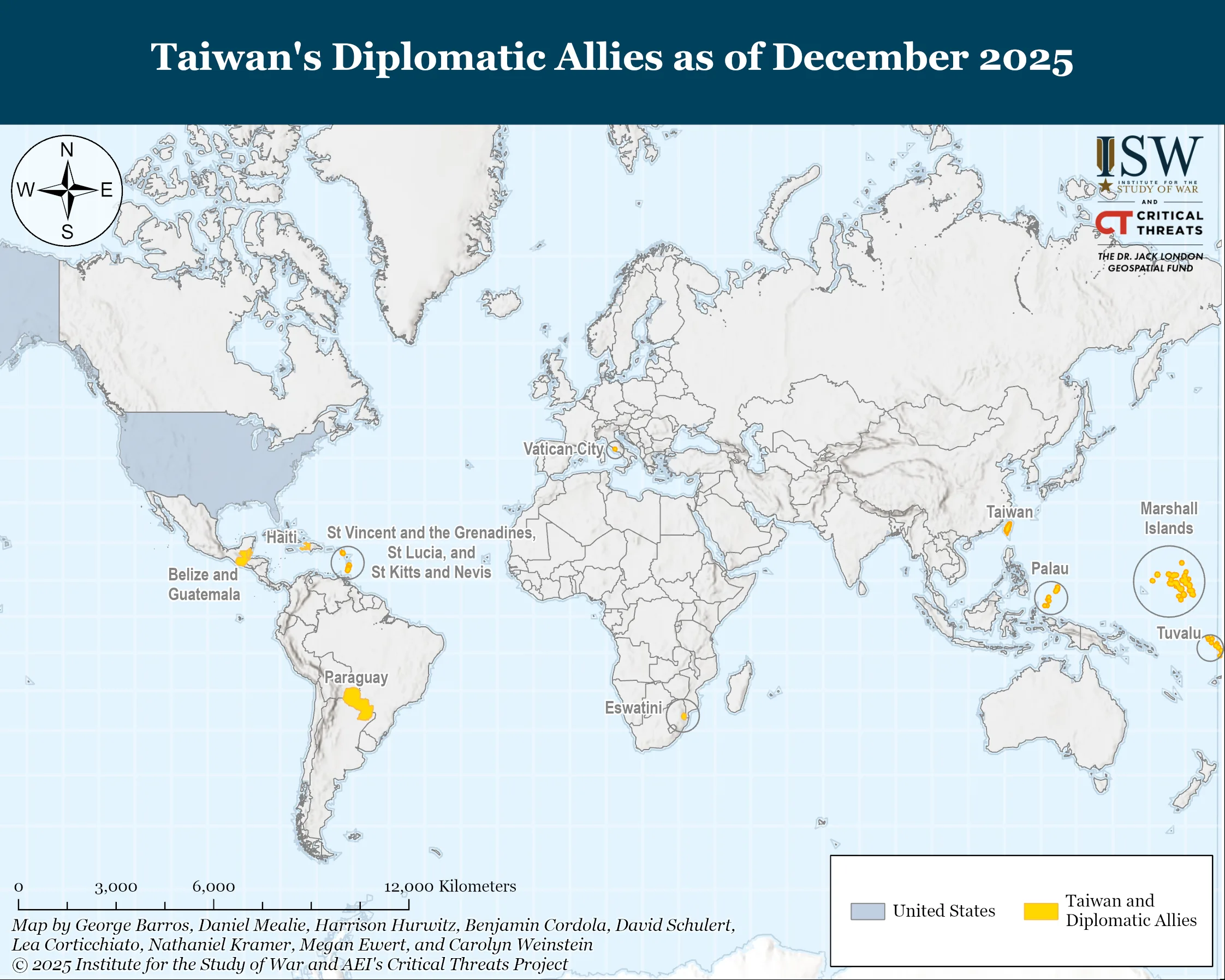
Saint Vincent and the Grenadines’ new PRC-friendly government is a likely next target for the PRC’s campaign to poach Taiwan’s diplomatic allies. Saint Vincent is one of twelve remaining countries that have diplomatic relations with Taiwan rather than the PRC. Hong Kong-based PRC state media Phoenix TV asked the PRC MFA on November 26 to confirm reports that Saint Vincent Prime Minister Ralph Gonsalves had been in contact with Beijing and was exploring developing relations with the PRC.[105] MFA spokesperson Mao Ning did not address the allegations but gave a boilerplate statement claiming that the “one China principle” is a universal consensus and expressing hope that the “relevant country” will make the “right decision.” [106] Gonsalves’ United Labor Party (ULP) suffered a crushing defeat in an election the next day, when the opposition New Democratic Party (NDP) took 14 out of 15 parliamentary seats and ousted Gonsalves from power for the first time in 24 years.[107] The NDP and the new prime minister, Godwin Friday, in 2018 pledged to sever ties with Taiwan and recognize the PRC. Friday’s stance on relations with Taiwan has been more ambiguous in recent years, however, and he did not address the issue in his 2025 campaign.[108] Friday met with Taiwan’s ambassador to Saint Vincent and the Grenadines on November 30.[109]
The PRC will likely pressure the new government to cut ties with Taiwan and build diplomatic relations with the PRC. Former PM Gonsalves is a vocal supporter of Taiwan who visited Taiwan twelve times during his tenure and routinely criticized the PRC in international fora.[110] Phoenix TV’s allegation about Gonsalves may have been referring to an article in the Saint Vincent Times on November 26 that detailed Gonsalves’ unofficial overtures to the PRC. The PRC is an important economic partner for Saint Vincent, despite their lack of official relations.[111] Former PM Gonsalves told an unspecified PRC official in March 2024, by his own account, that he was willing to establish diplomatic relations with the PRC but was not willing to break diplomatic ties with Taiwan to do so. The PRC refuses to have diplomatic relations with any country that recognizes Taiwan under its “one China principle,” however. New PM Godwin Friday and the NDP are likely more amenable to PRC pressure to cut ties with Taiwan due to past statements.[112] Former PM Gonsalves claimed that PRC businesses in Saint Vincent tried to interfere in the election and that a PRC embassy in a neighboring country was coordinating the Chinese diaspora in Saint Vincent to fundraise for the NDP.[113]

[1] https://www.washingtonpost.com/opinions/2025/11/25/taiwan-president-defense-spending-china/
[2] https://www.taiwannews dot com.tw/news/6254051; https://focustaiwan dot tw/politics/202510170007
[3] https://www.cna dot com.tw/news/aipl/202511260136.aspx
[4] https://www.cna dot com.tw/news/aipl/202511260136.aspx
[5] https://focustaiwan dot tw/politics/202511260017; https://www.cna.com dot tw/news/aipl/202511260136.aspx; https://www.chinatimes dot com/realtimenews/20251126004646-260417?ctrack=pc_armament_headl_p01&chdtv
[6] https://focustaiwan dot tw/politics/202511260017
[7] https://warontherocks.com/2023/08/logistics-interdiction-for-taiwan-unification-campaigns/; https://api.army.mil/e2/c/downloads/2025/05/08/1888a601/tradoc-g2-how-china-fights-in-lsco-apr-25-public.pdf
[8] https://understandingwar.org/research/china-taiwan/china-taiwan-weekly-update-october-20-2025/
[9] https://understandingwar.org/research/russia-ukraine/russian-drone-innovations-are-likely-achieving-effects-of-battlefield-air-interdiction-in-ukraine/; https://www.aei.org/research-products/report/a-defense-of-taiwan-with-ukrainian-characteristics-lessons-from-the-war-in-ukraine-for-the-western-pacific/
[10] https://understandingwar.org/research/china-taiwan/china-taiwan-update-october-31-2025/
[11] https://understandingwar.org/research/china-taiwan/china-taiwan-update-october-31-2025/
[12] https://focustaiwan dot tw/politics/202511260017
[13] https://understandingwar.org/wp-content/uploads/2025/05/Ukraine20and20the20Problem20of20Restoring20Maneuver20in20Contemporary20War_final.pdf
[14] https://www.taiwannews dot com.tw/news/6251807
[15] https://www.scmp dot com/news/china/politics/article/3334936/taiwan-opposition-blocks-us40-billion-defence-budget-prompting-protests-ruling-dpp
[16] https://newbloommag.net/2024/03/02/tpp-kmt-spying-charges/
https://www.fmprc.gov dot cn/eng/xw/fyrbt/lxjzh/202511/t20251113_11752756.html; https://www.fmprc.gov dot cn/eng/xw/fyrbt/lxjzh/202405/t20240530_11347516.html
[18] https://www.scmp dot com/news/china/politics/article/3334936/taiwan-opposition-blocks-us40-billion-defence-budget-prompting-protests-ruling-dpp
[19] https://www.reuters.com/world/china/taiwan-president-says-he-will-propose-extra-40-billion-defence-spending-2025-11-25/
[20] https://newbloommag.net/2024/03/02/tpp-kmt-spying-charges/
[21] https://www.scmp dot com/news/china/politics/article/3334936/taiwan-opposition-blocks-us40-billion-defence-budget-prompting-protests-ruling-dpp?module=perpetual_scroll_0&pgtype=article; https://focustaiwan dot tw/politics/202511260014
[22] https://understandingwar.org/research/china-taiwan/china-taiwan-weekly-update-september-26-2025/
[23] https://www.taiwannews dot com.tw/news/6202200
[24] https://www.chinatimes dot com/opinion/20231022000045-262110?chdtv
[25] https://udn dot com/news/story/10930/9175236?from=udn-catebreaknews_ch2
[26] https://www.globaltimes dot cn/page/202512/1349482.shtml
[27] https://newbloommag.net/2023/10/02/hai-kun-controversy/
[28] https://www.taiwannews.com dot tw/news/6253456
[29] https://understandingwar.org/research/china-taiwan/china-taiwan-weekly-update-september-26-2025/
[30] http://www.jstor.org/stable/resrep27713.15; http://www.jstor.org/stable/resrep65340.5
[31] https://www.reuters.com/business/aerospace-defense/taiwan-airline-seeks-role-whole-society-defence-with-surveillance-flights-2025-12-01/
[32] https://www.reuters.com/business/aerospace-defense/taiwan-airline-seeks-role-whole-society-defence-with-surveillance-flights-2025-12-01/
[33] https://english.president.gov dot tw/Page/670 ; https://understandingwar.org/research/china-taiwan/china-taiwan-weekly-update-april-4-2025/
[34] https://www.cga.gov.tw/GipOpen/wSite/ct?xItem=166396&ctNode=650&mp=999
https://www.cga.gov.tw/GipOpen/wSite/ct?xItem=166447&ctNode=650&mp=999
https://www.cga.gov.tw/GipOpen/wSite/ct?xItem=166493&ctNode=650&mp=999
[35] https://x.com/MoNDefense
[36] https://docs.google.com/spreadsheets/d/1qbfYF0VgDBJoFZN5elpZwNTiKZ4nvCUcs5a7oYwm52g/edit?gid=1177684118#gid=1177684118
[37] https://kns.cnki dot net/kcms2/article/abstract?v=dSUnQCB_TmOq8Kl1zo1DpodNGZad0R9AEd6MjFWPYIJegXVJM-4lfcphKUQb1NonscEbVzaLdOqHoJ6AjT_2foY7Y4kAMB6AOZ45-9YZ1Gvg1of8mKt5BvzijZef3GDGGqkEJWtQu1Vyi5Z8Zt8QEVvqLKewkkPYclHCzMjTmQ5CeOFkkavasQ==&uniplatform=NZKPT&language=CHS
[38] https://unitracker.aspi.org.au/universities/zhejiang-university/
https://selectcommitteeontheccp.house.gov/sites/evo-subsites/selectcommitteeontheccp.house.gov/files/evo-media-document/from-ph.d-to-pla-report_final.pdf
https://ad-aspi.s3.ap-southeast-2.amazonaws.com/2019-11/The%20China%20Defence%20Universities%20Tracker_0.pdf?VersionId=ozIi2cWm.kXpe7XsEZ44vUMMQBNfnR_x
[39] https://odin.tradoc.army.mil/WEG/Asset/f4974eb58f26cf3dcd5c31f60b346d8f
https://www.globaltimes dot cn/page/202411/1322770.shtml
[40] https://www.tasa.org dot tw/en-US/missions/detail/Beyond-5G-LEO-Satellite
[41] http://military dot people.com.cn/n/2015/0317/c172467-26702265.html
[42] https://www.mfa.gov dot cn/web/wjdt_674879/fyrbt_674889/202511/t20251127_11761781.shtml
[43] http://www.mod.gov dot cn/gfbw/fgwx/16423994.html
[44] https://www.mfa.gov dot cn/web/ziliao_674904/zcwj_674915/200509/t20050901_7949796.shtml; http://www.mod.gov dot cn/gfbw/fgwx/16423994.html
[45] http://www.mod.gov dot cn/gfbw/fgwx/16423994.html
[46] http://www.mod.gov dot cn/gfbw/fgwx/16423994.html
[47] https://www.bloomberg.com/news/articles/2025-11-27/china-warns-of-nuclear-conflict-risks-after-trump-orders-testing?srnd=next-china
[48] https://www.sipri.org/media/press-release/2025/nuclear-risks-grow-new-arms-race-looms-new-sipri-yearbook-out-now; https://edition.cnn.com/2024/09/25/asia/china-icbm-test-pacific-ocean-intl-hnk; https://www.armscontrol.org/act/2024-11/news/china-conducts-rare-icbm-test-over-pacific; https://fas.org/publication/nuclear-notebook-china-2025/; https://www.csis.org/analysis/parading-chinas-nuclear-arsenal-out-shadows; https://www.aei.org/foreign-and-defense-policy/5-key-updates-in-the-pentagons-2021-china-military-power-report/
[49] http://www.mod.gov dot cn/gfbw/fgwx/16423994.html
[50] https://www.armscontrol.org/act/2025-11/news-briefs/trump-says-us-will-resume-nuclear-testing
[51] https://eyeonchina.substack.com/p/dont-fight-the-whites?utm_source=post-email-title&publication_id=222442&post_id=180079985&utm_campaign=email-post-title&isFreemail=true&r=jog8j&triedRedirect=true&utm_medium=email
[52] https://www.reuters.com/world/china/china-criticises-japans-plan-deploy-missiles-island-near-taiwan-2025-11-24/
[53] https://www.asahi dot com/ajw/articles/16182808?msockid=09f1f7538b4e6ea80f75e24c8f4e60ab
[54] https://treaties.un.org/doc/Publication/UNTS/Volume%20136/volume-136-I-1832-English.pdf
[55] https://thediplomat.com/2014/08/no-taiwans-status-is-not-uncertain/
[56] https://thediplomat.com/2024/08/china-rejects-the-san-francisco-system/
[57] https://www.fmprc.gov dot cn/fyrbt_673021/jzhsl_673025/202511/t20251127_11761781.shtml
[58] https://www.fmprc.gov dot cn/fyrbt_673021/jzhsl_673025/202511/t20251127_11761781.shtml
[59] https://japan.kantei.go dot jp/104/diplomatic/202511/25usa.html
[60] https://www.aei.org/articles/china-taiwan-update-november-25-2025/
[61] https://www.wsj.com/politics/national-security/trump-after-call-with-chinas-xi-told-japan-to-lower-the-volume-on-taiwan-3af795d6
[62] https://japan.kantei.go dot jp/tyoukanpress/202511/27_p.html
[63] http://cpc.people.com dot cn/n1/2025/1127/c64387-40612667.html
[64] http://cpc.people.com dot cn/n1/2025/1127/c64387-40612667.html
[65] https://www.fmprc.gov dot cn/fyrbt_673021/jzhsl_673025/202511/t20251125_11759683.shtml
[66] https://www.msn.com/en-us/news/world/trump-urged-japan-to-avoid-escalation-in-china-dispute-sources-say/ar-AA1ReUGi?ocid=BingNewsVerp
[67] https://un.china-mission.gov dot cn/eng/czthd/202512/t20251202_11764524.htm
[68] https://www.fmprc.gov dot cn/zyxw/202511/t20251127_11761926.shtml ; https://www.fmprc.gov dot cn/zyxw/202511/t20251128_11762901.shtml
[69] https://www.bloomberg.com/news/articles/2025-11-27/crypto-exchange-upbit-hit-by-exploit-after-10-3-billion-deal?embedded-checkout=true
[70] https://www.joongang.co dot kr/article/25386147
[71] https://home.treasury.gov/news/press-releases/sm774
[72] https://www.yna.co dot kr/view/AKR20251128054100017?input=1195m; https://www.chosun dot com/economy/economy_general/2025/11/27/BKGVUPB5DRH5LB25VEGH6O7TWA/
[73] https://www.bbc.com/news/articles/c2kgndwwd7lo
[74] https://www.bbc.com/korean/articles/c1wgv04yvdqo
[75] https://www.bbc.com/korean/articles/c1wgv04yvdqo
[76] https://news.kbs.co dot kr/news/pc/view/view.do?ncd=7982933
https://www.lawtimes dot co.kr/news/202300
[78] https://www.hankookilbo dot com/News/Read/A2025113010420001989?did=NA
[79] https://www.nknews.org/2025/11/kim-vows-to-upgrade-outdated-north-korean-air-force-with-new-strategic-assets/
http://www.airrecognition.com/index.php/archive-world-worldwide-news-air-force-aviation-aerospace-air-military-defence-industry/global-defense-security-news/global-news-2016/october/2961-south-korea-plans-to-buy-more-taurus-missiles-after-north-korea-s-new-nuclear-test.html
[82] https://www.chosun dot com/politics/diplomacy-defense/2025/05/17/VSSMMQSKFNDV5EBIPRUDZ53UHY/
[83] https://www.kdjournal dot com/news/articleView.html?idxno=250; https://kdi.re dot kr/file/download?atch_no=029n9FVbjARMDD5j5cGjkg%3D%3D
https://www.news1 dot kr/diplomacy/defense-diplomacy/5786856
[84] https://news.kbs.co dot kr/news/pc/view/view.do?ncd=8421560
[85] https://www.ft.com/content/96fe9898-a3a4-4a33-be1d-da06bdb6cb2b
[86] https://www.tomshardware.com/tech-industry/semiconductors/chinas-top-ai-firms-shift-model-training-overseas-to-access-nvidia-gpus
[87] https://www.bis.gov/press-release/commerce-strengthens-restrictions-advanced-computing-semiconductors-enhance-foundry
[88] http://www.gov dot cn/zhengce/2019-07/24/content_5414325.htm
[89] http://www.qstheory dot cn/2019-03/04/c_1124190255.htm
[90] https://assets.anthropic.com/m/ec212e6566a0d47/original/Disrupting-the-first-reported-AI-orchestrated-cyber-espionage-campaign.pdf
[91] https://www.techinasia.com/news/malaysia-curbs-data-center-growth-limits-ai-chip-access
[92] https://www.reuters.com/world/asia-pacific/malaysia-says-trade-permit-required-ai-chips-us-origin-2025-07-14/
[93] https://www.wsj.com/tech/china-ai-chip-curb-suitcases-7c47dab1?gaa_at=eafs&gaa_n=AWEtsqdcD5ZRYXcLe4CVzG6h-IGNCL_N9nVHzqdeG1S7FlMjMPbGs8XD5-6N&gaa_ts=692f7109&gaa_sig=EdkQvLgRXRx__rAkOIHgbK2mRSKoY7rmXc0jm3XNTreftLbug0VrmTPPdIQI3wng-y8PryT2N5_TJJ06TR9L-Q%3D%3D
[94] https://english.news dot cn/20251201/85a355625398431dbea0b7cfe1a2a984/c.html; https://en.irna dot ir/news/86014183/Sahand-2025-Joint-Drills-Iran-Belarus-Uzbekistan-kick-off
[95] https://english.news dot cn/20251201/85a355625398431dbea0b7cfe1a2a984/c.html; http://eng.chinamil.com dot cn/CHINA_209163/TopStories_209189/16326477.html
[96] https://en.irna dot ir/news/86013101/Cmdr-of-Sahand-2025-drill-calls-IRGC-architect-of-security-in; https://www.tehrantimes dot com/news/521150/Iran-SCO-allies-send-message-to-hegemonic-powers-as-joint; https://defapress dot ir/fa/news/797125/%D9%BE%D8%B1%D9%88%D8%A7%D8%B2-%D8%B1%DB%8C%D8%B2%D9%BE%D8%B1%D9%86%D8%AF%D9%87%E2%80%8C%D9%87%D8%A7%DB%8C-%D8%B3%D9%BE%D8%A7%D9%87-%D8%AF%D8%B1-%D8%B1%D8%B2%D9%85%D8%A7%DB%8C%D8%B4-%D8%B6%D8%AF%D8%AA%D8%B1%D9%88%D8%B1%DB%8C%D8%B3%D8%AA%DB%8C-%D8%B3%D9%87%D9%86%D8%AF-%DB%B2%DB%B0%DB%B2%DB%B5-%D9%81%DB%8C%D9%84%D9%85
[97] https://en.irna dot ir/news/86014183/Sahand-2025-Joint-Drills-Iran-Belarus-Uzbekistan-kick-off; https://defapress dot ir/fa/news/797125/%D9%BE%D8%B1%D9%88%D8%A7%D8%B2-%D8%B1%DB%8C%D8%B2%D9%BE%D8%B1%D9%86%D8%AF%D9%87%E2%80%8C%D9%87%D8%A7%DB%8C-%D8%B3%D9%BE%D8%A7%D9%87-%D8%AF%D8%B1-%D8%B1%D8%B2%D9%85%D8%A7%DB%8C%D8%B4-%D8%B6%D8%AF%D8%AA%D8%B1%D9%88%D8%B1%DB%8C%D8%B3%D8%AA%DB%8C-%D8%B3%D9%87%D9%86%D8%AF-%DB%B2%DB%B0%DB%B2%DB%B5-%D9%81%DB%8C%D9%84%D9%85; https://understandingwar.org/research/middle-east/iran-update-december-2-2025/
[98] https://www.iss.europa dot eu/publications/briefs/rehearsing-war-china-and-russias-military-exercises#reference6; http://english.scio.gov dot cn/infographics/2018-06/05/content_51673238.htm
[99] https://www.hudson.org/security-alliances/sino-russian-interactions-regarding-shanghai-cooperation-organization-richard-weitz#:~:text=Though%20several%20SCO%20members%2C%20notably,aerial%20drones%20against%20terrorist%20groups
[100] https://jamestown.org/autonomous-battlefield-pla-lessons-from-russias-invasion-of-ukraine/; https://www.defenseone.com/ideas/2024/12/how-china-adopting-battlefield-lessons-ukraine/401694/
[101] https://www.reuters.com/world/americas/honduras-election-swings-again-conservative-asfura-takes-slim-lead-2025-12-04/
[102] https://www.reuters.com/world/americas/conservative-asfura-backed-by-trump-takes-slim-lead-honduras-presidential-2025-12-01/
[103] https://www.bloomberg.com/news/articles/2025-11-28/taiwan-eyes-a-rare-victory-over-beijing-in-honduras-election
[104] https://www.taipeitimes dot com/News/taiwan/archives/2025/04/02/2003834499 ; https://www.bloomberg.com/news/articles/2025-11-28/taiwan-eyes-a-rare-victory-over-beijing-in-honduras-election
[105] https://www.mfa.gov dot cn/web/wjdt_674879/fyrbt_674889/202511/t20251126_11760587.shtml
[106] https://www.mfa.gov dot cn/web/wjdt_674879/fyrbt_674889/202511/t20251126_11760587.shtml
[107] https://apnews.com/article/st-vincent-grenadines-gonsalves-godwin-friday-election-19dae7a73c91ccad643ade4b1ed08cba
[108] https://www.searchlight dot vc/news/2023/04/06/no-change-policy-regarding-relationship-taiwan-says-opposition-leader/; https://focustaiwan dot tw/politics/202511300008
[109] https://focustaiwan dot tw/politics/202511300008
[110] https://www.stvincenttimes dot com/gonsalves-diplomatic-tightrope-between-taiwan-loyalty-beijing-overtures/
[111] https://www.stvincenttimes dot com/gonsalves-diplomatic-tightrope-between-taiwan-loyalty-beijing-overtures/
[112] https://www.taiwannews.com dot tw/news/6255662
[113] https://www.stvincenttimes dot com/chinese-interference-st-vincent-elections-2025/