Unlock the Editor’s Digest for free
Roula Khalaf, Editor of the FT, selects her favourite stories in this weekly newsletter.
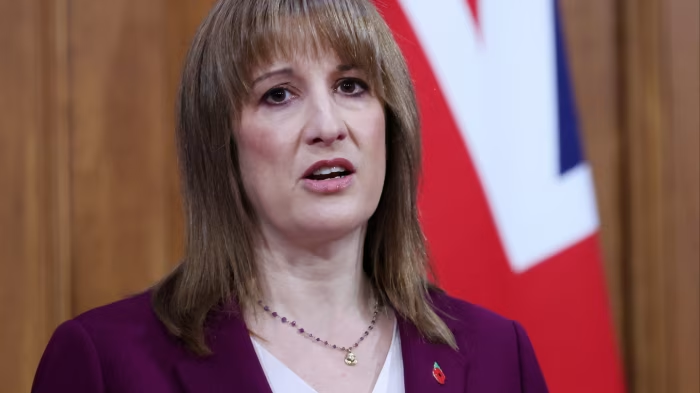
UK chancellor Rachel Reeves has strongly indicated that she is about to break Labour’s manifesto commitments on tax rises, while signalling she will bow to pressure from Labour MPs to lift the two-child benefit cap.
Speaking ahead of her Budget on November 26, Reeves said: “It would of course be possible to stick with the manifesto commitments but that would require things like deep cuts in capital spending.”
Although Reeves insisted no final decisions had been taken, those involved in Budget preparations say she is set to increase income tax rates by 2p in the pound, offset by a similar cut in national insurance contributions.
This would be a breach of a promise in Labour’s 2024 general election manifesto, which pledged not to raise income tax, VAT or NICs.
A 2p cut in NICs would mean that working people would not see a tax rise in their payslip, but people not paying NICs such as landlords and pensioners would end up paying more.
“What I promised during the election campaign was to bring stability back to our economy and what I can promise now is I will always do what I think is right for our country — not the politically easy choice,” she said.
Reeves told the BBC’s Matt Chorley that she wanted to stabilise the public finances and would not balance the books by cutting spending on capital projects, such as infrastructure, which she said would stunt growth.
The gilt market was stable, with the 10-year yield close to flat on the day at 4.46 per cent. Hopes that the public finances will be repaired by the Budget have helped fuel a rally in gilts in recent weeks, pulling down the UK’s borrowing costs.
In a separate development, Reeves gave what her allies said was a “clear signal of intent” that she intends to lift the two-child benefit cap, in a move intended to placate restive Labour MPs.
Reeves has been warning Labour MPs for months that they should not expect her to find £3.5bn to fund removing the cap after they refused to back a plan to save £5bn from the wider welfare bill in July.
As recently as last week, allies of Reeves were strongly critical of Lucy Powell, Labour’s deputy leader, who said the cap should be removed in its entirety. “It’s as if the bond markets don’t exist,” said one.
Reeves and her team have been looking at a phased removal of the two-child cap, perhaps with a tapered rate of payment for third and subsequent children, but Labour MPs want to tackle the issue in full now.
On Monday Reeves sounded far more emollient on the issue: “I don’t think it’s right that a child is penalised because they are in a bigger family through no fault of their own,” she said.
“There are plenty of reasons why people make decisions to have three or four children and then find themselves in difficult times.”
People close to the Budget preparations said final decisions had not yet been taken on whether the two-child cap would be lifted in its entirety now, or over a longer period.
But the chancellor’s allies have raised fears that some voters will be angry if they are asked to pay more in tax to fund benefits for larger families.
One Labour MP from the right of the party said the idea was “mad” but others welcomed Reeves’ apparent change of heart.
Labour MP Emily Thornberry, chair of the Commons foreign affairs committee, said it was “good” Reeves appeared to be indicating she would lift the two-child cap in full.
“If Rachel is able to get rid of this cruel restriction that fuels child poverty, I would strongly welcome it.”
Another Labour MP said it would be “great” if Reeves lifted the two-child cap, but warned it may not be enough to “quell” backbench disquiet over having to explain the possibility of a breach of the manifesto pledge to their constituents.
“We are getting hammered in our mailboxes from ‘working people’ saying you promised not to hit us,” the MP said.
One backbench Labour MP suggested breaching the manifesto to raise income tax would be “tactically suicidal” for the party.
“The mistake was the manifesto,” the MP said. “Surely a wealth tax and capital gains tax changes are less politically dangerous.”
Reeves said a likely downgrade to the Office for Budget Responsibility’s productivity forecasts was one of the drivers behind weaker public finances. The growth drag from Brexit is one of the reasons for the UK’s poor productivity numbers, economists say.
Research released this month by economists at the Bank of England, the Bundesbank, King’s College London and the universities of Stanford and Nottingham underscored the economic hit from leaving the EU. Brexit had reduced UK GDP by 6-8 per cent, with the impact accumulating gradually over time, they found. Investment was reduced by between 12 per cent and 18 per cent.
Additional reporting by Ian Smith in London