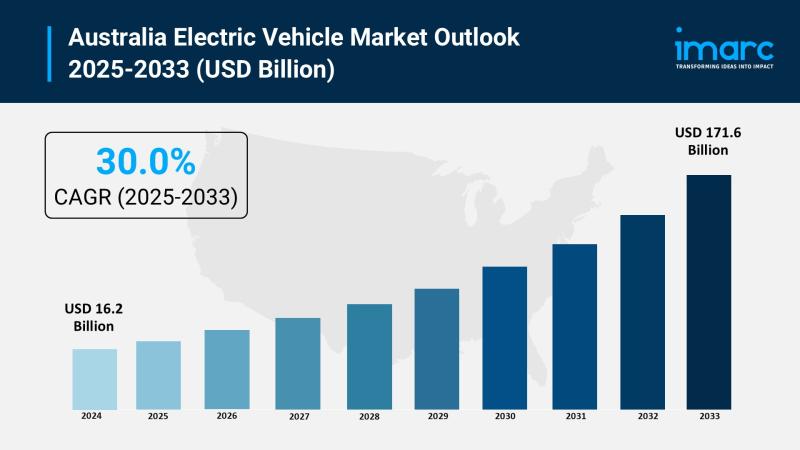
The latest report by IMARC Group, “Australia Electric Vehicle Market Size, Share, Trends and Forecast by Vehicle Type, Battery Type, Technology, Distribution Channel, and Region, 2025-2033,” provides an in-depth analysis of the Australia electric vehicle market. The report also includes competitor and regional analysis, along with a breakdown of segments within the industry. The Australia electric vehicle market size reached USD 16.2 billion in 2024 and is projected to grow to USD 171.6 billion by 2033, exhibiting an exceptional growth rate of 30.00% during the forecast period.
Report Attributes and Key Statistics:
Base Year: 2024
Forecast Years: 2025-2033
Historical Years: 2019-2024
Market Size in 2024: USD 16.2 Billion
Market Forecast in 2033: USD 171.6 Billion
Growth Rate (2025-2033): 30.00%
Australia Electric Vehicle Market Overview:
The Australia electric vehicle market is experiencing unprecedented growth driven by increasing environmental consciousness, government incentives, and rapid technological advancement. The market demonstrates remarkable momentum with EV sales reaching record levels and achieving a 10.3% market share in 2025. Strategic expansion is fueled by the introduction of more affordable models, expanded charging infrastructure, and growing consumer acceptance of battery electric vehicles (BEVs) and plug-in hybrid electric vehicles (PHEVs). The sector benefits from intensifying competition between established players like Tesla and emerging Chinese manufacturers including BYD and Geely, while key market drivers include environmental sustainability concerns, declining battery costs, and supportive government policies promoting clean transportation solutions.
Request For Sample Report: https://www.imarcgroup.com/australia-electric-vehicle-market/requestsample
Australia Electric Vehicle Market Trends:
• Chinese Brand Dominance emerging through BYD and Geely gaining significant market share with competitive pricing and advanced technology, challenging Tesla’s traditional leadership position
• Extended Range Innovation expanding through 400-600 km tier vehicles growing at 29.70% CAGR as falling battery costs enable longer-range models without exceeding mainstream price points
• Charging Infrastructure Expansion transforming accessibility through nationwide fast-charging networks, home charging solutions, and workplace charging facilities supporting widespread EV adoption
• Government Policy Support driving market acceleration through efficiency standards, tax incentives, fleet vehicle requirements, and infrastructure funding initiatives promoting clean transportation
• Passenger Car Segment Leadership maintaining dominance with 51.68% revenue share in 2024 as consumers increasingly embrace electric alternatives for daily commuting and family transportation
• Technology Integration advancing through software updates, autonomous features, smart connectivity, and energy management systems enhancing user experience and vehicle functionality
• Sustainable Manufacturing influencing production processes as manufacturers adopt eco-friendly practices, recycled materials, and renewable energy sources in vehicle assembly
Australia Electric Vehicle Market Drivers:
• Environmental Sustainability Concerns motivating consumer preference for zero-emission vehicles over traditional internal combustion engines across urban and suburban markets
• Government Incentives and Policies creating favorable conditions through tax rebates, fleet mandates, emissions standards, and infrastructure investment supporting market growth
• Declining Battery Costs enabling manufacturers to offer competitively priced electric vehicles while improving range and performance capabilities
• Charging Infrastructure Development facilitating widespread adoption through expanding networks of public charging stations, fast-charging corridors, and home installation programs
• Technological Advancement driving consumer interest through improved battery technology, enhanced range capabilities, faster charging times, and advanced driver assistance systems
• Corporate Fleet Adoption supporting market expansion through businesses transitioning to electric vehicle fleets for cost savings and sustainability goals
• Energy Independence encouraging adoption as consumers seek alternatives to fossil fuel dependency while supporting domestic renewable energy sources
Market Challenges:
• Supply Chain Disruptions affecting vehicle availability and delivery timelines as global semiconductor shortages and shipping delays impact production schedules
• Range Anxiety persisting among consumers despite technological improvements, particularly for long-distance travel and rural area coverage
• Charging Infrastructure Gaps limiting adoption in regional areas where charging station density remains insufficient for widespread consumer confidence
• Initial Purchase Price Premium creating barriers for price-sensitive consumers despite long-term operational cost savings and government incentives
• Grid Capacity Concerns requiring infrastructure upgrades to support increasing electricity demand from widespread EV adoption and fast-charging networks
• Battery Recycling Challenges demanding sustainable end-of-life solutions for lithium-ion batteries and rare earth material recovery systems
• Market Competition Intensity pressuring profit margins as numerous international brands enter the Australian market with aggressive pricing strategies
Market Opportunities:
• Regional Market Penetration expanding distribution networks to underserved areas with limited EV access while developing targeted marketing for rural and remote communities
• Commercial Vehicle Electrification developing specialized electric trucks, vans, and delivery vehicles for business applications and last-mile logistics solutions
• Battery Technology Innovation creating opportunities through solid-state batteries, faster charging capabilities, and improved energy density for enhanced vehicle performance
• Renewable Energy Integration establishing partnerships between EV manufacturers and solar energy providers for complete sustainable transportation ecosystems
• Used EV Market Development creating secondary markets for electric vehicles with certified pre-owned programs, warranty extensions, and financing solutions
• Fleet Management Services targeting corporate customers with comprehensive electric fleet solutions including maintenance, charging infrastructure, and driver training programs
• Smart City Integration leveraging vehicle-to-grid technology, smart charging systems, and urban mobility solutions for sustainable city development
Browse the full report with TOC and List of Figures: https://www.imarcgroup.com/australia-electric-vehicle-market
Australia Electric Vehicle Market Segmentation:
Analysis by Vehicle Type:
• Passenger Vehicles
• Commercial Vehicles
• Others
Analysis by Price Category:
• Australia Electric Vehicle Market By Price Category
• Mid-Range
• High/Luxury Range
Analysis by Propulsion Type:
• Battery Electric Vehicle
• Hybrid Electric Vehicle
• Plug-In Hybrid Electric Vehicle
Regional Analysis:
• Australia Capital Territory & New South Wales
• Victoria & Tasmania
• Queensland
• Northern Territory & Southern Australia
• Western Australia
Australia Electric Vehicle Market News:
August 2025: BYD Sealion 7 emerged as Australia’s leading EV model, surpassing Tesla Model Y with 1,427 units sold in July and 5,183 units year-to-date, demonstrating the rapid rise of Chinese manufacturers in the Australian market.
July 2025: Australian EV sales reached a record 10.3% market share in 2025, driven by surging interest in Chinese brands BYD and Geely alongside a rebound in Tesla Model 3 sales, according to FCAI and EVC data.
January 2025: Australia achieved a new record for EV sales in 2024 with approximately 114,000 new battery electric and plug-in hybrid vehicles sold, representing a significant increase from previous years and demonstrating strong market momentum.
Key Highlights of the Report:
• Comprehensive market analysis projecting exceptional growth from USD 16.2 billion in 2024 to USD 171.6 billion by 2033 with 30.00% CAGR
• Detailed examination of competitive landscape with Tesla facing challenges from rising Chinese manufacturers BYD and Geely gaining market share
• Strategic assessment of passenger car segment dominance maintaining 51.68% revenue share while commercial vehicle electrification presents new opportunities
• In-depth analysis of charging infrastructure expansion supporting nationwide EV adoption with fast-charging networks and home installation programs
• Regional market evaluation covering all Australian states and territories with diverse consumer preferences and infrastructure development levels
• Technology integration insights highlighting software updates, autonomous features, and smart connectivity enhancing user experience
• Consumer behavior assessment revealing environmental sustainability concerns and government incentives as primary adoption drivers
Frequently Asked Questions (FAQs):
Q1: What are the primary factors driving Australia’s electric vehicle market growth to USD 171.6 billion by 2033?
A1: The market is driven by increasing environmental consciousness, government incentives and policies, declining battery costs, and expanding charging infrastructure. Growing competition from Chinese manufacturers like BYD and Geely, alongside technological advancements and corporate fleet adoption, contribute to the exceptional 30.00% growth rate during the forecast period.
Q2: How are Chinese manufacturers impacting the Australian EV market?
A2: Chinese manufacturers, particularly BYD and Geely, are rapidly gaining market share through competitive pricing and advanced technology offerings. BYD’s Sealion 7 has emerged as Australia’s leading EV model, surpassing Tesla’s traditional dominance and creating a more diverse, competitive marketplace that benefits consumers through increased choice and affordability.
Q3: What role does charging infrastructure play in market growth?
A3: Charging infrastructure expansion is critical for widespread EV adoption, with nationwide fast-charging networks, home charging solutions, and workplace charging facilities removing range anxiety barriers. Government investment in charging infrastructure, combined with private sector development, is creating the foundation necessary to support the projected market growth and consumer confidence in electric vehicle technology.
Note: If you require specific information not currently within the scope of the report, we can provide it as part of the customization.
Ask an analyst for your customized sample: https://www.imarcgroup.com/request?type=report&id=21951&flag=C
Contact Us:
IMARC Group
134 N 4th St. Brooklyn, NY 11249, USA
Email: Sales@imarcgroup.com
Tel. No.: (D) +91 120 433 0800
Americas: +1 201-971-6302
About Us:
IMARC Group is a global management consulting firm that helps the world’s most ambitious changemakers to create a lasting impact. The company provides a comprehensive suite of market entry and expansion services. IMARC offerings include market assessment, feasibility studies, company incorporation assistance, factory setup support, regulatory approvals and licensing navigation, branding, marketing and sales strategies, competitive landscape and benchmarking analyses, pricing and cost research, and procurement research.
This release was published on openPR.