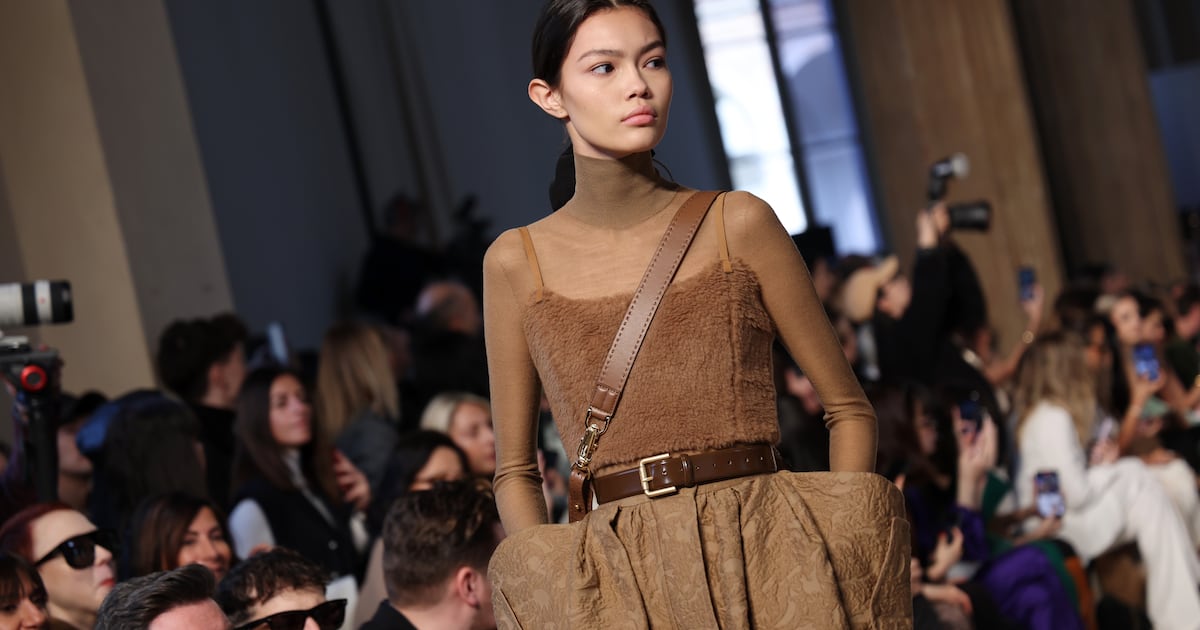
Pockets are simple, extremely practical folds of fabric stitched into our clothes, and a place to stow coins, keys and phone, while freeing up the hands. That is unless you are a woman, of course.
For centuries, pockets have been a gendered battleground, with the lack of pockets in women’s clothing more than merely inconvenient, but a feminist issue that has stretched across centuries.
In menswear, pockets have evolved as a standard fixture within coats, jackets, thawbs, trousers and shorts, making these items fashionable, comfortable and useful in one swipe. For women, however, pockets are often at best an afterthought, frequently too small, too shallow, or too fake to be of any use. This difference is more than a quirk of tailoring however, but rather a persistent reminder of female dependence.
The desire to carry important things appears to be a universal human trait, with the earliest known example dating back more than 5,300 years, to Otzi, also known as the Iceman. A perfectly preserved mummy found in the Otztal Alps between Austria and Italy, he was wearing a belt with a sewn pouch that contained flint, a scraper and dried tinder, suggesting he valued these items enough to keep them close by.
The idea of wearing a pouch or small bag to hold things seems to have developed simultaneously around the world, with many cultures tying them around the waist inside clothing. In China, such small bags were called hebao, while in Japan, people tucked items into kimono sleeves, or inside inro, decorated containers that hung from the obi (sash).
By the 16th century in Europe, pockets were large and detachable, and worn tied around the waist by both men and women. The name itself derived from the French Norman word poke or pouque, entering English as poche or pouch.
During the 17th century, a gendered distinction began to emerge. Men’s pouches, already hidden amid clothing layers, became accessible via a slit in the outer layer. Eventually, this culminated in some clever spark sewing the slit to the pocket hidden within, creating the pocket as we know today.
Women, on the other hand, still had to make do with a small bag tied around the waist beneath her clothes. The Victoria & Albert Museum lists most women of the period wearing at least two layers of undergarments and a petticoat, under which her pocket would be tied. While this kept the contents safe, it also made access impossible in public, denying her the freedom that men enjoyed.
By the early years of the 18th century, women’s fashion for sleek, high-waisted empire-line dresses made internal pockets impossible. Instead, women carried a reticule, an early form of handbag, barely big enough for a handkerchief.
This was less about fashion, however, but rather a reflection of how women were perceived by society at the time. Regarded as a decorative adjunct to men, women relinquished their money to their husbands and were only beginning to be able to independently own property. In the UK, women could not secure a mortgage without a man until 1975.
“One supremacy there is in men’s clothing … its adaptation to pockets,” Charlotte P Gilman wrote in The New York Times in 1905.
“Women have from time to time carried bags, sometimes sewn in, sometimes tied on, sometimes brandished in the hand, but a bag is not a pocket.”
The Suffragette movement of the early 20th century that sought equality for women gave rise to the Suffrage suit, which had large pockets as a visual push back to the routine absence thereof.
In September 1910, American publication Duluth News Tribune highlighted how unusual pockets were regarded at the time. “If a lady needs pockets, they may easily be added to her suit or gown. The dressmaker may raise her eyebrows, but you are the one paying the bill,” it advised.
Around the same time, French designer Gabrielle ‘Coco’ Chanel emerged. Determined to rid women of restrictive clothing and being treated as fragile, she instead championed independence via trousers, jackets and dresses that were as practical as they were stylish. With no tight waistbands, Chanel’s designs were comfortable and pragmatic, and finished with military-like buttons. By the 1920s, her pieces were fitted with ample pockets inside and out.
The First and Second World Wars pushed women out of the home and into the workforce, where they donned masculine trousers and overalls to work on farms and in factories. In everyday life, however, their coats, jackets and dresses frequently would have had small or even fake pockets as the fashion standard.
When Europe emerged from the devastation of the wars, French designer Christian Dior debuted his New Look of 1947, with full skirts and a wasp waist.
Scandalous for the yards of fabric needed in a time of rationing, it also had overtly feminine padded hips and small, discreet pocketing. Dior’s proclamation that “men have pockets to keep things in, women for decoration,” prompted Coco Chanel out of retirement despite already being in her seventies, furious at what she regarded as a backwards step in women’s emancipation. “Dior doesn’t dress women. He upholsters them,” she is said to have retorted.
Since the 1950s, Italian house Max Mara has imbued its collections with pockets, as it caters to the wardrobes of working women, but fast forward to the 2010s, and pockets remained deeply divided. In 2018, when researching the differences between pockets in gendered jeans, journalists Jan Diehn and Amber Thomas revealed that women’s pockets were 48 per cent shorter and 6.5 per cent narrower than the male equivalent.
Some historians believe the abaya entered Saudi Arabia some 80 years ago via travellers from Iraq and Iran. Fashion archiving project The Zay Initiative has quoted an unnamed older woman as saying “this practice is only recent. It came with oil”. Even more recent is the addition of pockets, shifting the abaya from a decorative outer layer into something far more practical, as designers also experiment with new materials. A similar transition has been seen in Moroccan jalabiya, with pockets increasingly the norm as women look for functionality.
With pockets such a recent addition to women’s clothing, is it tempting to link the gap to the growth of handbag sales. With Cognitive Market Research valuing the luxury bag market at more than $23.5 billion in 2024, there seems little incentive for brands to add pockets as a functional and free alternative.
In 2023, Hannah Carlson, senior lecturer in apparel design at the Rhode Island School of Design, released Pockets: An Intimate History of How We Keep Things Close. Carlson’s research suggests that women’s missing pockets are linked more to societal norms than function. Speaking with The New York Times, she explained that “men’s clothes are meant for utility and women’s for beauty,” and as such enforce “old ideas about women’s place and the more limited social and economic contributions they are expected to make”.
The pocket’s story is far from concluded it seems. With fashion so slow to accommodate women’s practical needs, it stands as a reminder that revolutions often begin with the smallest details. In reclaiming the pocket, women take ownership of something far more significant – the right to carry their own essentials, but more importantly, make their own choices.