At a glance
Expert’s Rating
Pros
- Decent IP48-rated design
- Useful cover display
- Larger battery welcome
Cons
- Not much has changed from Razr 50
- Relatively poor performance
- US gets it much cheaper than UK
Our Verdict
The Razr 60 is a lot like the Razr 50, which means it has all of the same strengths and flaws. It’s a solid foldable, with a neat design and good screens. However, performance continues to be inadequate, the cameras aren’t great, and Motorola’s split pricing between the US and Europe is really starting to grate.
Price When Reviewed
This value will show the geolocated pricing text for product undefined
Best Pricing Today
Best Prices Today: Motorola Razr 60
$599.99
If the Motorola Razr 60 Ultra and the Samsung Galaxy Z Flip 7 have taught us anything, it’s that foldable phone manufacturers are learning their lessons – but only very slowly.
They’re the two best compact flip phones yet, but they also suffer from all of the same key flaws as before to a certain degree. Most notably, they’re both still very expensive.
Last year, the Motorola Razr 50 (and before that, the Razr 40) offered a noteworthy alternative – a premium-ish flip phone with a price well shy of £1,000/$1,000. The Razr 60 offers more of the same, and it’s no longer such a unique proposition.
The Galaxy Z Flip 7 FE is now also on the market, offering a similar flip phone formula at an only slightly more expensive asking price. Has Motorola done enough to retain its Razr’s edge?
Design & Build
- Vegan leather back comes in three colours
- Improved IP48 certification
- Responsive side-mounted fingerprint sensor
Without having the Motorola Razr 50 to hand for a direct comparison, I can’t be 100% certain, but if there’s any great departure in the design of the Razr 60, I can’t immediately spot it.
This is much the same flip phone design, with identical dimensions of 171.3 x 74 x 7.3mm (when open). It weighs the same 188g, too. Samsung’s new Galaxy Z Flip 7 FE weighs about the same, but at 6.9mm thick, it comes up a little slimmer.
It might be chunkier, but Motorola continues to pursue a softer, warmer design than its rival. Its rounded edges make the phone a little easier to hold and much easier to pry apart than the Z Flip 7 FE.
Jon Mundy / Foundry
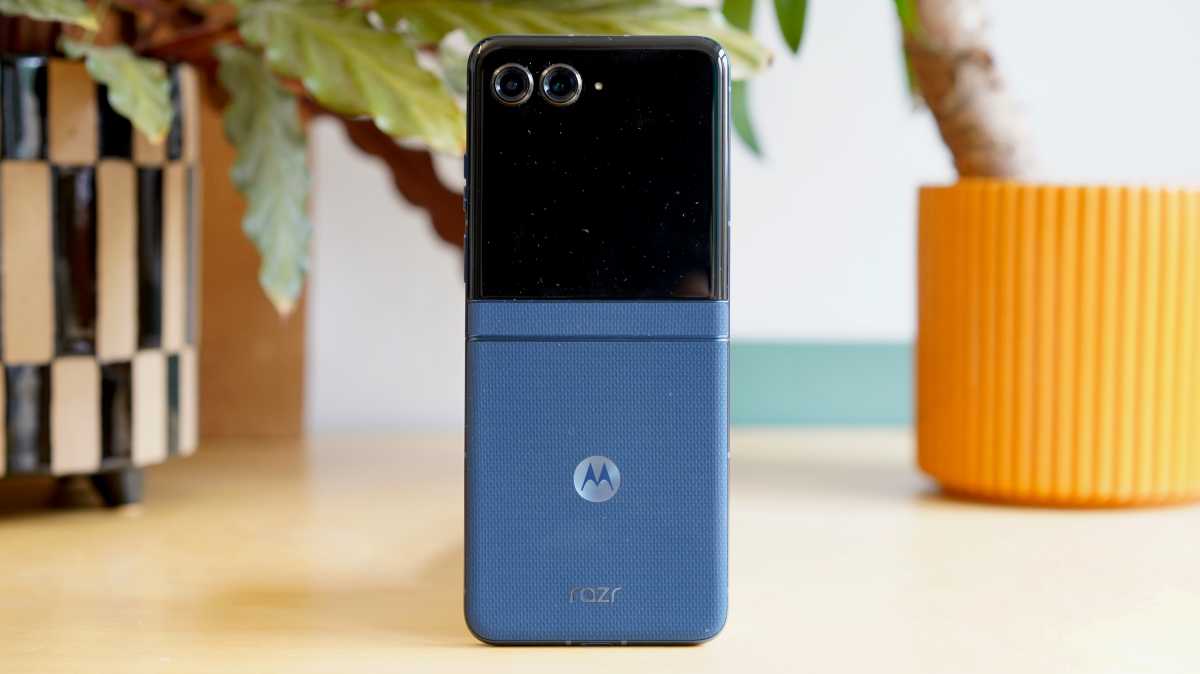
The rear panel continues to be coated in a faux leather material that lends extra grip. It also lends more confidence when positioning the phone on an abrasive surface for an impromptu group selfie that you also want to be in.
Conversely, I found that this material was more susceptible to marking up and staining. After an active weekend of eating and drinking in London, I noticed a prominent stain on the rear cover that was reluctant to budge, even with the use of cleaning wipes and plenty of elbow grease.
We’re still waiting for true dust resistance in a compact foldable, but for now, the Razr 60 is as good as anything in this department
This textured plastic, together with the aluminium frame, comes in three colours. My model is a Pantone Gibraltar Sea, which is a nice, deep navy blue. There’s also Pantone Spring Bud (a vibrant green) and Pantone Lightest Sky (a kind of greyish tinge). There are distinct textures to accompany these fresh colours, which is a welcome point of differentiation.
Jon Mundy / Foundry
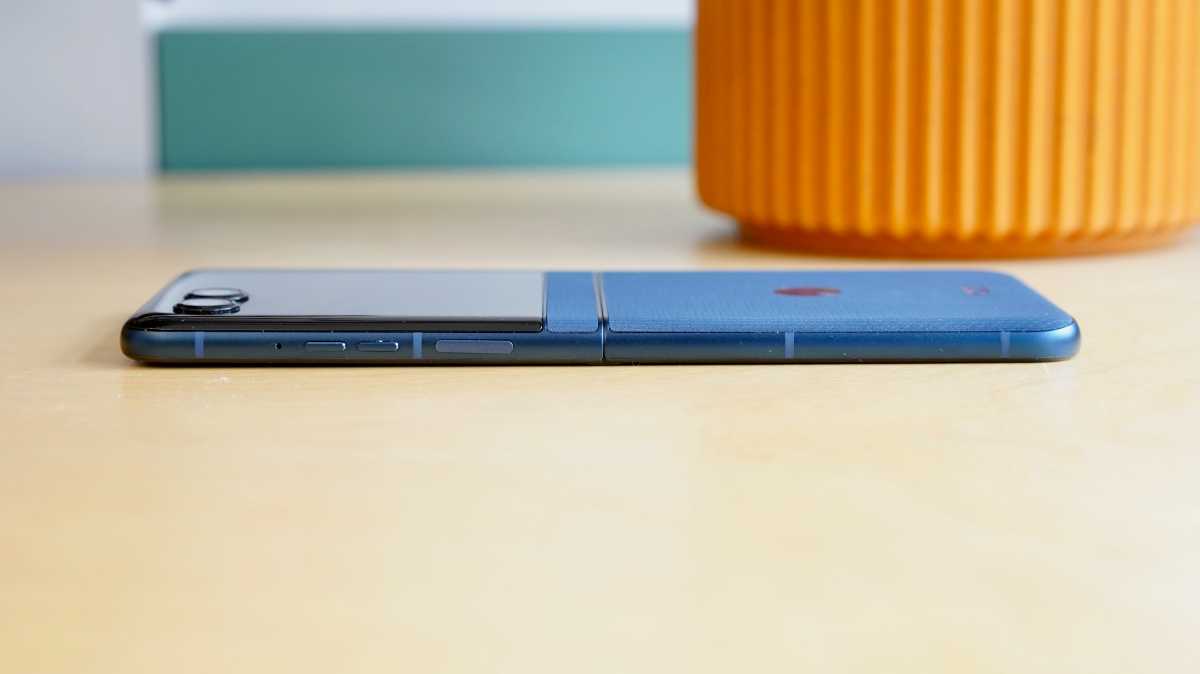
Motorola’s hinge mechanism is looser than that of its Galaxy Z Flip 7 FE. This makes it harder to prop up on a table, but easier to manipulate.
While the look of the phone is all but identical to its predecessor (new colours notwithstanding), Motorola has made one important improvement. Like the Flip 7 FE, the Razr 60 is now IP48 rated, which means it’s more resistant to dust particles.
We’re still waiting for true dust resistance in a compact foldable, but for now, the Razr 60 is as good as anything in this department. It also retains full, flagship-level water resistance, meaning it’ll survive submersion in up to 1.5m of water for up to 30 minutes.

Jon Mundy / Foundry
Motorola’s side-mounted fingerprint sensor, stashed under the power button, is as responsive as I’d hope for. It’s also more prominent than Samsung’s solution, which makes it easier to feel out and access whether folded or unfolded. That’s important when you’re scrambling to tap in on the tube during rush hour, or looking to make a mobile payment in a crowded bar.
Talking of which, I continue to prefer Samsung’s positioning of the NFC module. Motorola positions it in the lower half, and it can be awkward to register when the phone is open.
Screens & Speakers
- 6.9-inch internal display
- Genuinely usable 3.4-inch cover display
- 120Hz refresh rate
Motorola hasn’t changed its displays for the Razr 60, and it arguably didn’t need to. Not when it outguns the more expensive Galaxy Z Flip 7 FE in a couple of key metrics.
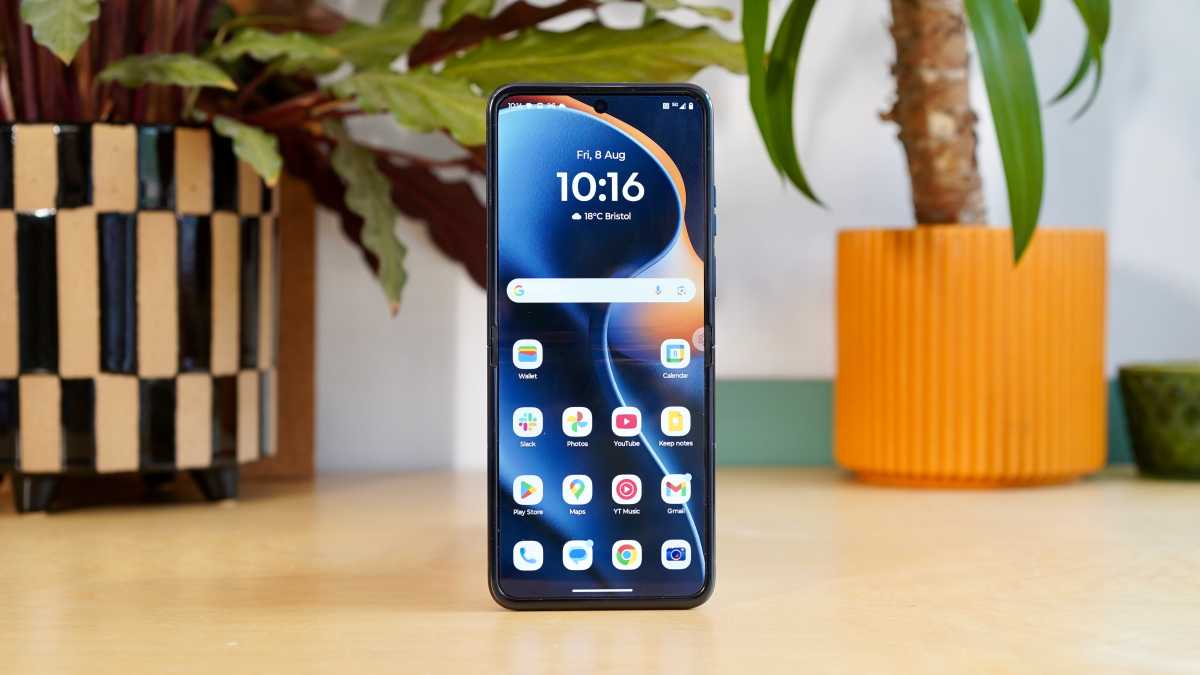
Both screens are bigger here than their opposite numbers. There’s an expansive 6.9-inch internal display with a just-so 1080 x 2640 resolution (FHD+) and a 120Hz refresh rate. It gets to a solid 3000 nits of peak brightness.
Jon Mundy / Foundry
In each of those aspects, it falls short of the Razr 60 Ultra’s main screen, but beats the Galaxy Z Flip 7 FE.
You’ll still notice a bit of a ditch halfway up the phone, where the crease is, but this will fade into the background when the screen is active.
Jon Mundy / Foundry
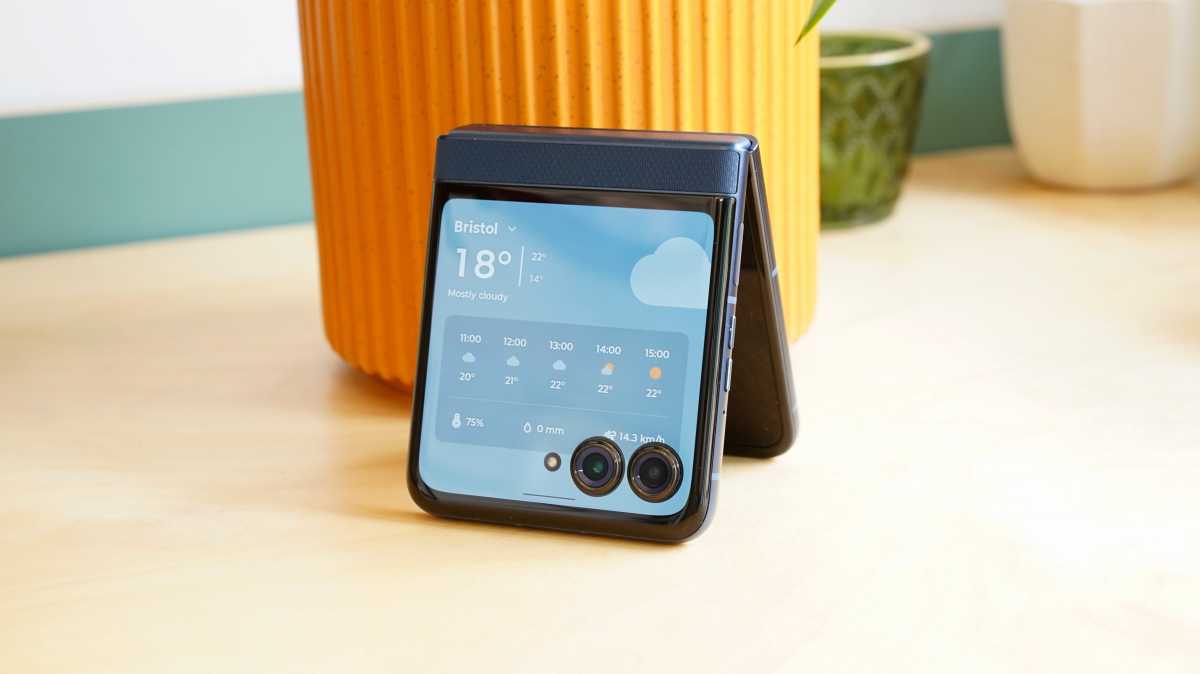
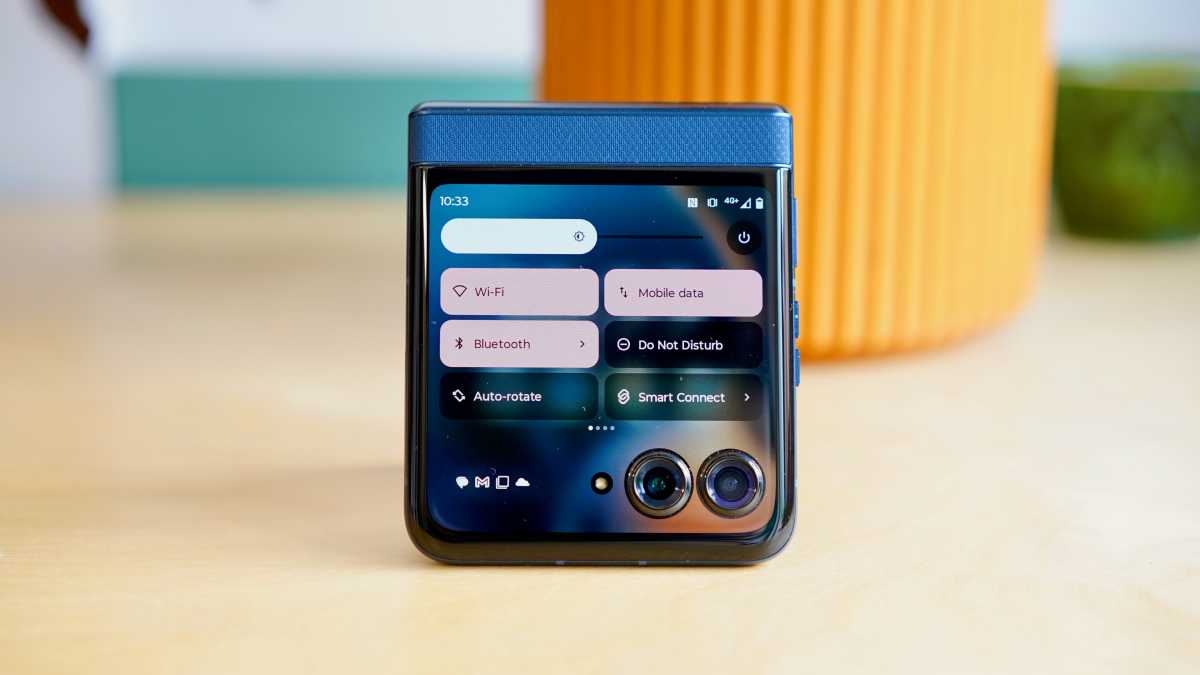
The Razr 60 also retains its 3.6-inch cover display, which made last year’s model much more usable when in the closed position. With a 1056 x 1066 resolution, a design that encompasses the camera, and a 90Hz refresh rate, the Razr 60’s cover screen is far more impressive than the Flip 7 FE equivalent.
That’s especially true when you factor in Motorola’s superior cover UI, which lets you run many apps in this shrink-wrapped format. You’ll still want to open the phone up to get more involved tasks done, but it’s quite viable to check your messages or interact with your chosen music app.
The Razr 60’s cover screen is far more impressive than the Flip 7 FE equivalent
It’s good to see that Motorola has included stereo speakers here, despite the limited space in all foldables. However, they continue to underwhelm with their thin output.
I’d always recommend connecting Bluetooth headphones or a speaker for a premium audio experience, but that’s especially true here.
Specs & Performance
- Mediatek Dimensity 7400X isn’t much of an upgrade
- Only 8GB RAM
- 256GB storage
- Relatively poor performance for the money
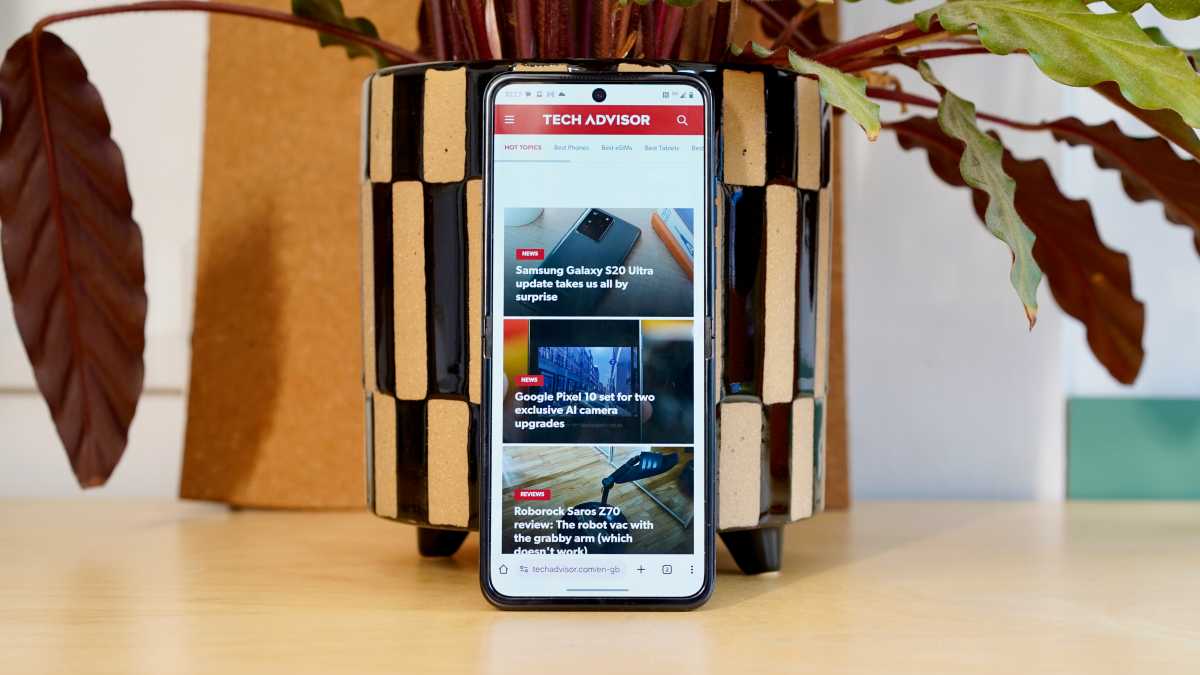
If there’s one stand-out weak point of the Razr 60 compared to other compact foldable phones, it’s performance. Motorola has made a nominal upgrade by switching to the Mediatek Dimensity 7400X, but it would be a stretch to call this a generational improvement.
Jon Mundy / Foundry
Indeed, it has the same basic make-up of cores and GPU as the Razr 50’s Dimensity 7300X. All that’s really different, as far as I can see, is a slightly faster CPU clock speed.
Given that we were far from impressed by the Razr 50’s mid-range (at best) performance, this is a bit of a shame. After all, you’re paying £799/$799 here, which still counts as flagship money in non-foldable terms.
If there’s one stand-out weak point of the Razr 60 compared to other compact foldable phones, it’s performance
Paired with just 8GB of RAM as standard, I can’t say that my time with the Razr 60 was lag- or stutter-free. There’s a sense of lag throughout the OS, and the odd delay when booting up an app or unlocking the phone, which speaks to this component being less capable than I’d like.
Motorola Razr 60 benchmarks
My benchmark tests confirm this impression, barely rising above its predecessor, and falling well short of the Galaxy Z Flip 7 FE.
You’ll be able to play advanced 3D games like Genshin Impact, but not on the top graphical settings. At least, if you wish to maintain a playable frame rate.
There’s only the one model of the Razr 60 on sale here in the UK, so it’s good to see that it comes with a solid 256GB of storage. It’s the one area where this spec feels almost generous.
Camera
- 50Mp main camera
- 13Mp ultrawide
- 32Mp front, but main camera is way better at selfies
While the Razr 60 Ultra has taken things up a notch on the camera front, the plain Razr 60 keeps things the same.
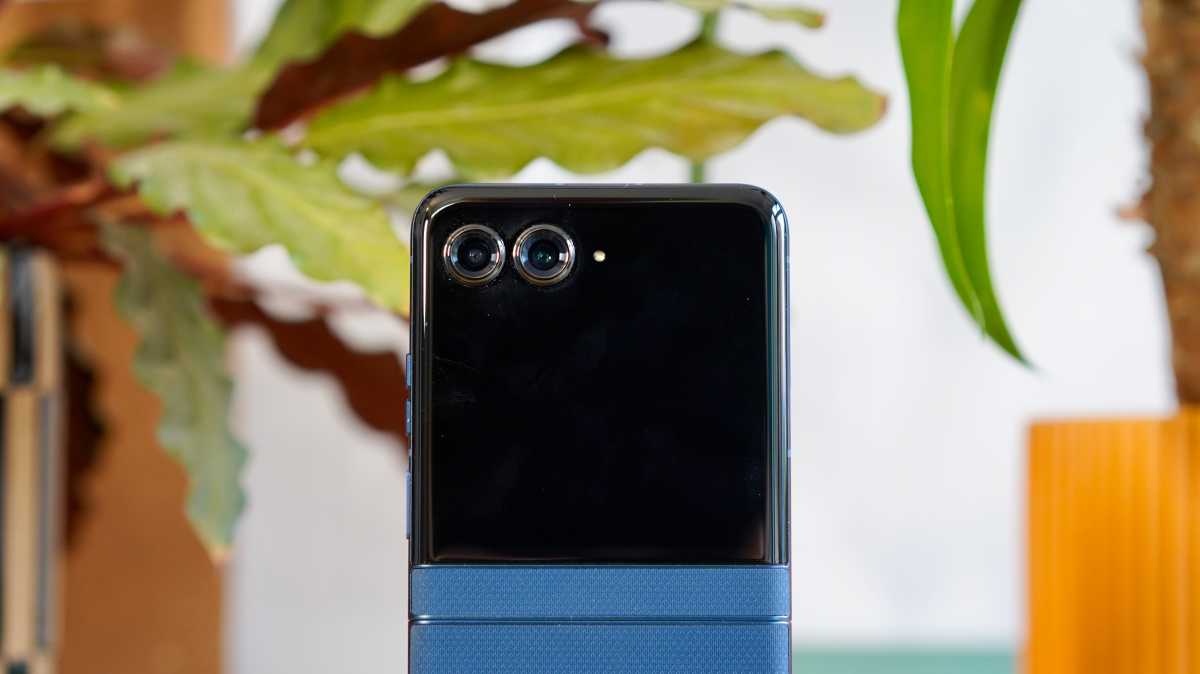
There’s the same 50Mp 1/1.95″ main sensor with OIS, accompanied by the same 13Mp 1/3.0″ ultra-wide. Those aren’t the largest or most impressive-looking sensors you’ll find in a £800/$800 smartphone.
Jon Mundy / Foundry
Perhaps more worrying for Motorola, the main sensor is quite a bit smaller than that of its reasonably priced foldable rival, the Galaxy Z Flip 7 FE.
Combined with that sub-par processor, the Razr 60 takes competent photos but nothing more. Buy any similarly priced non-foldable phone, and you’ll likely obtain much better results.
The Samsung Galaxy Z Flip 7 FE takes better shots, especially in low light. The Razr 60’s night mode snaps come across as murky and indistinct by comparison.

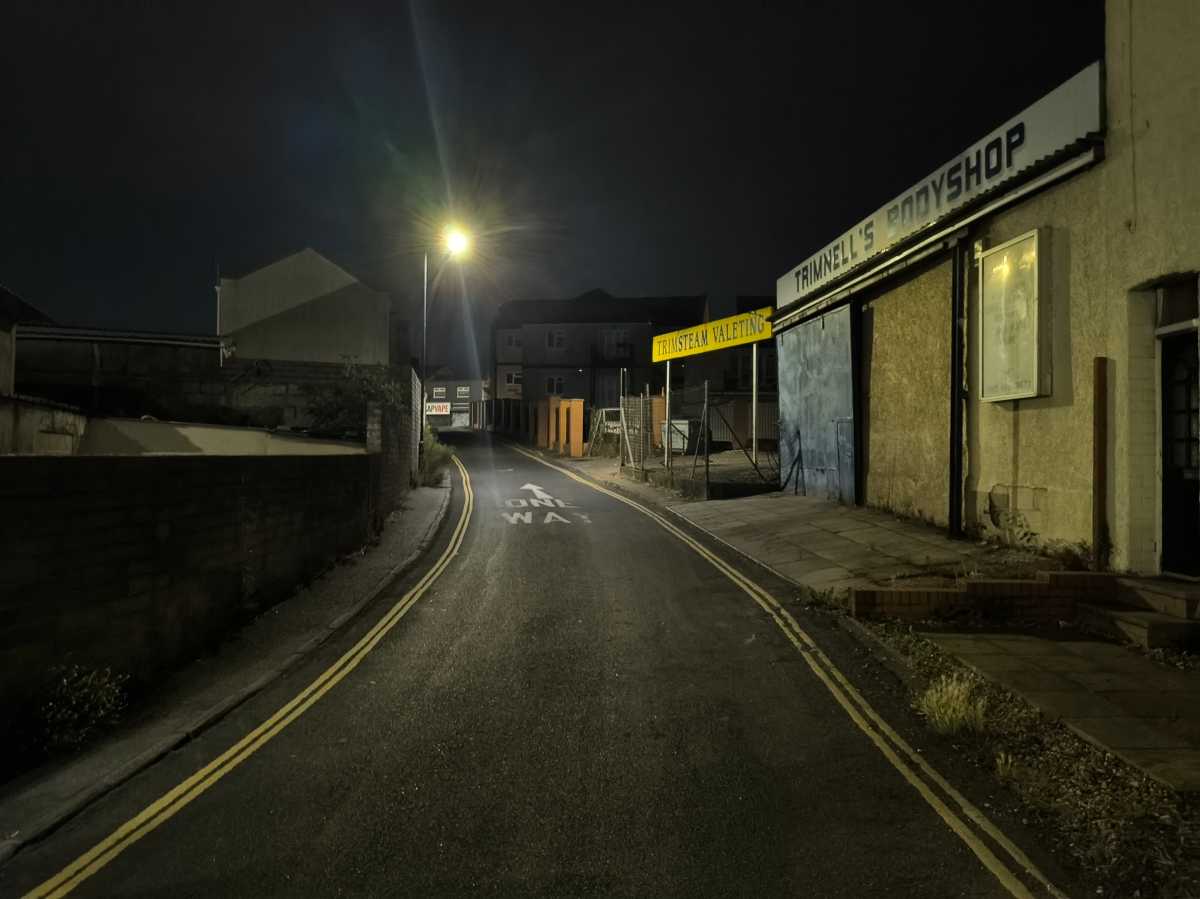
I didn’t find daytime shots here to be quite so artificially vibrant as last year’s model, but the odd image appeared to struggle with highlights, and there’s a processed look to certain shots.
One big saving grace in a generally mediocre camera set-up is the quality of the selfies
Conversely, food shots taken in half-decent lighting looked nice and appetising, with Motorola’s punched-up colour science proving effective.
The 13Mp ultra-wide is adequate, but sees a big drop off in quality compared to the main sensor. It also can’t match the main camera’s tone as well as the Galaxy Z Flip 7 FE. With no dedicated telephoto lens, zoomed shots will crop in on that main sensor and swiftly lose sharpness beyond the 2x mark.
One big saving grace in a generally mediocre camera set-up is the quality of the selfies – at least when you use the cover display as a viewfinder and put the main camera to use. The 32Mp front camera can’t get close on depth, sharpness or dynamic range, but it doesn’t need to.


Battery Life & Charging
- Larger 4500mAh battery
- 30W wired charging support
- 15W wireless charging
The biggest hardware upgrade this year relates to the Razr 60’s battery, which has been scaled up from 4200mAh in the Razr 50 to 4500mAh. Given that the Razr 40 gave us a 4000mAh cell, this marks major progress over the past two years.
It’s also notable that the Galaxy Z Flip 7 FE only packs in a puny 4000mAh cell. However, despite the improvement, I can’t say that the Razr 60 outshone the Z Flip 7 FE in the stamina stakes.

Jon Mundy / Foundry
A day with moderate to heavy usage (around four hours and 30 minutes of screen-on time) would leave me with about 30% left. That isn’t significantly better than the Galaxy Z Flip 7 FE, if at all.
With that said, lighter users – which you have to assume most compact foldable owners will be – are looking at the possibility of two days of use in between charges.
Here’s another slightly perplexing fact: the Razr 60 scored significantly worse than the Razr 50 in our PC Mark 3.0 Battery test. At just 8 hours and 3 minutes, it fell around 2 hours 40 minutes short of its predecessor, and about 6 hours 30 minutes short of the Motorola Razr 60 Ultra. But remember, this doesn’t accurately reflect the real world.
Lighter users are looking at the possibility of two days of use in between charges
Recharging speeds aren’t spectacular, with 30W wired and 15W wireless support retained from last year’s model. Even so, it retains the ability to take on a full charge in just under an hour, which is way better than the Galaxy Z Flip 7 FE.
Software & AI
- Android 15
- Clean and stock-ish
- Three Android versions, four years of security updates
Like its big brother, the Razr 60 Ultra, the Razr 60 runs Android 15 out of the box.
I like Motorola’s approach to Android a lot. It’s closer to Google’s own Pixel UI than almost anything else out there, though it’s steadily taken on its own subtle look over recent years, with bespoke widgets, menus and icons.
There’s still too much bloatware here, including the Opera web browser (on top of Chrome), LinkedIn, Amazon Music (on top of YouTube Music), and Facebook. You can count some poor-quality games in with those, too.
Jon Mundy / Foundry
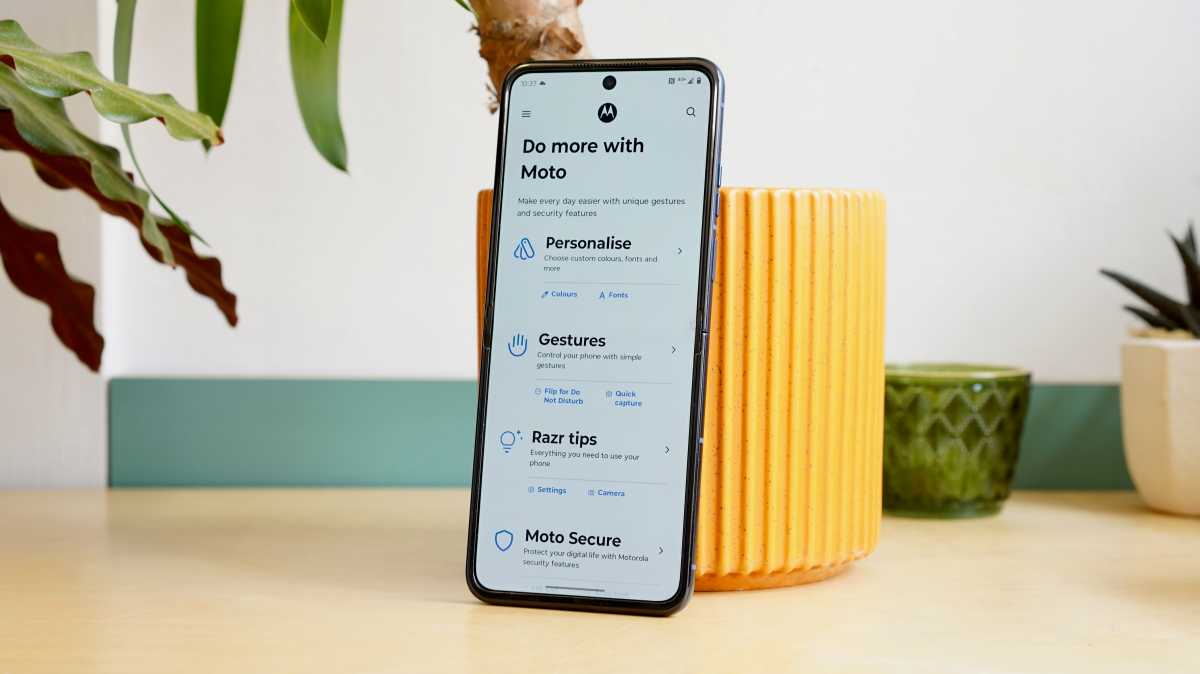
Motorola’s Moto app continues to be one of the best smartphone hub apps in the business, offering an intuitive introduction to the phone’s key functions. You can jump into home screen personalisation, general tips, and Motorola’s brilliant gesture shortcuts from here.
The double-twist gesture to bring up the camera works beautifully in conjunction with using the main camera for selfies.
We’ve already mentioned how Motorola’s cover display implementation is much more involved than Samsung’s. Essentially, you’re getting a condensed version of Android that simply works in the way you’d expect, booting up tiny windowed versions of apps. It’s less visually appealing than Samsung’s widget-heavy approach, but also more flexible and empowering.
I like Motorola’s approach to Android a lot
As it happens, I don’t find myself using this screen all that much beyond checking the time, weather, and monitoring incoming messages while out and about. But the slick, friction-free operation is much appreciated nonetheless.
In terms of AI tools, there’s no dedicated AI button like on the Razr 60 Ultra. Motorola does, however, supply a floating AI control that can be moved at will – though I still found it getting in the way quite a lot, especially when browsing the web.
Jon Mundy / Foundry
This button grants access to tools such as ‘Update me’, which will summarise your calls and notifications. ‘Image Studio’ will generate images and stickers using natural language, and is as impressive and pointless as it is on any other modern Android phone since AI took hold.
‘Remember this’ is an interesting one. It’ll read whatever’s on screen – whether text or image – and save them for later, mining the screenshot for information. So, nothing groundbreaking when it comes to AI, but some potentially useful features.
The Razr 60 will get the same three Android updates and four years of security updates as its predecessor, which places it at an instant disadvantage compared to the flat seven years of support that Samsung promises for the Galaxy Z Flip 7 FE.
It’s also unclear when the device will get the update to Android 16.
Price & Availability
Some small amount of credit is due to Motorola for keeping the price of the Razr 60 the same as before. The sole 256GB model will set you back £799 in the UK, which is quite cheap for a foldable.
You can buy it directly from Motorola, as well as from Amazon, though the latter is via an unknown third-party seller.
It’s being sold in the US under the name of the Motorola Razr 2025. We have no idea why the name has to be changed. Perhaps it’s to cover up the fact that US customers are getting a much more keenly priced device at just $699.99 (which works out to about £520). Even when you allow for tax, that’s way cheaper.
It’s available in the US directly from Motorola or via Amazon.
Taking the UK price, this undercuts its closest rival, the Samsung Galaxy Z Flip 7 FE, by a not inconsiderable £50. However, knowledge of that US price takes the shine off such apparently competitive pricing.
Should you buy the Motorola Razr 60?
It’s a bit of a shame to see so few meaningful improvements to Motorola’s more reasonably priced foldable. Expanded battery and improved IP48 rating aside, the Razr 60 looks and handles an awful lot like the Razr 50 before it, and doesn’t perform much better either.
On one hand, it’s good to see the pricing remain similarly consistent – especially given that it undercuts Samsung’s new Galaxy Z Flip 7 FE. However, it continues to rankle that customers in the US are getting a much better deal than those in the UK.
There have been no further advancements in the camera department, which continues to take fairly middling shots, but truly excellent selfies if you use that cover display to its full potential.
And it’s those foldable attributes that really count here. If you don’t want to use your phone all that much and wish it to disappear when not in use, this is one of the most accessible solutions around.
Specs
- Android 15
- 6.9in, FHD+, OLED, 120Hz, flat display
- 3.6in, 1056 x 1066, OLED, 120Hz, display
- Side-mounted fingerprint sensor
- Mediatek Dimensity 7400X
- 8GB RAM
- 256GB storage
- 50Mp, f/1.7 main camera
- 13Mp, f/2.2 ultra-wide camera
- Up to 4K @ 30fps rear video
- 32Mp front-facing camera
- Stereo speakers
- Dual-SIM
- Wi-Fi 802.11 a/b/g/n/ac/6
- Bluetooth 5.4
- 4500mAh battery
- 30W wired, 15W wireless charging
- 171.3 x 74 x 7.3mm
- 188g
- Launch colours: Pantone Gibraltar Sea, Pantone Spring Bud, Pantone Lightest Sky